Summary:
You searched for “cleaning service,” got a dozen results, and now you’re not sure if you need a janitorial company, an office cleaner, a commercial cleaning crew, or something else entirely. It’s a legitimate question — and most cleaning company websites don’t actually answer it. They just list services and hope you figure it out.
We’re going to cut through that. By the end of this page, you’ll know exactly what each service type covers, which one fits your business, and what to watch out for when you’re evaluating providers on Long Island, NY. Let’s start with the term that causes the most confusion.
What Is Janitorial Service — and What Does It Actually Include?
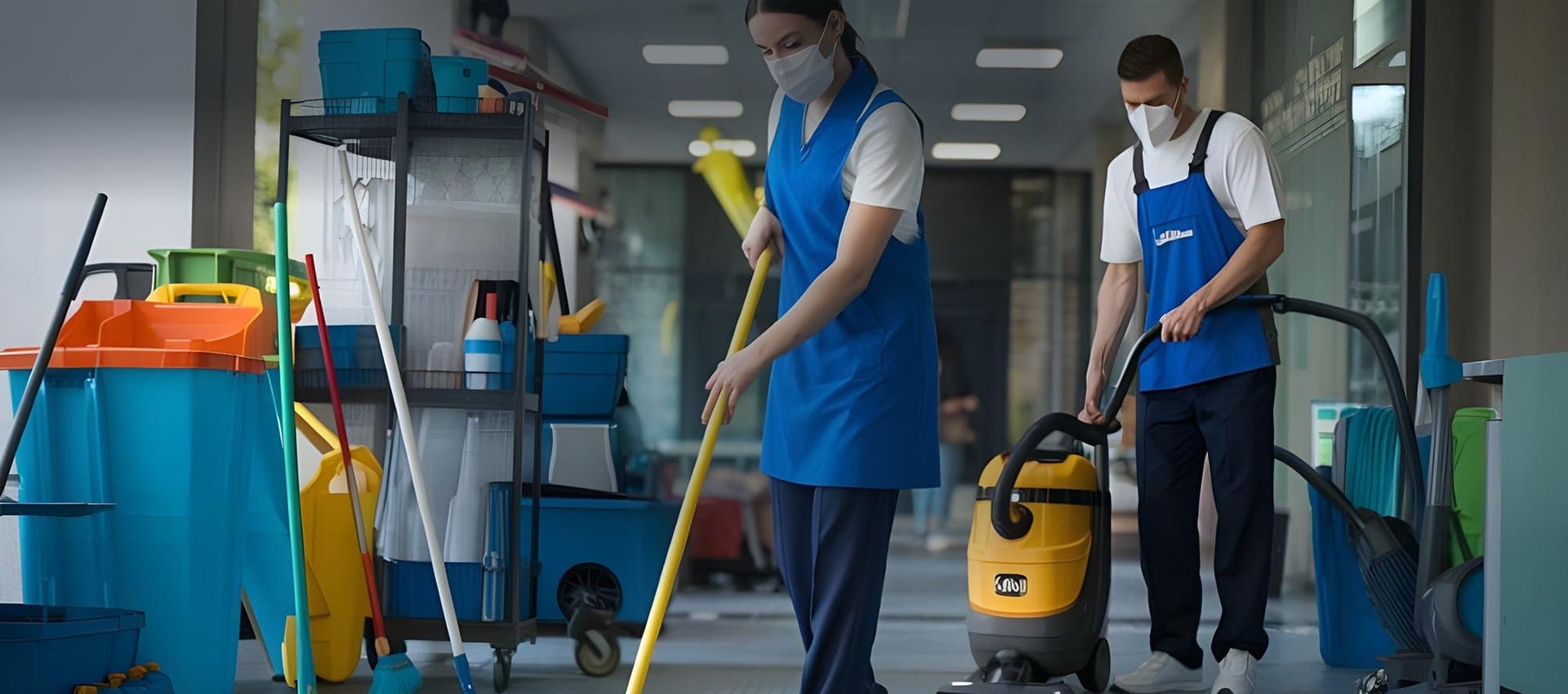
Janitorial service is the recurring, routine maintenance that keeps a commercial space functional on a daily or weekly basis. Think trash removal, restroom cleaning and restocking, vacuuming, mopping, wiping down surfaces, and sanitizing high-touch areas like door handles, light switches, and copier controls. It’s not glamorous work, but it’s the foundation of a clean, professional environment.
The key word is recurring. We schedule janitorial service around your business — whether that means nightly after your office empties out, a few times a week, or on a custom rotation that fits your foot traffic and hours. It’s designed to maintain a consistent baseline, so your space looks the same on a random Wednesday in February as it did the week you signed the contract.
How Is Janitorial Service Different from Office Cleaning?
This is where most people get tripped up, and honestly, the industry doesn’t help by using the terms loosely. Here’s the clearest way to think about it: janitorial service is maintenance, and office cleaning can mean either the same thing or something deeper — depending on who you’re talking to and what they’re quoting you.
When a company advertises office cleaning, they might mean routine upkeep — the same scope as janitorial service, just marketed toward smaller office environments. Or they might mean periodic, more thorough cleaning that goes beyond daily maintenance: cleaning inside cabinets, scrubbing grout, deep-cleaning carpets, or addressing buildup that routine visits don’t touch. The distinction matters because buying the wrong one leaves you either overpaying for depth you don’t need right now, or underpaying for maintenance that won’t actually keep your space clean between visits.
For most businesses across Long Island — a law firm in Mineola, a medical practice in Garden City, a marketing agency with 15 people in Huntington — what they actually need is reliable janitorial service on a set schedule, with a deeper clean built in a few times a year. The problem is they often hire one or the other without understanding they might need both working together.
Commercial cleaning is a broader term that typically refers to larger-scale or more specialized work: post-construction cleanup, commercial kitchen deep-cleaning, stripping and refinishing floors, or servicing multi-location facilities. It’s not wrong to use the term interchangeably with janitorial service in casual conversation, but when you’re signing a contract, it’s worth understanding exactly what’s covered.
The simplest test: if you need someone in your building on a regular schedule to keep things clean and functional, that’s janitorial service. If you need a one-time or periodic deep clean that goes beyond maintenance, that’s commercial cleaning or a scheduled deep clean layered on top of your routine service.
What About Maid Service — Can't I Just Hire That for My Office?
This comes up more than you’d expect, especially for smaller businesses on Long Island that are just getting started or running lean. Maid service is designed for residential spaces — homes, apartments, vacation rentals. The products are residential-grade, the scope is built around domestic environments, and the scheduling is usually one-time or occasional rather than the kind of reliable, recurring maintenance a commercial space requires.
Putting a maid service in a commercial environment is a little like hiring a house painter to repaint the exterior of a commercial building. They might do fine work, but the scale, the materials, the compliance requirements, and the expectations are completely different. A busy office with 20 employees cycling through a shared kitchen and two restrooms every day is not the same cleaning challenge as a three-bedroom home.
There’s also a liability dimension. Commercial spaces have different insurance requirements, different surface types, different chemical safety considerations, and in some cases — like medical offices or food service environments — specific regulatory standards that residential cleaning companies aren’t equipped to navigate. In Suffolk County, for example, food service facilities operate under the Suffolk County Sanitary Code, and any cleaning contractor working in those environments needs to understand what that means for how they work.
Beyond compliance, there’s a practical quality gap. A trained janitorial team working a commercial account knows how to maintain VCT floors, handle restroom sanitization at a commercial volume, manage restroom restocking, and follow a documented scope of work that produces consistent results night after night. That’s not what maid service is built to deliver — and expecting it to is a setup for disappointment on both sides.
If you’re running a vacation rental in the Hamptons or on the North Fork, a residential-style cleaning service makes complete sense for turnovers. But for your office, your retail space, or your professional practice, you need a commercial janitorial service — full stop.

How to Choose the Right Cleaning Service for Your Long Island Business
Once you understand what you’re actually looking for, the next question is how to evaluate providers — because not all janitorial companies deliver the same thing, and the Long Island market has no shortage of options, from national franchise operations to small local independents.
The most important thing you can ask any cleaning company isn’t about price. It’s about consistency. How do we ensure the same quality on visit 47 as we delivered on visit one? What happens when the regular crew is unavailable? Who do you call if something isn’t right, and how fast do we respond? These questions separate companies that are serious about service from ones that are good at winning contracts and inconsistent at keeping them.
What Long Island Businesses Should Look for Before Signing a Cleaning Contract
Start with the basics: any janitorial company you’re considering should be fully insured, carry workers’ compensation coverage, and be able to provide a certificate of insurance before their team sets foot in your building. This isn’t optional. If something gets damaged or a cleaner is injured on your property, you need to know you’re protected — and a reputable company will have this documentation ready without hesitation.
Background-checked staff is the next non-negotiable. You’re giving someone after-hours access to your business. That means access to equipment, files, client information, and physical space that represents everything you’ve built. Knowing that every person on the cleaning crew has been vetted isn’t a luxury — it’s a basic expectation that serious providers meet as a matter of course.
Beyond the fundamentals, look at how the company handles scope. Do they hand you a generic package, or do they ask questions first? A 3,000-square-foot medical office in Garden City has different needs than a 1,500-square-foot accounting firm in Farmingdale. The frequency, the products used, the attention to specific areas — all of it should reflect your actual space, not a template. Companies that lead with packages before they understand your building are selling convenience for themselves, not service for you.
Pricing transparency matters too. Vague quotes that change after the first invoice are one of the most common complaints business owners have about cleaning companies. A provider that prices clearly upfront — based on your square footage, the frequency of service, and the specific scope of work — is telling you something about how they operate overall. If they’re straight with you on pricing before you sign, they’re probably straight with you when something goes wrong after.
One more thing worth asking: what’s the process when you’re not satisfied? Not “are you satisfied?” — that’s easy to say. What actually happens, step by step, if a restroom was missed or a floor wasn’t mopped? The answer tells you everything about how much they value keeping your account versus just landing it.

Frequently Asked Questions About Janitorial Service on Long Island, NY
**How often does a business actually need janitorial service?**
It depends on your foot traffic, the size of your space, and how your building gets used. A high-traffic medical office or busy retail location in a Nassau County commercial corridor might need service five nights a week. A smaller professional office in Huntington or Babylon with a modest team might be well-served by two or three visits per week. The right frequency isn’t about what sounds reasonable — it’s about what keeps your space genuinely clean between visits, not just presentable on the days right after a cleaning.
**Do janitorial companies need to be licensed in New York?**
New York State doesn’t issue a specific janitorial license, but any legitimate commercial cleaning company operating on Long Island needs to carry general liability insurance and workers’ compensation coverage — both are legal requirements, not optional. For companies working in food service environments, familiarity with the Suffolk County Sanitary Code is also essential. When you’re vetting providers, ask for proof of insurance directly. A company that hesitates or delays on that request is a red flag worth taking seriously.
**Is it worth outsourcing, or should I just have employees handle it?**
We hear this one often from Long Island business owners. The honest answer: when you factor in the actual hourly cost of having an employee spend 30 to 45 minutes on cleaning tasks instead of their job, outsourcing almost always makes more financial sense — and that’s before you account for the quality difference between a trained cleaning professional and someone doing it as an afterthought at the end of their day. Long Island’s workforce is expensive and highly educated. Your people’s time is better spent on the work you hired them to do.
**What’s the difference between a local cleaning company and a franchise operation?**
On Long Island, you’ll find both. Franchise cleaning companies — and there are several operating across Nassau and Suffolk Counties — offer the backing of a national brand and standardized protocols. Local independents offer something different: faster response times, no corporate layer between you and the decision-maker, and genuine accountability from people who are embedded in the same community you’re doing business in. Neither is automatically better, but it’s worth knowing which one you’re working with and what that means for how issues get resolved.
**How do I know if my cleaning company is actually doing a good job?**
The most reliable sign isn’t how the office looks right after a cleaning — it’s how it holds up two or three days later. Consistent results between visits, restrooms that stay stocked and sanitized, floors that don’t show buildup along the edges and under furniture — these are the markers of a cleaning company that follows a real process rather than just hitting the visible surfaces and moving on. If you’re regularly noticing things that were missed, that’s not a one-off — it’s a pattern worth addressing directly.
Finding the Right Janitorial Service for Your Long Island Business
The difference between janitorial service and office cleaning isn’t just terminology — it affects what you’re paying for, how often your space gets cleaned, and whether the results actually hold up. Most businesses on Long Island need both: reliable routine maintenance on a consistent schedule, with deeper cleaning layered in periodically. The key is knowing what you have, what you need, and what to ask before you sign anything.
What you don’t need is another cleaning company that performs well for six weeks and then becomes impossible to reach. You need a provider that shows up, does the work, and handles problems like a professional when they come up.
If you’re evaluating your options on Long Island, we’re here to help. We work with businesses across Nassau and Suffolk Counties — from small professional offices to larger commercial facilities — and we build every cleaning plan around the actual space, not a generic package. Reach out and let’s figure out what your business actually needs.