Dirty, scuffed, or dull floors say a lot about your business before a customer or employee says a word. If you have been searching for commercial floor cleaning services, you already know the stakes: worn floors wear out faster, look unprofessional, and can even become liability risks when they get slippery or stained. The tricky part is figuring out who to hire, what you should actually be paying, and which service level fits your space.
This guide breaks down exactly how to evaluate a commercial floor cleaning company and what fair pricing looks like in 2026, whether you manage an office, a retail store, or a warehouse. You will learn the questions to ask before signing a contract, the differences between cleaning frequencies and methods, and how flooring type changes both cost and technique.
We put this together from what we see every week servicing offices and commercial spaces across New York. By the end, you will know how to compare quotes, spot red flags in a proposal, and choose a provider that keeps your floors looking their best without surprise charges.
What commercial floor cleaning services include
Most people picture a mop and bucket when they think of commercial floor cleaning services, but a real contract covers a lot more ground, much like what commercial cleaning includes and what it costs overall. Reputable providers scope the job around your floor type, foot traffic, and industry requirements, then build a checklist that goes beyond a quick sweep. Knowing what should be on that checklist helps you spot a thin proposal before you sign anything.
Core tasks you should expect
Any solid office floor cleaning or retail cleaning contract includes daily or scheduled sweeping and mopping, spot treatment for spills and stains, and edge or corner detailing where dust and grime build up unnoticed. Trash and debris removal near entrances usually gets bundled in too, since that’s where floors take the most abuse.
A floor cleaning contract without stripping, sealing, or buffing listed anywhere is missing half the job.
Specialized services worth asking about
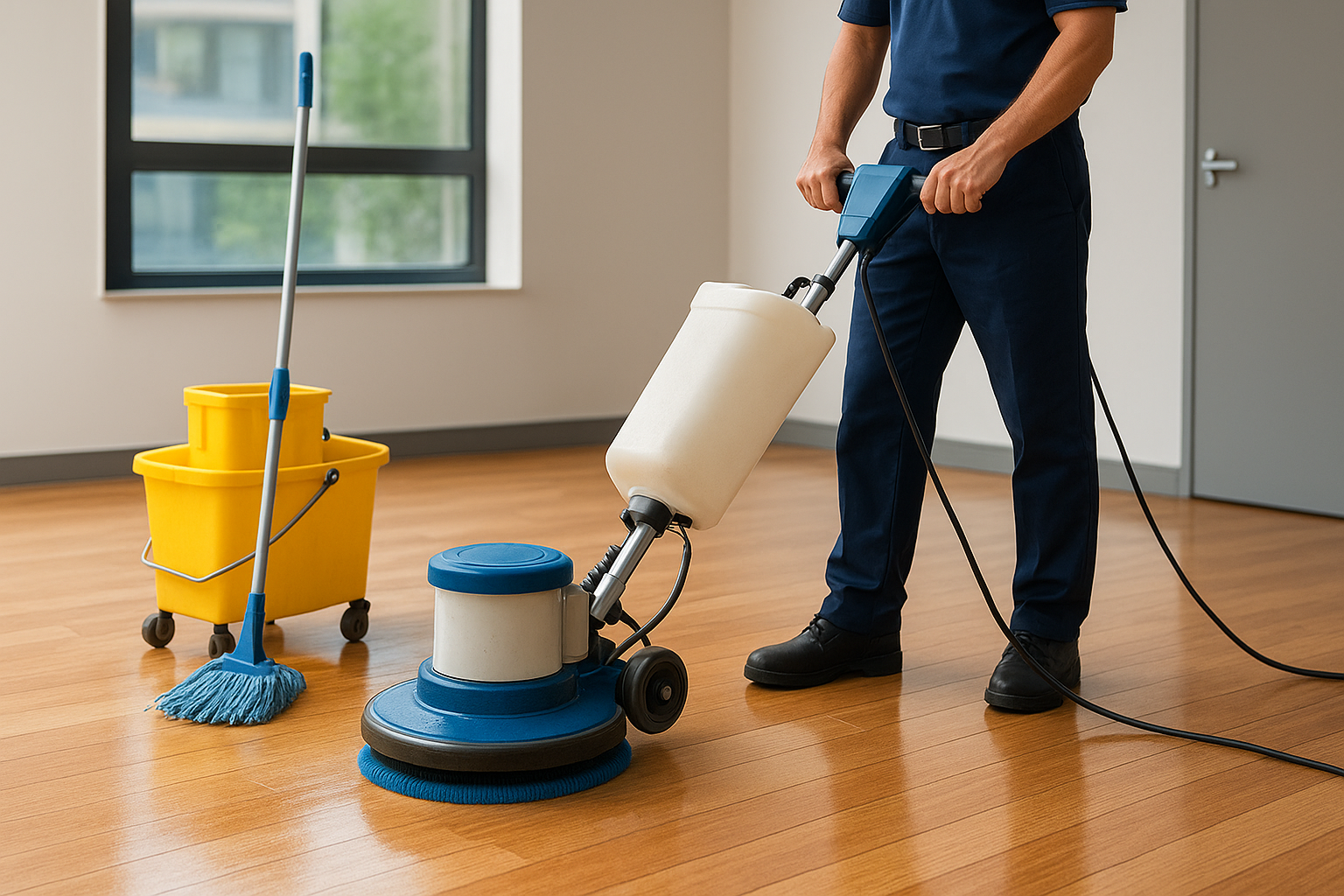
Beyond daily upkeep, ask whether the company offers deep restorative work. This is where pricing and floor longevity really diverge between providers.
| Service | What it does | Typical frequency |
|---|---|---|
| Stripping and waxing | Removes old finish, applies new protective coat on VCT/vinyl | Every 6-12 months |
| Buffing and burnishing | Restores shine without stripping | Monthly to quarterly |
| Grout and tile deep cleaning | Extracts embedded dirt from grout lines | Quarterly |
| Carpet extraction | Deep-cleans commercial carpet fibers | Every 3-6 months |
| Concrete polishing | Restores warehouse or industrial floor sheen | Annually |
Additionally, a company worth hiring should explain which cleaning products touch your floors. Eco-friendly, non-toxic solutions matter for offices with employees present daily and for retail spaces where customers walk barefoot or with small children nearby. If a quote doesn’t mention product type or method for your specific flooring, keep asking questions before moving forward.
Step 1. Identify your floor type and cleaning needs
Before you request a single quote, walk your space and note exactly what’s underfoot. Floor type drives everything else, from the cleaning method a crew uses to how often they need to show up. VCT tile needs a different approach than polished concrete or commercial carpet tile, and a provider who quotes you without asking about substrate is guessing.
The floor type you have determines the method, the chemicals, and the price, not the other way around.
Match your space to a cleaning need
Think through foot traffic, industry rules, and appearance standards before comparing companies:
- Retail or lobby areas: high traffic, needs daily sweeping plus frequent buffing to maintain shine
- Medical or food service: needs disinfecting protocols and non-toxic products due to health codes
- Warehouses: concrete floors need periodic polishing and dust control, not daily mopping
- Offices: commercial carpet cleaning and vinyl maintenance on a set rotation, usually after hours
Writing these details down gives you a real basis for comparing bids later. A commercial floor maintenance plan built around your actual traffic patterns, not a generic template, is what separates a fair quote from a padded one.
Step 2. Compare cleaning methods and costs
Once you know your floor type, request pricing broken down by method, not a flat per-visit number. Commercial floor cleaning cost varies widely depending on square footage, frequency, and whether you need restorative work layered on top of routine mopping, so it helps to review how commercial cleaning is priced before comparing bids. A vague quote that bundles everything into one line item makes it impossible to know what you’re actually paying for.
If a quote can’t tell you the price per square foot by method, it can’t tell you if you’re overpaying.
Typical pricing ranges
Use these national averages as a starting point when reviewing bids from local providers, and check what carpet cleaning costs per room versus per square foot if carpeted areas make up most of your space:
| Method | Average cost | Best for |
|---|---|---|
| Routine sweep/mop | $0.05-$0.15 per sq ft | Daily maintenance, all floor types |
| Stripping and waxing | $0.30-$0.75 per sq ft | VCT and vinyl |
| Buffing/burnishing | $0.10-$0.25 per sq ft | Maintaining shine between waxing |
| Carpet extraction | $0.15-$0.35 per sq ft | Commercial carpet, offices |
| Concrete polishing | $1.00-$3.00 per sq ft | Warehouses, industrial spaces |
Watch for providers who quote flat monthly rates without explaining what’s included. Fair pricing ties directly to the methods and frequency your floor actually needs, not a one-size-fits-all package.
Step 3. Vet and compare cleaning companies
Once you have your floor specs and a price range in mind, start calling providers with specific questions instead of asking for a generic quote. Vetting a cleaning company properly now saves you from mid-contract surprises later, like discovering the crew isn’t insured or the products they use aren’t safe for your carpet warranty.
Questions to ask before signing
Run through this checklist on every call:
- Are your technicians background-checked and fully insured?
- Can you provide proof of liability coverage and workers’ comp?
- Do you offer eco-friendly cleaning products as an option, and at what cost difference?
- What’s your process if a floor gets damaged during service?
- Can I see references from clients with similar flooring or square footage?
- Is pricing itemized by method, or bundled into one flat rate?
A company that hesitates to answer insurance and staffing questions isn’t ready to handle your floors.
Compare proposals side by side
Request at least three written quotes and line them up on the same spreadsheet. Look past the bottom-line number and check whether each proposal lists frequency, method, and product type for every service area. Providers offering commercial cleaning in New York should also know regional code requirements, like disinfecting standards for food service floors, without you having to explain them first.
Step 4. Set up an ongoing maintenance schedule
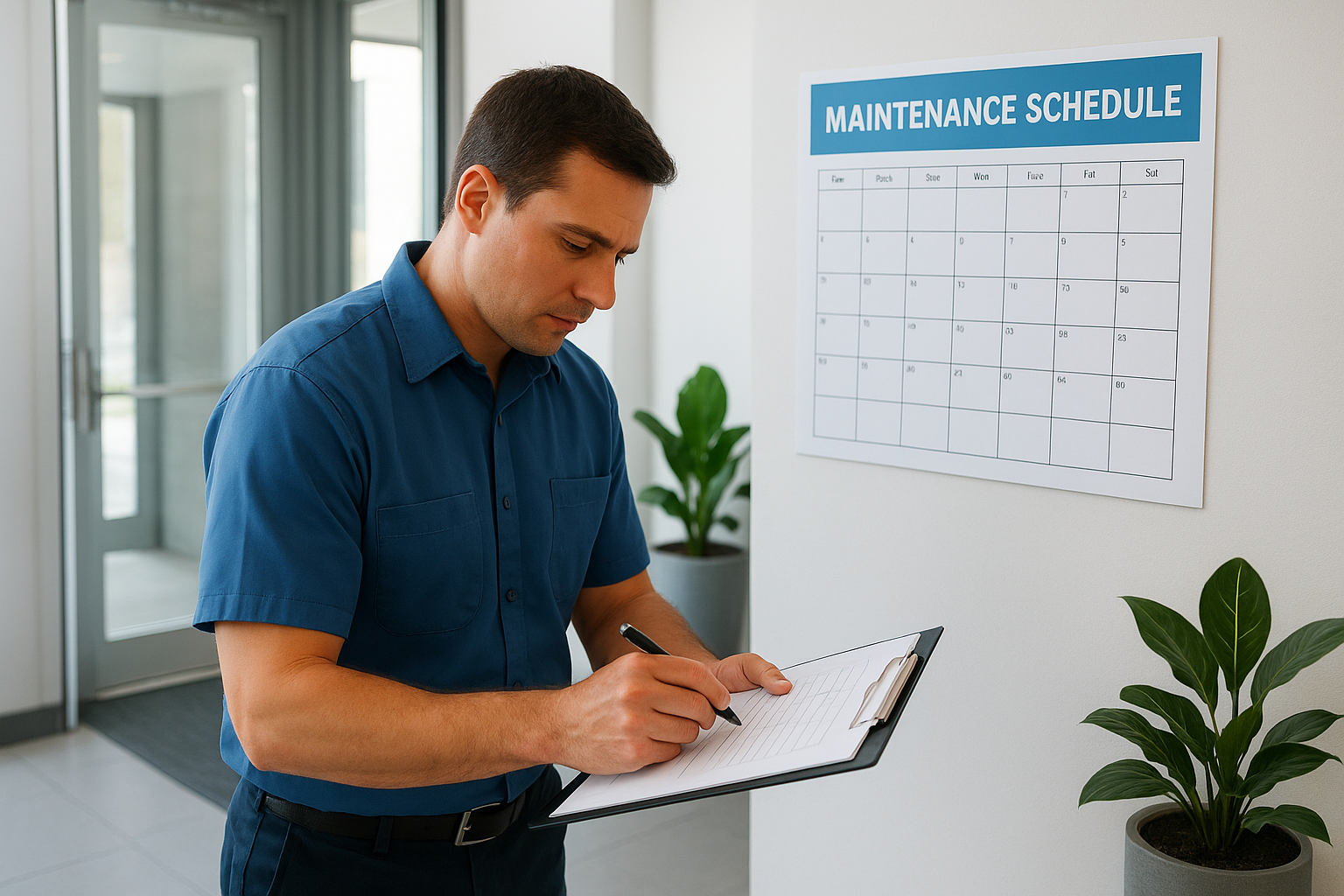
Once you pick a provider, lock in a written maintenance schedule that matches the traffic patterns you identified in step one. A schedule prevents the slow slide back into dull, worn floors that started your search in the first place, and it gives you a paper trail if service quality drops.
Build a schedule around real usage
Set frequencies by zone instead of applying one blanket plan to the whole building, and use ideal cleaning schedules by space as a reference point:
- Entrances and lobbies: daily sweep/mop, weekly buffing
- Restrooms and break rooms: daily disinfecting pass
- Office carpet: vacuum daily, extract every 3-6 months
- Warehouse concrete: dust control weekly, polish annually
Floors hold up best when the schedule matches the traffic, not the calendar.
Review and adjust quarterly
Revisit the plan every quarter with your provider. Seasonal factors like salt and slush in winter or increased retail foot traffic during holidays should shift frequency temporarily. Good commercial cleaning services build this flexibility into the contract upfront rather than charging extra every time conditions change, so ask about seasonal adjustments before you sign.
Keeping your floors in top shape
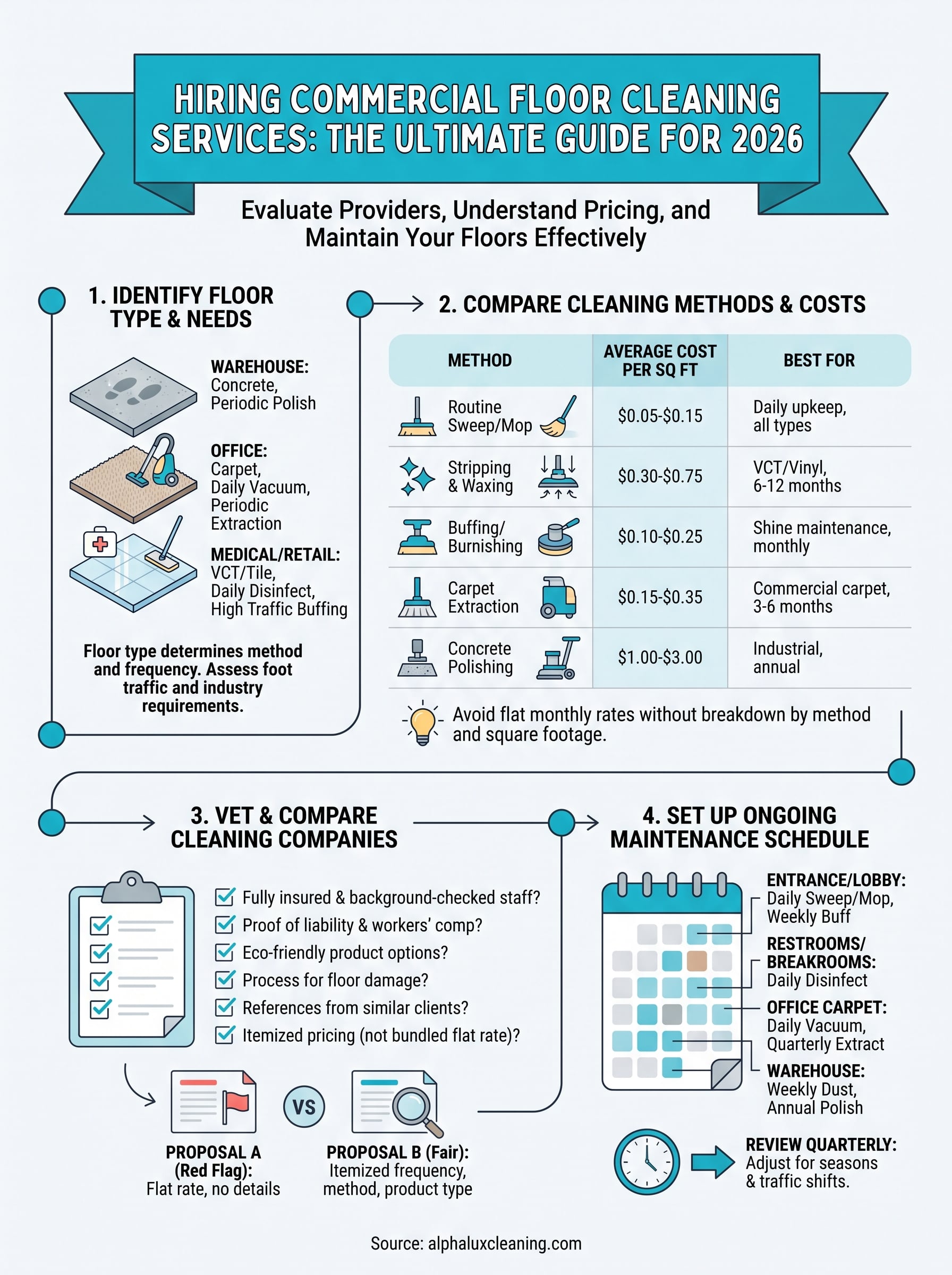
Getting your floors right comes down to four things: knowing your floor type, understanding what each cleaning method actually costs, vetting providers with real questions instead of taking their word for it, and locking in a schedule built around your traffic, not a generic calendar. Skip any of these steps and you end up back where you started, staring at dull, scuffed floors and wondering why the last provider didn’t cut it.
Hiring commercial floor cleaning services shouldn’t feel like a gamble. When you walk into a proposal with your floor specs, a cost benchmark, and a list of vetting questions, you put yourself in control of the negotiation instead of just accepting a flat rate.
If you manage a property in New York and want a provider that already builds plans around your floor type and traffic patterns, see AlphaLux Cleaning’s commercial cleaning services and request a free estimate for a schedule that actually fits your space.