
If you’re wondering what to do if your cleaner damages something, it’s understandable to feel uncertain, especially when you don’t know when or how it happened. Before deciding who’s responsible, make the area safe and record what you found. A calm, factual response can protect your home and make the conversation more constructive.
You may be concerned about repair or replacement costs, or worry that raising the issue will create conflict. You don’t have to jump to conclusions or let the damage go unaddressed. Start by preventing further harm, then gather clear information about what you found and when you noticed it.
This guide explains how to assess damage, document its condition and timeline, and communicate your concerns respectfully. It also covers how to review relevant service terms and discuss practical next steps without assuming responsibility or insurance coverage before the facts are clear. A careful record and a straightforward conversation can help you work toward a reasonable resolution.
Key Takeaways
- If you’re deciding what to do if your cleaner damages something, prioritize safety and preserve the item before drawing conclusions.
- Create a dated record with photos and notes. Keep what you observed separate from what you suspect.
- Compare the damage with condition records, timing, and other possible explanations before deciding when it occurred.
- Raise the concern calmly with a concise account of the damage, supporting evidence, and the discussion you’re requesting.
- Document any agreed next steps and consider the quality of communication when deciding whether to continue service.
What to Do First If Your Cleaner Damages Something
Discovering damage after a cleaning visit can be upsetting, but you don’t need to decide immediately how it happened or who is responsible. First, protect people and pets, prevent further harm, and record what you can observe. A measured response gives you a clearer starting point for the conversation that follows.
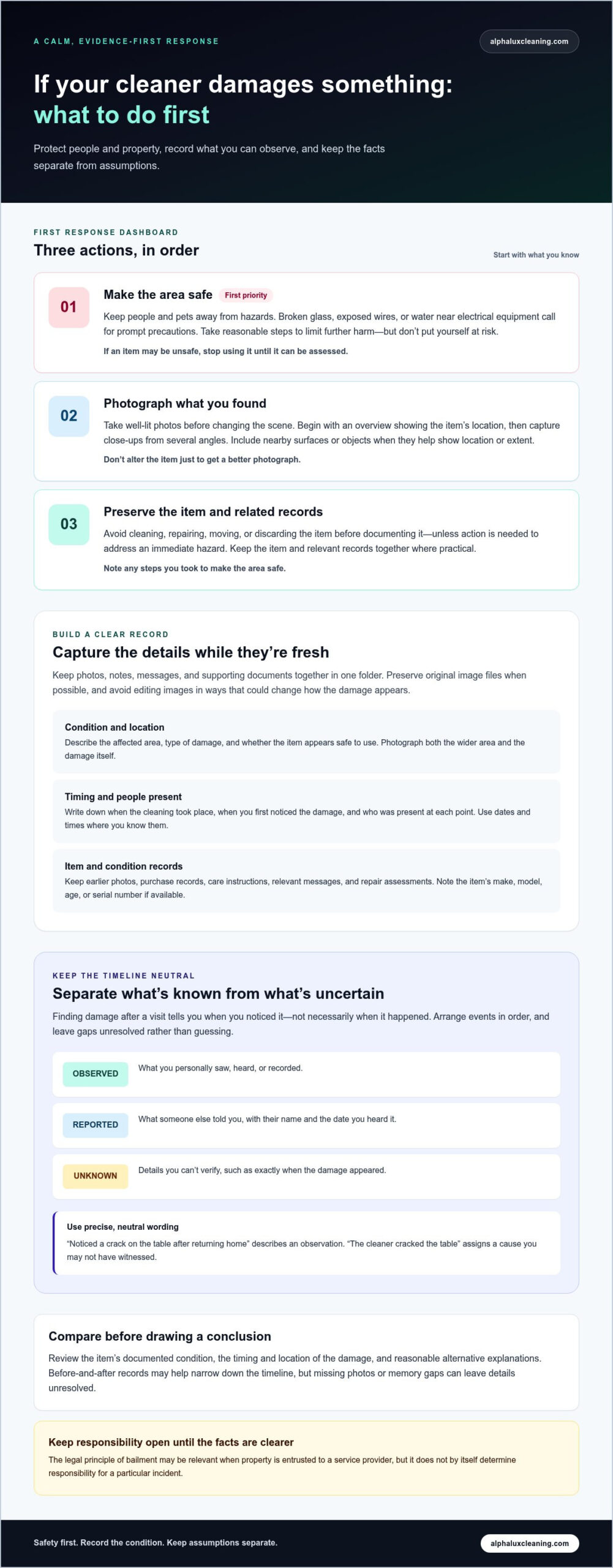
If you’re working out what to do if your cleaner damages something, follow this order: make the area safe, photograph the condition, then preserve the item and any related materials. Broken glass, exposed wires, or water leaking near electrical equipment call for prompt precautions. Keep people away and take reasonable steps to limit further injury or property damage, but don’t put yourself at risk. Cosmetic damage, such as a scratch or chipped finish, may not need urgent action, so document it before attempting a repair.
How to assess damage without making it worse
Describe what you see plainly: note the affected area, the type of damage, and whether the item appears safe to use. If you’re unsure, stop using it until it can be assessed. Avoid cleaning, repairing, moving, or throwing away the item before documenting its condition, unless doing so is necessary to address an immediate hazard. Keep people and pets away from broken pieces, and don’t handle a damaged electrical item if it may be unsafe.
Timely, clear documentation helps everyone review what happened fairly, without relying on memory or assumptions.
What to record in the first few minutes
Take well-lit photos before changing the scene. Start with an overview showing where the item is, then take close-ups from several angles to show the damage. Include nearby surfaces or objects if they help establish the location or extent. Don’t alter the item just to get a better photograph.
Write down when the cleaning took place, when you first noticed the damage, and who was present at each point. Stick to what you know. For example, “noticed a crack on the table after returning home” is more precise than “the cleaner cracked the table” if you didn’t see it happen. Preserve relevant receipts, care instructions, messages, and earlier photos showing the item’s condition. These records can help establish a useful timeline. The legal principle of bailment may be relevant when considering property entrusted to a service provider, but it doesn’t by itself determine responsibility for a particular incident.
Keep the item and records together where practical, and make a brief note of any steps you took to make the area safe. With immediate risks addressed and the initial facts preserved, you’ll be better prepared to discuss the concern calmly.
How to Document Cleaner Damage and Build a Clear Timeline
A clear record can make a difficult conversation more productive. Write down details while they’re fresh, and keep photos, messages, and supporting documents together in one folder. The goal isn’t to prove a cause before you know it. It’s to preserve reliable information so everyone can review the same facts.
Which photos and records are most useful?
Along with close-ups of the affected area, capture the entire room or work area. Wider views show where the item was and what surrounded it, while close-ups help clarify its condition. Keep original image files when possible, and avoid editing them in ways that could change how the damage appears.
Note identifying details such as the item’s make, model, age, or serial number, if available. Gather pre-cleaning photographs, purchase records, care instructions, relevant messages, and repair assessments. An assessment can describe the condition or work needed, but it doesn’t establish when the damage occurred. Keep copies in a dedicated digital or paper folder so you can review and update the record easily.
How to create a neutral incident timeline
Arrange events in order, using dates and times where you know them. Include the cleaning appointment, when the damage was discovered, who saw the item before and after the visit, and any steps taken afterward. If a detail is uncertain, say so rather than filling in the gap. For example, write “noticed a scratch on the cabinet after the appointment” instead of “the cleaner scratched the cabinet” unless you directly witnessed it.
- Observed: What you personally saw, heard, or recorded.
- Reported: What another person told you, with their name and the date you heard it.
- Unknown: Details you can’t verify, such as exactly when the damage appeared.
Evidence describes the item’s condition and the sequence of events; speculation assigns a cause before those facts have been reviewed. Keeping those separate makes your account more precise and helps prevent a reasonable concern from becoming an accusation based on incomplete information. If you’re considering what to do if your cleaner damages something, a neutral timeline gives you a practical basis for raising the issue and discussing possible next steps.
Once your notes are organized, save future updates and replies in the same folder. For residential cleaning options, explore AlphaLux Cleaning services.
How to Tell Whether Damage Happened During the Cleaning
Finding damage after a cleaning visit establishes when you noticed it, not necessarily when it occurred. A before-and-after comparison can help narrow down the timeline, but gaps in photos or memory may leave some details unresolved. Compare the item’s documented condition, the timing and location of the damage, and reasonable alternative explanations before drawing a conclusion.
What details can help clarify when damage occurred?
Look for records showing the item shortly before the appointment, such as dated photos, maintenance notes, or messages mentioning its condition. Compare them with its current state. Consider whether the item was moved or handled, exposed to moisture, or already showing wear. A mark in an area that was cleaned may be relevant, but its location alone doesn’t establish how or when it happened.
Be clear about what you can’t confirm. If no one saw the item immediately before the visit, record that gap rather than treating the last known condition as proof. Assessing what to do if your cleaner damages something means reviewing the evidence carefully, not filling in missing details with assumptions.
How to handle pre-existing wear or conflicting accounts
Describe earlier wear accurately. A pre-existing scratch or fragile finish may provide context, but it doesn’t automatically explain a newly noticed change. If accounts differ, invite each person to share their recollection calmly. Keep the conversation focused on the condition observed, available records, the impact, and what information could help clarify the timeline.
Use a simple comparison to organize the facts and identify what remains uncertain:
| Observation | Evidence to review | Questions that remain open |
|---|---|---|
| A new-looking scratch is visible on a surface. | Earlier photos, current close-ups, and notes about prior wear. | When was the surface last seen clearly, and by whom? |
| An item appears to have been moved. | Photos showing its previous position, room records, or witness recollections. | Was it moved during cleaning or at another time? |
| A finish looks cloudy or changed. | Care instructions, condition photos, and any record of moisture or handling. | Could age, existing wear, or another event have contributed? |
This comparison helps organize the facts; it isn’t a legal finding about responsibility. Liability can depend on the circumstances and applicable rules. For now, distinguish what the evidence supports from what remains unknown, then use that clearer picture to guide a fair discussion.
How to Raise the Issue and Compare Practical Resolution Options
Once you’ve organized the facts, share the concern in a calm, direct message. A clear opening makes it easier to discuss what happened without presenting an unverified cause as certain. Treat the first message as an invitation to review the incident together, rather than a demand for a specific outcome before the details are understood.
What to include in your first message
Keep your note concise and specific. Include the cleaning date, when you noticed the damage, what you observed, and how it affects you. Attach a few clear photographs and mention any immediate safety concern. Then ask to discuss the incident and appropriate next steps. For example:
- Date: “The cleaning took place on [date].”
- Observation: “I noticed [description] on [item] at [time or date].”
- Evidence and impact: “I’ve attached photos. The item is currently [brief impact or safety concern].”
- Request: “Could we discuss the details and possible next steps?”
Use neutral language and keep a copy of the message and any replies with your incident records. A respectful exchange gives everyone an opportunity to share relevant information.
When repairs, replacement, or insurance may be discussed
Resolution can take different forms, and none is automatic. A conversation may clarify what each person remembers. If the item’s condition or repair needs are unclear, a qualified repair assessment may help explain the damage and possible options. Depending on the facts, repair or replacement could be discussed, but don’t assume either will be approved or paid for.
Insurance may also be considered, but coverage, responsibility, and claim procedures depend on the circumstances and applicable policy terms. Review relevant policy documents before relying on coverage or assuming a deadline. AlphaLux Cleaning employs vetted, insured professionals, but that fact alone doesn’t determine whether a particular incident is covered or how it will be resolved. This general information doesn’t determine legal responsibility or insurance coverage.
For more guidance on evaluating a cleaning company’s practices and communication, read this guide to choosing a cleaning company. AlphaLux Cleaning provides residential and commercial cleaning services, including recurring and deep cleaning.
How to Move Forward With a Cleaning Company After Damage
Once you’ve discussed the concern, focus on creating a clear path forward. If you agree on an action, summarize it in writing so everyone has the same understanding of what will happen next. Include who will handle each step and when you’ll follow up. A concise recap can prevent misunderstandings, even when the next step is simply gathering more information.
How to keep the resolution organized
Keep the original report, replies, photographs, repair estimates, and later updates together. After a call or conversation, send a brief note confirming any agreed action, who is responsible, and when you’ll review progress. If the plan changes, add the update to the same record. This creates a practical reference without implying that a particular repair, payment, or insurance outcome is assured.
If communication stalls, review any relevant policy documents and procedures before relying on coverage or assuming what happens next. Keep a record of follow-up messages and responses. The facts and applicable terms matter, so don’t treat a general conversation as a guarantee of resolution.
How to rebuild confidence in future cleaning visits
Deciding whether to continue service is personal. Consider whether the company listens respectfully, communicates clearly, and follows through on the steps discussed. You should feel comfortable raising reasonable concerns and clear about how future visits will be handled. AlphaLux Cleaning employs vetted, insured professionals, though that doesn’t guarantee a specific remedy or outcome in an individual situation.
If you choose to continue, a short conversation before the next appointment can help set expectations. Discuss access arrangements, fragile belongings, special care instructions, and how you prefer to communicate about concerns. Store valuables or delicate objects safely where practical, and clearly point out items that need extra attention. These steps help establish a shared understanding without assigning blame for an unresolved incident.
For an overview of cleaning options and what different services can involve, read the complete guide to house cleaning services. When choosing a service, consider whether standard cleaning, recurring cleaning, or a more detailed deep cleaning plan fits your home or workplace.
Take the Next Step With Clarity and Confidence
When you’re deciding what to do if your cleaner damages something, start with safety, record what you observe, and avoid assuming how the damage happened. A clear timeline and respectful, fact-based conversation can help you explore reasonable next steps without adding unnecessary stress.
Keep photos, messages, and agreed actions together in writing. If you continue service, discuss fragile belongings, care instructions, and communication preferences before future visits. These small habits can help rebuild confidence and set clear expectations.
AlphaLux Cleaning serves residential and commercial properties across New York State and employs vetted, insured professionals. Its cleaning plans include standard, deep, recurring, move-in and move-out, and post-construction cleaning.
Explore AlphaLux Cleaning’s residential and commercial cleaning services to find a cleaning plan for your home or workplace.
Frequently Asked Questions
What should I do first if my cleaner damages something?
Make the area safe, then document the damage before changing the item or its surroundings. Keep people and pets away from hazards such as broken glass, leaks, or an item that may be unsafe to use. Take photos, note when you noticed the issue, and preserve relevant records. You don’t need to decide who is responsible right away. First establish what you can observe and what needs attention.
Should I take photos if my cleaner damages an item?
Yes, take clear photos as soon as it’s safe to do so. Photograph the damaged area close up and capture wider views that show the item’s location and surrounding space. Several angles can help show the condition accurately. Keep the original images and note when you took them. Photos record what the item looked like at that time, but they don’t prove exactly when or how the damage occurred.
Can I ask the cleaning company to pay for a repair?
Yes, you can raise the concern and ask to discuss a reasonable resolution, including whether a repair assessment may help. Share your photos, timeline, and any relevant repair information, and explain the impact. Whether the company is responsible or will contribute to repair costs depends on the facts, applicable terms, and any relevant process. Keep the conversation respectful and document proposed or agreed next steps in writing.
What if I am not sure the damage happened during the cleaning?
Say clearly that you noticed the damage after the visit but can’t confirm when it happened. Compare the item’s condition with earlier photos or records, consider who saw it before and after the appointment, and note possible alternative explanations, such as existing wear or later handling. Share the facts without presenting a guess as certainty. A careful review can help you discuss the concern without making a premature accusation.
Should I repair the damaged item before contacting the cleaning company?
Usually, document the item and contact the company before arranging non-urgent repairs or disposing of it. Photos, an assessment, or an estimate may help clarify the condition and possible options. If the item presents an immediate safety risk, take reasonable steps to protect people and prevent further damage, while recording its condition first if it’s safe. Keep receipts and details of any urgent action you take.
Does a cleaning company’s insurance automatically cover damaged property?
No. A company being insured doesn’t automatically mean a particular item or incident is covered. Coverage and claim procedures depend on the policy terms and circumstances, and responsibility may require a separate review. Read relevant policy documents before relying on coverage or assuming a deadline. Insurance isn’t a guaranteed repair or payment; the available facts and applicable terms matter.
How should I report damage to a cleaning company?
Send a concise, calm message stating the cleaning date, when you noticed the damage, what you observed, and how it affects you. Attach a few clear photos, mention any safety concern, and ask to discuss the incident and possible next steps. Keep a copy of your message and replies. A clear written report creates a useful record without assuming who caused the damage.