

What if the best cleaning schedule is the one that asks less of you, not more? When chores feel endless or pile up unexpectedly, a strict routine can become another source of pressure. A cleaning schedule to reduce stress should make home upkeep feel manageable, even when your week doesn’t go to plan.
You don’t need to clean everything at once or keep every room spotless. A few well-chosen tasks can prevent last-minute cleaning marathons and help you decide what needs attention first. The key is to build a routine around your real life, not an ideal week.
This guide explains how to prioritize essential chores, divide them into daily and weekly tasks, and adjust your plan when schedules change. You’ll also find practical ways to share responsibilities and restart after a missed day. The goal isn’t perfection. It’s a home that feels calmer and easier to maintain.
Key Takeaways
- Build a cleaning schedule to reduce stress by choosing priorities that fit your actual week, not an ideal routine.
- Use a simple planning sequence to turn household chores into manageable daily, weekly, and monthly tasks.
- Keep checklist frequencies flexible so you can adjust them to your home and changing schedule.
- When life gets busy, reschedule essential tasks and let non-urgent chores wait.
- Make upkeep more sustainable by sharing responsibilities, simplifying standards, or choosing professional help for selected tasks.
Why a Cleaning Schedule Can Reduce Stress Without Demanding a Perfect Home
A cleaning schedule isn’t a demand to keep every surface spotless. It’s a flexible plan for spreading household tasks across the time and energy you actually have. Instead of seeing every unfinished chore at once, you can tell what matters now, what can wait, and when you’ll return to it. That clarity helps keep chores from feeling like an endless backlog.
A stress-reducing cleaning schedule makes essential household tasks visible and manageable without requiring a perfect home every day. Housecleaning can serve practical purposes beyond appearance; this overview of the benefits of housecleaning offers useful background. A schedule turns your household’s needs into a routine that works for you.
How predictable routines make household tasks feel manageable
Without a plan, small chores compete for attention. You might wonder whether to tackle the kitchen, clear the entryway, or start laundry, then postpone all three because choosing feels like another task. Assigning a chore to a planned day reduces those repeated decisions. If Thursday is your usual day to check the bathroom, you don’t have to reconsider its priority every morning.
Specific tasks are easier to start than broad goals. “Clear the dining table” gives you a defined first step; “get the house in order” can feel too large to begin. A short list also helps separate practical priorities from chores that simply caught your eye. The aim isn’t to make every task effortless, but to make the next step clear.
Why an imperfect schedule can still work
A useful routine leaves room for real life. Work, household plans, and energy levels can change what you’re able to do. If you miss a planned task, adjust the schedule instead of treating the whole plan as a failure. Move an essential job to another available day, or let a non-urgent task wait. One missed slot doesn’t erase your progress.
Define success by whether your home remains manageable for the people who live in it, not by whether every room looks untouched. One household may prioritize a usable kitchen and moving laundry along. Another may focus on clear walkways or a comfortable living room. Your priorities can change from week to week, so your plan should change with them.
To keep a cleaning schedule to reduce stress supportive, separate tasks into two groups:
- Essential: tasks that help the household function comfortably, such as keeping frequently used areas in order.
- Optional: tasks that can be postponed when time or energy is limited.
This distinction makes it easier to choose what can wait. A flexible plan offers direction, not a daily test you can fail.
How to Build a Cleaning Schedule Around Your Real Week
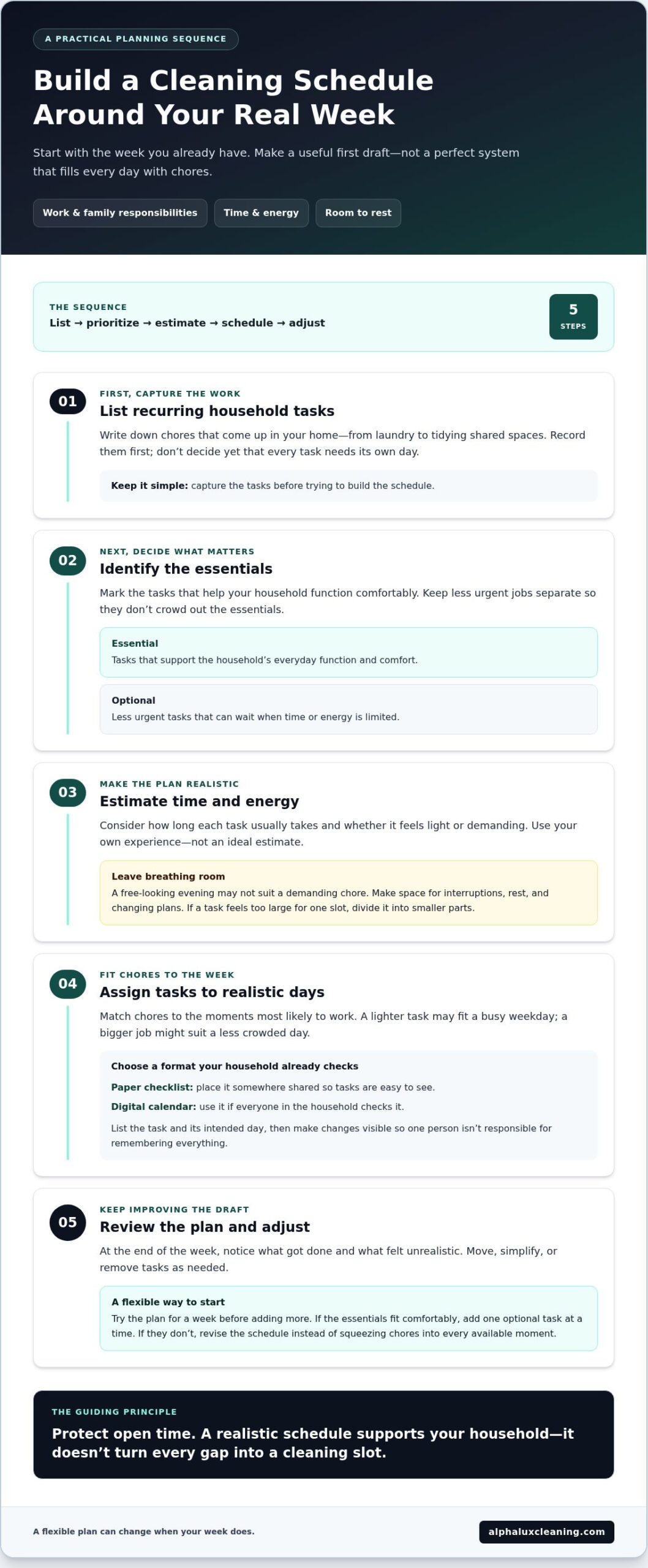
A schedule works best when it reflects the week you already have, including work, family responsibilities, and time to rest. Start with a short planning session rather than filling every day with chores. The goal is a useful first draft, not a perfect system that’s hard to follow.
List recurring tasks, choose the essentials, estimate the time and energy they need, assign them to realistic days, then review and adjust.
- List recurring tasks. Write down the chores that come up in your household, from laundry to tidying shared spaces. Capture them first without deciding that each needs its own day.
- Identify priorities. Mark the tasks that help your home function comfortably. Keep less urgent jobs separate so they don’t crowd out the essentials.
- Estimate time and energy. Consider how long each task usually takes and whether it feels light or demanding. Use your own experience, not an ideal estimate.
- Assign days. Match tasks to the moments most likely to work. A lighter chore may fit a busy weekday, while a bigger job might suit a less crowded day.
- Review the plan. At the end of the week, notice what got done and what felt unrealistic. Move, simplify, or remove tasks as needed.
Choose priorities before assigning cleaning days
Let household routines guide your first choices. If the kitchen gets frequent use, keeping it functional may matter more than dusting a rarely used room. Separate tasks that have a practical consequence if delayed from those that can wait. Start with a short list of essentials, then add optional jobs after you see how the plan fits into everyday life.
Match tasks to available time and energy
A free-looking evening isn’t automatically the right time for a demanding chore. Consider your usual energy and commitments, and leave breathing room for interruptions, rest, and changing plans. If a task feels too large for one slot, divide it into smaller parts. A realistic schedule protects open time instead of treating every gap as an opportunity to clean.
Choose a format your household already checks. A paper checklist in a shared spot makes tasks easy to see; a digital calendar may work better if everyone uses it. Keep the plan simple: list the task and its intended day, then make changes visible so one person isn’t responsible for remembering everything.
Try the plan for a week before adding more. If the essentials fit comfortably, add one optional task at a time. If they don’t, revise the schedule rather than squeezing chores into every available moment. For help with selected recurring tasks, AlphaLux Cleaning’s customizable recurring cleaning can complement the household tasks you prefer to manage yourself.
A Flexible Daily, Weekly, and Monthly Cleaning Checklist
Use the checklist below as a menu, not a set of rules. The right frequency depends on your household size, pets, which rooms get the most use, and what makes your home feel comfortable. A cleaning schedule to reduce stress should reflect those details, so keep the tasks that help and change or skip the rest.
Daily and weekly tasks to keep the routine light
A short daily reset can help shared spaces stay usable without turning every evening into a cleaning session. Choose one small action, such as returning items to their usual places or clearing a commonly used surface. If even that feels like too much on a particular day, let it go and return to your plan later.
For weekly planning, select a few tasks that match your home’s needs. You don’t need to complete every example each week. Rotate options to keep the checklist focused:
- Daily, if useful: return frequently used items to their usual spots; take care of a small task that would otherwise interrupt your routine.
- Weekly, choose what fits: attend to a high-use area, keep laundry moving, or set aside time for a room that needs regular attention.
- Rotate: take turns scheduling one or two additional chores instead of treating every possible task as a weekly requirement.
For example, a household with a busy kitchen might give that space regular attention, while another may prioritize shared living areas or pet-related upkeep. Use these as starting points, not rules. For step-by-step methods for particular chores, the beginner’s guide to cleaning a home offers practical guidance beyond this scheduling checklist.
Monthly and occasional tasks to prevent checklist overload
Keep less frequent jobs on a separate monthly or seasonal list. This prevents occasional chores from crowding the weekly plan and gives you a place to note tasks that matter without assigning them an urgent date. Choose one at a time, based on what needs attention and the time you have.
- Monthly ideas: review a less-used room, attend to an area that doesn’t need weekly attention, or check whether a household task has been overlooked.
- Seasonal or occasional ideas: revisit storage areas, adjust routines as household needs change, or plan a more thorough refresh when it’s practical.
These are suggestions, not a mandatory whole-home checklist. A smaller household may need a different rhythm than a larger one, and pets, visitors, work patterns, and personal preferences can all shift priorities. Start with the few tasks that make daily life easier. Add another only if the routine still feels manageable, then adjust as your home and schedule change.
How to Adapt Your Cleaning Schedule When Life Gets Busy
A schedule should reduce pressure, not create guilt. Busy weeks happen, and a useful routine lets you adjust without turning every postponed task into extra work. Treat the plan as a guide, not a promise to complete every chore on its assigned day. The aim is to keep essential home routines manageable while making room for changing demands.
When your week fills up, use this simple reset:
- Reassess priorities. Identify what matters for comfort and day-to-day function right now.
- Reschedule essentials. Move only the important tasks to realistic open spaces.
- Drop non-urgent tasks. Let less pressing chores wait instead of squeezing them into already full days.
For example, an unexpected work deadline and extra appointments may take the time you planned for chores. Keep the task that would make daily life difficult if delayed, move another essential to a day with more breathing room, and remove the rest from this week’s plan. You can rotate postponed optional tasks into a later week, but only if the list stays short. If you’re repeatedly carrying tasks forward, a shorter checklist is more realistic than a growing backlog. That’s how a cleaning schedule to reduce stress stays responsive to real life.
What to do after missing a planned cleaning day
Don’t double the next day’s workload to “catch up.” Decide which task is still important, move it to a workable time, and release low-priority chores for now. If your schedule has become crowded, restart with one manageable task rather than trying to restore the original plan all at once. A small, deliberate reset counts as progress.
How to share household tasks fairly
Assign each task an owner instead of relying on one person to notice everything and send reminders. Ownership can include noticing when a task is due and deciding when to complete it. The right division depends on household members, commitments, and available time, so review it together when those factors change. Adjusting responsibilities is part of maintaining a workable plan, not a sign that the plan failed.
If a packed routine leaves you wanting help with selected recurring tasks, AlphaLux Cleaning’s recurring cleaning support can complement your household schedule. Keep the tasks you prefer to handle yourself and use professional support where it helps preserve time and comfort at home.
Make Your Cleaning Schedule Sustainable With the Right Support
A routine doesn’t have to depend on one person doing everything or on every room meeting the same standard. Shared responsibilities, simpler expectations, and professional help can all make a household plan easier to maintain. The right mix depends on what your household can manage and which tasks you’d prefer to handle yourself.
Professional cleaning is an option, not a requirement for a calm, comfortable home. It may suit a household during a particularly busy period or when certain jobs are difficult to fit into the usual routine. Some people keep up with everyday tasks themselves and arrange help for selected work. Others value regular cleaning as one part of their overall plan. There’s no single correct balance.
When professional cleaning may fit into a routine
Consider professional support if recurring chores keep being postponed, household responsibilities are difficult to balance, or you want more thorough attention for areas that need it. The purpose isn’t to replace your personal routine. It’s to make room for the tasks and standards that matter most to you, without treating every chore as your responsibility alone.
Choose a level of help that complements your plan
Recurring cleaning can provide consistent support as part of an ongoing household routine. Deep cleaning is a more comprehensive service for times when you want broader attention. AlphaLux Cleaning offers customizable plans with vetted, insured cleaning professionals, so support can be shaped around your home’s needs.
If you’re comparing different kinds of help, the complete guide to house cleaning services explains common options in more detail. Use it to decide which tasks you’d like to keep on your checklist and which could be handled with professional support. That distinction can help your cleaning schedule to reduce stress while preserving the parts of home care you want to manage personally.
Start with the tasks that feel hardest to fit into your routine, then decide whether shared responsibilities, simpler standards, or professional support would help. If cleaning support suits your household, explore an AlphaLux Cleaning plan that aligns with your needs and preferred level of help.
Let Your Routine Grow With You
Your home-care routine doesn’t need to be fully figured out before it can help. Start with a plan that feels manageable, then let it evolve as your schedule, energy, and household needs change. A cleaning schedule to reduce stress isn’t another standard to meet; it’s a practical tool you can reshape whenever life calls for a different balance.
If you’d like support with selected tasks, AlphaLux Cleaning offers customizable recurring and deep cleaning plans. Vetted, insured professionals and eco-friendly, non-toxic products can provide added reassurance as you decide what to manage yourself and where outside help would be useful.
Choose the next step that feels right for your home, whether that means adjusting your checklist or exploring professional support. Explore AlphaLux Cleaning’s customizable cleaning plans and consider which option could complement your routine. A more comfortable home can begin with a small, realistic choice, and you can build from there.
Frequently Asked Questions
How many cleaning tasks should I schedule each day?
Start with one or two small tasks, then adjust based on how they fit your day. A task might be putting away items after dinner or handling one load of laundry from start to finish. If you regularly have capacity for more, add another; if the plan feels crowded, scale back. The right number is the one you can manage without letting cleaning take over time set aside for other needs.
What should I do if I keep falling behind on my cleaning schedule?
Reduce the plan until its regular tasks fit your actual routine. If chores are repeatedly pushed aside, the schedule may include too much or place tasks at difficult times. Keep only what’s most useful for the next week, and leave the rest unscheduled for now. A cleaning schedule to reduce stress should help you make decisions, not keep a running record of tasks you feel you’ve failed to complete.
Is it better to schedule cleaning by room or by task?
Choose the approach that makes it easiest to begin and finish. A room-based plan suits someone who prefers to focus on one area at a time, while a task-based plan works well if you like completing the same type of chore across several rooms. You can combine them: set aside a day for the kitchen, then group a few quick tidying tasks elsewhere. Try one format and switch if it feels cumbersome.
How can I remember cleaning tasks without constantly checking a list?
Connect a recurring chore to something already built into your day. For instance, check the laundry basket when planning the week’s meals or do a quick room reset before settling in for the evening. Keep one trusted reminder system rather than scattering notes across apps, calendars, and paper lists. A brief weekly review can refresh your memory without requiring you to monitor the checklist throughout the day.
Should I clean when I have more energy or follow fixed days?
Use both cues: give recurring tasks a general place in your week, then match demanding chores to times when you tend to have more capacity. If your energy or availability varies, treat the day as a preferred window rather than a strict deadline. For example, plan a larger task for a less busy part of the week, with a backup option if that time becomes unavailable.
How do I make a cleaning schedule work for different household members?
Build the plan around each person’s availability and comfort with particular tasks, then agree on clear ownership. One person might handle a recurring chore on a set day, while another takes responsibility for a different task when their schedule allows. Make expectations visible to everyone, and revisit the division after a change in work, school, or household routines. Shared responsibility works best when the plan doesn’t depend on one person to manage every reminder.