
What if a cleaning mishap leaves you with a repair bill, or a cleaner is hurt while working in your home? The liability of using an uninsured cleaning service depends on what happened, the worker’s relationship with the service, and which insurance policies may apply. Hiring a service without insurance can create practical risks, but it doesn’t automatically determine who is responsible or who pays.
Before welcoming a cleaner into your home or business, it helps to understand the difference between legal responsibility and insurance coverage. This guide explains common situations involving injuries, property damage, and missing belongings in New York, along with practical steps to clarify a cleaning arrangement. Coverage and legal responsibility depend on the facts, so no general explanation can guarantee a particular outcome.
AlphaLux Cleaning employs vetted, insured professionals and provides residential and commercial cleaning across New York State. Knowing what to document and what to look for in a cleaning arrangement can help you make a more informed decision.
Key Takeaways
- The liability of using an uninsured cleaning service depends on the incident, the working relationship, and the policies involved, not simply on whether coverage is absent.
- If a cleaner is injured, an item is damaged, or property goes missing, consider two separate questions: who may be responsible, and whether insurance may respond.
- Compare insured and uninsured arrangements as a practical risk-management decision. Insurance doesn’t guarantee payment or prevent accidents.
- Before a visit, clarify the cleaning scope and document existing damage and valuables to help reduce misunderstandings.
- AlphaLux Cleaning’s vetted, insured professionals provide residential and commercial cleaning for households and workplaces across New York State.
Liability of Using an Uninsured Cleaning Service: What the Risk Actually Means
If something goes wrong during a cleaning visit, your first concern may be practical: who will pay for a repair, medical care, or a missing item? The liability of using an uninsured cleaning service can’t be determined from the word “uninsured” alone. Responsibility depends on the circumstances, and an insurance decision is separate from whether someone may be legally responsible.
In general, legal liability concerns responsibility for harm or loss. Depending on what happened and how the work was arranged, a claim might involve the cleaner, the service arranging the work, or a property owner. Even if one party may be responsible, that doesn’t establish that a particular policy will cover the loss. Coverage depends on the policy’s terms and the specific facts.
What does “uninsured cleaning service” mean?
Insurance isn’t one universal protection. A cleaning service may have no relevant coverage, carry coverage that applies only in certain situations, or have exclusions that affect a particular claim. The word “insured” also doesn’t explain by itself which people, incidents, or losses a policy covers.
Different types of coverage address different risks. A gap in one kind of protection doesn’t answer every liability question, and the presence of insurance doesn’t mean a claim will be paid. The key distinction is between a party’s possible responsibility and an insurer’s decision under the applicable policy.
Why the details of the incident matter
Different events raise different questions. If a cleaner is injured, the circumstances of the injury and the working relationship may matter. If a valuable item is accidentally damaged, what happened and what the relevant policy says may affect whether coverage applies. If property goes missing, establish what is missing and when it was last seen before drawing conclusions about responsibility or insurance.
These examples aren’t conclusions about a specific New York claim. The service arrangement, events leading to the loss, and applicable policy wording can all shape what happens next. A property owner’s policy has its own terms and limits, so don’t assume it covers every incident involving a cleaner.
Liability depends on the event, the working relationship, and applicable policy terms. The same “uninsured” label can therefore lead to different questions in different situations. The sections that follow look at injuries, accidental damage, and missing property, then offer practical ways to clarify a cleaning arrangement. This information is general guidance, not a legal determination. A specific claim may require advice from a qualified New York legal or insurance professional.
Uninsured Cleaning Service Liability in New York: Injury, Damage, and Coverage
A cleaning-related incident can involve very different questions depending on what happened. An injury may raise questions about the worker’s relationship with the service and applicable New York rules. A damaged item calls for a different assessment, while a missing item may require establishing what was there and when it was last seen. In every scenario, possible responsibility and insurance response are separate issues.
If a cleaner is injured while working
Suppose a cleaner slips on a wet floor while working in a home or workplace. The circumstances of the injury matter, as does the worker’s classification. Whether someone is treated as an employee or an independent contractor may affect which rules apply, but a label in an agreement alone may not settle the question. The facts of the working arrangement can be relevant.
Workers’ compensation is a separate consideration from general questions about fault or other insurance. New York requirements can depend on the specific employment situation, so review current state guidance and seek case-specific advice where needed. An uninsured service doesn’t automatically make a homeowner or business responsible for an injury, and a client’s own insurance doesn’t automatically protect them. The details and applicable policies need to be assessed.
If belongings are damaged or go missing
Accidental damage: Imagine a cleaner knocks a lamp from a table while dusting. The practical questions include how the damage occurred, whether it happened during the cleaning work, and what the relevant policy says. Responsibility may depend on the facts. A service’s insurance or the client’s homeowners or business policy may or may not respond; exclusions, limits, and other terms can affect the outcome.
Missing property: A missing item raises different concerns from accidental breakage. First, establish what is missing, when it was last observed, and whether there is information linking its disappearance to the visit. A claim or allegation doesn’t itself prove responsibility. Policy wording and available evidence may affect how the matter is handled, and no particular policy should be assumed to cover it.
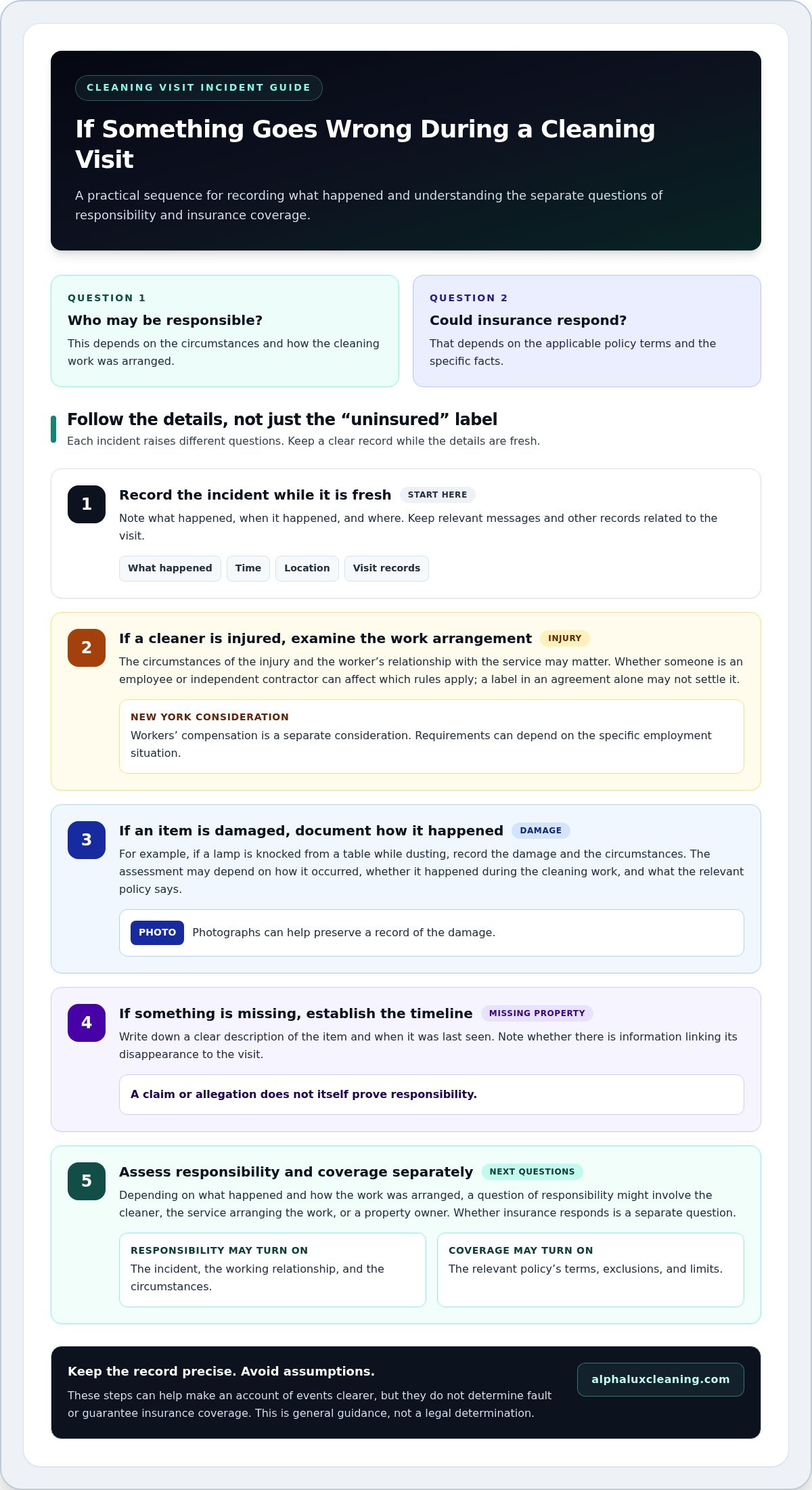
If an incident occurs, preserve relevant details while they’re fresh. Keep photographs of damage, note the time and location, and save messages or other records related to the visit. For a missing item, write down a clear description and when it was last seen. These steps don’t determine fault or guarantee coverage, but they can help make the account of events more precise.
The liability of using an uninsured cleaning service can’t be resolved with a single rule for every injury, damaged belonging, or missing item. Check New York-specific requirements and policy responses against current, reliable guidance rather than making assumptions. For a professionally managed cleaning arrangement in a home or workplace, AlphaLux Cleaning services provide cleaning by vetted, insured professionals.
Insured vs. Uninsured Cleaning Services: Compare the Practical Protections
Insurance can offer an important layer of financial protection, but an “insured” label doesn’t promise that every incident will be covered. The practical difference is whether relevant coverage may help with a claim, subject to the policy and circumstances. An uninsured arrangement may leave fewer insurance options to consider, but it doesn’t automatically establish who is legally responsible.
| Situation | Insured arrangement | Uninsured arrangement |
|---|---|---|
| Cleaner is injured | Relevant coverage may respond if the incident falls within its terms. Worker status and applicable rules still matter. | There may be no service coverage to address the injury. Responsibility depends on the facts and applicable rules, not simply on the absence of insurance. |
| Item is accidentally damaged | A claim may be considered under relevant coverage, subject to exclusions, limits, and the circumstances. | The client and service may need to address the loss without service insurance. Responsibility still depends on what happened. |
| Property goes missing | Whether a policy applies can depend on its wording, the evidence, and the nature of the claim. | Without relevant coverage, fewer insurance options may be available. An allegation alone doesn’t establish fault. |
| Claims handling | Applicable policies may provide a route for reviewing a covered claim, but outcomes aren’t guaranteed. | There may be no insurer for the service to involve, though other parties or policies may still be relevant. |
What insurance can add, and what it cannot promise
Relevant insurance may help address a covered claim and provide a defined process for assessing it. That can make an insured arrangement a meaningful safeguard for households and workplaces. Still, coverage depends on policy wording, exclusions, limits, and the specific event. Insurance doesn’t prevent accidents, establish who was at fault, or automatically resolve a disagreement about damage or injury.
View coverage as one practical consideration, not a substitute for clear communication and careful documentation. The guide to choosing a cleaning company offers a broader framework for assessing a cleaning arrangement alongside insurance questions.
Why worker status and policy wording matter
A service may describe a cleaner as an employee or an independent contractor, and those arrangements can raise different considerations. The label alone may not resolve how the relationship is treated under applicable rules. Policy documents matter too: a general statement that a service is “insured” doesn’t show which people, incidents, or losses fall within the policy’s scope.
When considering the liability of using an uninsured cleaning service, compare the actual protection available rather than relying on a simple insured-or-uninsured label. New York requirements and worker-classification questions can be fact-specific and may change. Consult current state guidance or a qualified legal or insurance professional for a case-specific explanation. AlphaLux Cleaning employs vetted, insured professionals, giving clients a professional cleaning option while recognizing that no insurance arrangement guarantees coverage for every claim.
Before a Cleaning Visit: A Practical Checklist to Reduce Uncertainty
A little preparation can make expectations clearer and help you describe what happened if a concern arises. It won’t eliminate every risk or determine who is responsible, but a simple record of the space and agreed work can reduce avoidable misunderstandings. These steps can help whether you’re arranging a one-time home cleaning or recurring care for a workplace.
Before the cleaners arrive
Take a few minutes to document the space and confirm the visit details. Keep the record factual and easy to find rather than relying on memory later.
- Note existing damage. Take dated photos of visible scratches, stains, loose fixtures, or other areas that could be mistaken for new damage. Add a brief note describing the location and condition.
- Secure valuables and sensitive documents. Put away jewelry, cash, personal papers, and items you don’t want handled. This is a sensible household precaution, not an assumption that a cleaner will act improperly.
- Keep the agreed scope in writing. Save the appointment details and a message or other record that describes which rooms or tasks are included. If there are surfaces or belongings you want left untouched, record that too.
- Keep relevant contact details accessible. Know how to reach the service if a question comes up during or after the visit, and keep scheduling or scope-related messages together.
Clear records can be especially helpful if the liability of using an uninsured cleaning service becomes a concern after an incident. They help establish what was already present and what work had been agreed, without deciding fault or whether an insurance policy applies.
If an incident happens during or after cleaning
Start with safety. If someone is injured or there’s an immediate hazard, address the urgent situation first. Once it’s safe, make a factual record and notify the relevant people so the circumstances can be reviewed.
- Write down the basics. Record the date, approximate time, location, what you observed, and who was present. Photograph visible damage or the surrounding area if it’s appropriate and safe.
- Preserve relevant information. Keep messages, appointment records, and photographs together. For a missing item, note what’s missing and when you last remember seeing it. Don’t treat a suspicion as proof.
- Notify the service. Describe the issue in neutral, factual language and keep a copy of your communication. If you believe an insurance policy may be relevant, contact the appropriate insurer and follow its instructions.
A written record can support a clearer discussion, but it doesn’t guarantee a claim will be accepted or establish who is legally responsible. Avoid guessing about fault or coverage before the facts and applicable policy terms are reviewed. If an injury, substantial loss, or disagreement makes the situation urgent or difficult to resolve, seek guidance from a qualified legal or insurance professional.
For residential or commercial cleaning, explore AlphaLux cleaning services.
How AlphaLux Cleaning Helps Clients Feel More Confident
Choosing a cleaning service is about more than the finished room. You’re also inviting professionals into a space you value, so dependable service and clear expectations matter. As the sections above explain, the liability of using an uninsured cleaning service depends on the circumstances, working relationship, and applicable policies. AlphaLux Cleaning provides residential and commercial cleaning with vetted, insured professionals.
A considered option for homes and businesses
AlphaLux serves residential and commercial clients across New York State, including Long Island. A household may want help keeping living spaces consistently comfortable, while a workplace may have different priorities for maintaining a clean, welcoming environment. Customizable cleaning plans help tailor the service to a client’s needs rather than assuming every home or business requires the same approach.
For households weighing the practical considerations involved in professional home care, AlphaLux’s complete guide to house cleaning services offers further context. A well-defined cleaning arrangement can align expectations about the space and the work, while giving clients a clear starting point for discussing their priorities.
Professional care with reassurance in mind
AlphaLux Cleaning employs vetted, insured professionals. That’s a meaningful consideration when deciding who will care for a home or workplace, but it isn’t a promise that every incident or claim will be covered. As with any insurance, the circumstances and applicable policy terms matter. Professional protections can inform a more considered decision, but they don’t eliminate risk or replace clear communication.
AlphaLux also uses eco-friendly, non-toxic products. This is separate from insurance: it describes the products used during cleaning, not liability or claim coverage. Customizable plans, professional staffing, and attention to product choices help clients make an informed selection for their spaces.
Greater peace of mind starts with realistic expectations. Understand the cleaning plan, keep important details clear, and remember that insurance questions depend on the specific situation. For households and workplaces seeking professional support, Explore professional cleaning with AlphaLux.
Choose Your Next Cleaning Arrangement with Confidence
The liability of using an uninsured cleaning service is a reason to make a thoughtful choice, not to expect the worst. Before scheduling, consider what matters most in your space, clarify expectations, and keep useful records. Those steps can help you feel prepared while leaving room to enjoy the benefits of professional cleaning: a cared-for home or workplace and more time to focus elsewhere.
AlphaLux Cleaning offers customizable plans for different client needs, with vetted, insured professionals serving residential and commercial clients across New York State. Insurance doesn’t guarantee that every claim will be covered, but choosing a service with professional protections can be a reassuring part of a well-managed arrangement.
Take the next step toward a cleaner, more comfortable space. Explore AlphaLux cleaning services and choose an approach that fits your home or workplace.
Frequently Asked Questions
Is a homeowner automatically liable if an uninsured cleaner is injured?
No. A cleaner’s uninsured status alone doesn’t make a homeowner automatically responsible for an injury. The working relationship, what led to the incident, and applicable New York rules can all matter. For example, the arrangements for a worker hired directly may differ from those made through a cleaning business. If an injury is serious or responsibility is disputed, get guidance from a qualified New York legal or insurance professional rather than relying on a general online explanation.
Can my homeowners insurance cover damage caused by an uninsured cleaning service?
Possibly, but you’ll need to consider your policy wording and the facts of the loss. A policy may treat a broken fixture differently from damage to personal belongings, and exclusions may affect whether a claim is considered. Don’t assume your homeowners insurance will cover a cleaning-related incident simply because the service lacks coverage. Review your policy and speak with your insurer or a qualified insurance professional about the specific damage.
What happens if an uninsured cleaner damages something in my home?
Document the item’s condition, the damage, and when you noticed it. For instance, photograph a chipped countertop from several angles and save any messages describing the work planned in that area. Then notify the cleaning service in neutral, factual terms. Responsibility or reimbursement isn’t automatic, and coverage depends on the circumstances and applicable policy wording. If the loss is substantial or there’s a disagreement, consider qualified legal or insurance advice.
Does it matter whether a cleaner is an employee or an independent contractor?
Yes. Worker classification can affect which legal and insurance considerations apply, and the title used in a contract or conversation may not settle the question. The actual working arrangement and relevant facts matter. For example, who directs the work and how the service is organized may be relevant to a classification review. New York rules can be specific, so this general information can’t determine a particular cleaner’s status.
Can an uninsured cleaning service still be held responsible for property damage?
Yes. A lack of insurance doesn’t by itself remove possible responsibility, but it also doesn’t prove that the service caused the damage. The liability of using an uninsured cleaning service depends on the incident, the evidence, and any relevant agreements and legal rules. Keep records that clarify the item’s condition before and after the visit, and don’t treat an insurer’s involvement or absence as a decision about fault.
What should I document if something goes wrong during a cleaning visit?
Make a factual record as soon as practical: note the date, location, people present, and what you observed. Take clear photographs when safe, and preserve appointment details and relevant messages. If an item is missing, record its description and when you last remember seeing it rather than assuming how it disappeared. Prioritize safety if someone is hurt, and seek qualified guidance for a serious injury or substantial loss.