What if a cleaner, more thoughtful routine starts with using the right product for each room and task, rather than the strongest one everywhere? That’s the practical idea behind green cleaning for schools and daycares. It’s understandable to wonder whether gentler product choices can still meet hygiene needs, especially when children share toys, tables, bathrooms, and high-touch surfaces throughout the day.
They can support a well-planned routine, but product choice is only part of the process. Cleaning removes dirt and germs; sanitizing and disinfecting serve different purposes and shouldn’t be treated as interchangeable steps. A clear plan helps staff know which process each surface needs, when it needs attention, and how to follow product directions consistently.
This 2026 guide explains those distinctions and shows how to shape a practical routine around rooms, activities, and daily demands. It also outlines New York’s green cleaning requirements for public and non-public elementary and secondary schools, and explains why private daycare centers should review the policies that apply to their setting. The result is a more consistent approach to cleanliness and product use that keeps children’s and staff’s needs in view.
Key Takeaways
- Build green cleaning for schools and daycares around each room’s needs, combining suitable product choices with consistent methods and staff routines.
- Match cleaning, sanitizing, or disinfecting to the task, and follow facility policies and product label directions.
- Review New York’s OGS Green Cleaning Program requirements alongside the rules and policies that apply to your specific facility.
- Map rooms and activities to create practical daily, periodic, and incident-response procedures staff can follow.
- Consider how customizable commercial cleaning plans and eco-friendly, non-toxic products can support a carefully maintained learning environment.
What green cleaning for schools and daycares means in practice
Green cleaning is the practice of choosing cleaning products and methods with environmental considerations in mind while still meeting a facility’s cleaning needs. It’s a coordinated program, not simply a switch to products with green packaging. Product choice, technique, cleaning frequency, and staff training all affect how consistently rooms are maintained. For a concise background on the concept, see What is green cleaning?
For green cleaning for schools and daycares to work well, decisions need to reflect the room, surface, activity, and facility procedures. Environmental claims alone don’t establish that a product suits every material or task. Staff should use products only as directed on the label and follow the facility’s written policies.
Why schools and daycares need a room-aware approach
Different rooms have different patterns of use. A classroom may need regular attention to desks, shared supplies, and floors. Food areas have distinct cleaning needs, while bathrooms require routines suited to fixtures and frequently touched surfaces. Nap rooms call for care around mats, cots, and other items children use. Shared-touch surfaces, such as door handles, may need attention at a frequency set by use and facility policy.
Room schedules matter, too. Plan cleaning around when children and staff use a space, allowing suitable time for the task and any label directions that must be followed before the room is used again. A simple room-by-room plan can record the surfaces to address, routine frequency, assigned staff role, and any special instructions. That detail helps keep work consistent when schedules or staff assignments change.
Thoughtful routines help spaces feel orderly and ready for learning, meals, rest, and play. The goal isn’t to apply the same procedure everywhere. It’s to maintain each area in a way that fits how people use it.
What green cleaning does, and does not, promise
A greener routine doesn’t mean skipping necessary hygiene measures or assuming one product can handle every situation. Cleaning still needs to match the task, and facility policies may call for additional steps in specific circumstances. A considered program makes those expectations clear, so staff can follow the right procedure instead of guessing.
Labels and intended use matter more than broad marketing language. Before adopting a product, review the surfaces it’s designed for, its directions, and any precautions. A label or environmental claim doesn’t automatically mean the product suits every room, material, or task. Follow the facility’s purchasing and use requirements, and don’t use a product outside its stated directions.
Terms such as “green” or “non-toxic” shouldn’t be treated as a promise that no individual could experience irritation. People may respond differently to products, so clear procedures for product use and concerns are part of responsible facility practice. The aim is a well-managed routine: careful choices, appropriate methods, and dependable staff practices that meet the needs of the space.
Cleaning, sanitizing, and disinfecting: match the method to the task
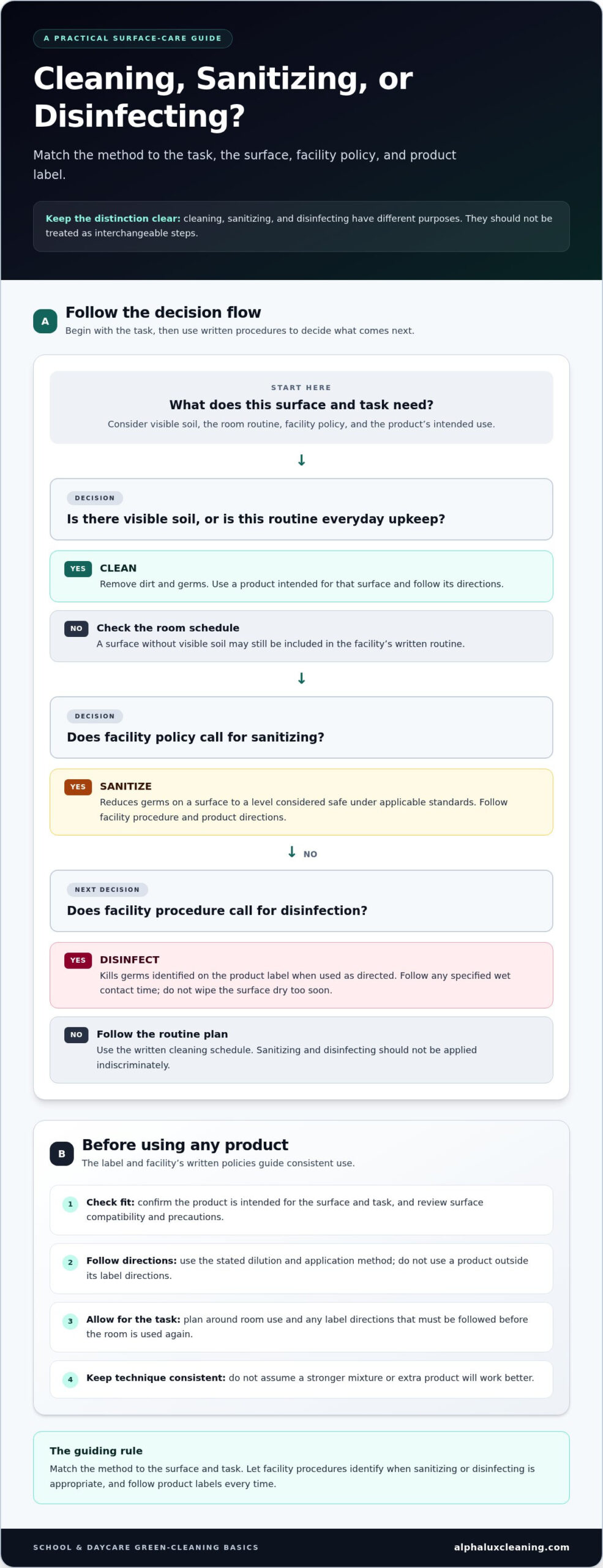
Cleaning, sanitizing, and disinfecting are different processes with different purposes. Knowing which one a task calls for helps staff meet hygiene needs without treating every surface as if it requires the same intervention. In green cleaning for schools and daycares, the decision should reflect the surface, task, facility policy, and product label.
| Process | What it does | How to think about it |
|---|---|---|
| Cleaning | Removes dirt and germs from a surface. | A practical first step for routine soil and everyday upkeep. |
| Sanitizing | Reduces germs on a surface to a level considered safe under applicable standards. | Use when the task or facility procedure calls for lowering germ levels. |
| Disinfecting | Kills germs identified on the product label when used as directed. | Reserve for situations where facility procedures call for disinfection. |
When routine cleaning is the appropriate first step
For everyday care, remove visible soil from desks, counters, floors, and commonly handled items using a product intended for that surface. A dusty desk, sticky counter, and floor with tracked-in dirt are different cleaning tasks, but each begins by addressing the soil rather than automatically applying a disinfectant. A surface that isn’t visibly dirty may still be part of a facility routine, so staff should follow the written schedule as well.
Use the product exactly as directed. Check dilution instructions, surface compatibility, and application directions. Don’t assume a stronger mixture or extra product will work better. Consistent technique helps prevent missed areas and avoids damage from using a product in a way the label doesn’t allow.
When sanitizing or disinfecting may be needed
Sanitizing and disinfecting have specific roles, but neither should be applied indiscriminately. Facility policies should identify when either process is appropriate, and the product label should guide its use. Disinfectants may require a specified period of wet contact to work as directed. Follow the label rather than wiping a surface dry too soon or assuming a quick spray is enough.
A bodily-fluid incident is not ordinary routine cleaning. It calls for the facility’s specific incident-response procedure and any applicable health or safety guidance. Staff should follow the assigned process and use the products and protective measures specified by their policy. Don’t improvise or treat the event as a reason to disinfect every nearby surface without direction.
Clear procedures make these distinctions easier to apply during a busy day. Customizable commercial cleaning plans from AlphaLux Cleaning can support a facility’s established upkeep routine, while staff continue to follow the facility’s procedures for sanitizing, disinfection, and incidents.
Green cleaning requirements and product criteria for New York facilities
New York’s school green-cleaning program has a defined scope. Chapter 584 of the Laws of 2005 amended Education Law § 409-i and Finance Law § 163-b, requiring public and nonpublic elementary and secondary schools to use environmentally sensitive cleaning products. The requirement has been in effect since September 1, 2006. The New York State Office of General Services (OGS), working with state education, health, environmental conservation, and labor departments, manages the State Green Cleaning Program.
OGS maintains and updates an approved products list. Schools covered by the law must select cleaning products from that list. Its categories include general-purpose cleaners, floor-care products, hand soaps, and vacuums. The program’s cleaning-product requirements don’t automatically cover disinfectants, which may be governed by separate health or workplace procedures. For green cleaning for schools and daycares, this distinction matters: a school mandate shouldn’t be assumed to apply identically to every childcare setting.
How to check whether a rule applies to your setting
Start by identifying the facility type and who oversees it. A public or nonpublic elementary or secondary school falls within the school program’s stated scope. A private daycare center isn’t defined as a school under this law, so the school requirement doesn’t automatically apply to it. If childcare operates inside a school, or a facility combines school, daycare, food-service, or other specialized spaces, don’t assume one rule covers every area.
Review the facility’s licensing context, written policies, and any applicable health or workplace requirements. Check current guidance from OGS and the relevant New York authorities responsible for the facility’s oversight. This helps establish which requirements apply before setting purchasing and use procedures. This overview is not legal advice.
How to assess products for a school or daycare
Regulatory approval is one part of product selection, not a substitute for checking whether a product suits a particular job. For each product under consideration, review:
- Intended use and surface compatibility: Confirm that the label identifies the task and material you need to address.
- Directions and warnings: Follow application instructions, dilution requirements, precautions, and any required safety documentation.
- Room conditions: Consider fragrance, ventilation, storage, and how staff will handle and access the product safely.
- Evidence for claims: Verify any certification against current, product-specific records rather than relying on broad marketing language.
A product may seem appropriate in general but still be unsuitable for a particular surface or procedure. Keep approved-product information and facility instructions accessible to staff, and revisit them when products, room uses, or applicable guidance change. This provides a reliable basis for everyday choices without extending school requirements to daycare settings where they may not apply.
How to put a green cleaning program into daily practice
A reliable program turns expectations into clear steps: identify what each space needs, decide who handles each task, and make procedures easy to follow. For green cleaning for schools and daycares, a written plan helps staff work consistently while accounting for room schedules, facility policies, and the products selected for each task.
Use this sequence to build the routine:
- Map rooms and activities. Note how each space is used, which surfaces are frequently handled, and when the room is occupied.
- Set task frequencies. Separate daily upkeep from periodic work and procedures reserved for incidents.
- Select suitable products. Match products to facility requirements, intended uses, and the surfaces being maintained.
- Train staff and assign roles. Make responsibilities, directions, and documentation expectations clear.
- Review and adjust. Use completed checklists and staff feedback to identify gaps or needed changes.
Build schedules around rooms and school-day rhythms
Start with a room map that records use, occupancy, shared-touch areas, and suitable cleaning windows. A classroom may need a different schedule from a bathroom, entryway, dining area, or shared play space. Coordinate work with room activities so staff can complete assigned tasks without disrupting lessons, meals, rest, or transitions. For broader facility-planning context, the commercial cleaning services guide can help frame how cleaning routines fit into a building’s operations.
A simple planning framework can separate tasks by timing:
- Daily: List recurring room and surface tasks, the responsible role, and where completion is recorded.
- Periodic: Schedule less frequent maintenance, such as attention to areas or surfaces that don’t need daily service.
- Incident response: Point staff to the facility’s separate procedure for bodily-fluid incidents or other situations requiring specific steps.
Keep responsibilities specific. “Clean the classroom” is difficult to verify; naming the task, location, assigned role, and completion record makes the routine more useful. Checklists can be kept in a designated staff area or maintained through the facility’s existing documentation process.
Train staff and review the program
Training should connect written procedures to actual tasks. Show staff where product directions and safety documentation are kept, how to follow facility instructions, and whom to notify about a spill, product concern, or supply issue. Cover storage, labeling, ventilation, and handling expectations. Keep products clearly identified and stored according to their directions and facility policy, rather than transferring them into unmarked containers.
Set a regular review point to look at completed checklists, supply storage, product use, and recurring maintenance concerns. Update the plan when room use changes, new guidance applies, or product information is revised. Share updates with everyone who performs or oversees cleaning so the current procedure remains clear across shifts and assignments. For help maintaining a dependable commercial cleaning routine, explore AlphaLux’s customizable commercial cleaning plans.
How AlphaLux supports a clean, carefully maintained learning environment
A facility’s cleaning routine needs to fit its spaces, operating priorities, and preferred schedule. AlphaLux Cleaning offers customizable commercial cleaning plans, so organizations can shape recurring cleaning around the areas and tasks that matter to them. For schools and daycare decision-makers, commercial cleaning can support an orderly, well-maintained environment while remaining separate from the facility’s own policies for sanitizing, disinfecting, and incident response.
AlphaLux Cleaning uses eco-friendly, non-toxic products that are safe for children, pets, and the environment. The company supplies cleaning products and equipment, so facility teams don’t need to provide them for the service. Trained, insured, and background-checked professionals carry out the cleaning.
For a wider view of the service approach and what professional cleaning can include, explore AlphaLux Cleaning’s professional cleaning services.
What a tailored cleaning plan can address
A useful plan begins with the facility’s priorities. Consider which spaces need routine attention, how often cleaning should take place, and how the preferred schedule fits building operations. A facility may prioritize shared spaces, classrooms, entry areas, or staff areas differently. Clear expectations help align the cleaning routine with how the building is used.
Consistency matters. A recurring plan can support upkeep over time, making cleaning part of a dependable facilities routine rather than an occasional catch-up task. The scope can be adjusted as operational needs change. Facility-specific requirements for approved products, room access, and hygiene procedures should remain part of planning, so the cleaning routine complements the organization’s own standards.
A simple next step for facility decision-makers
Start by outlining the facility’s cleaning priorities, preferred schedule, and relevant site procedures. This gives the estimate process a practical foundation and helps clarify the scope of cleaning needed. AlphaLux Cleaning provides free, no-obligation estimates by phone, text, or online form, giving facility decision-makers a straightforward way to discuss their needs.
To explore a tailored routine, request a free, no-obligation cleaning estimate by phone, text, or online form. A clear plan can bring greater consistency to your space’s upkeep and make the routine easier to manage.
Make your facility’s next cleaning step more intentional
A thoughtful green cleaning for schools and daycares program grows from clear priorities and consistent routines. Start by identifying what matters most to your facility, then shape a cleaning plan around its spaces and schedule. A dependable commercial cleaning partner can help make that routine easier to manage, while your team stays focused on the policies and requirements specific to your setting.
AlphaLux Cleaning offers customizable plans and uses eco-friendly, non-toxic products that are safe for children, pets, and the environment. Its professionals are licensed, bonded, insured, background-checked, and trained. AlphaLux also has a five-star rating and more than 500 happy clients overall.
Outline your facility’s needs and preferred schedule, then request a free, no-obligation estimate for your facility to discuss a practical cleaning routine.
Frequently Asked Questions
Are green cleaning products effective against germs in schools?
Some products are intended to sanitize or disinfect, but “green” by itself doesn’t establish that a product kills germs. For a germ-related task, check that the product label names the intended organism and surface, then follow its directions, including contact time and use instructions. For example, spraying a surface and wiping it immediately may not follow the label. Follow facility policy, and document the work when required.
Can green cleaning products trigger asthma or allergies?
Yes, a product marketed as green isn’t automatically suitable for every person. Fragrance, ingredients, ventilation, and individual sensitivities can all matter. Review the label and safety documentation, and store and use products as directed. If a student or staff member has a known sensitivity, follow the facility’s accommodation and health procedures. Don’t assume any product is irritation-free for everyone, even when it’s described as non-toxic.
Does New York’s green cleaning law apply to daycares?
Not automatically. New York’s Office of General Services describes Chapter 584’s green cleaning requirements for public and nonpublic elementary and secondary schools; a private daycare isn’t defined as a school under this law. A childcare program located within a school may have a different operating context. For green cleaning for schools and daycares, identify the facility’s licensing and relationship to a school, then verify current requirements with the relevant New York authorities.
What should staff do after a blood or bodily-fluid spill?
Staff should treat a blood or bodily-fluid spill as an incident, not an ordinary cleaning task. Follow the facility’s exposure-control, health, and safety procedures, including any protective equipment and product directions those procedures specify. The New York Office of General Services notes that blood spills may call for special practices. Keep the current response plan accessible, and make sure staff know where to find it and whom to notify.
How can parents learn about a school’s green cleaning practices?
Parents can review the school’s written cleaning policy or ask administrators how product selection, routine cleaning, and incident response are managed. Specific questions can make the conversation clearer: How are products stored? How can families share information about a child’s known sensitivity? What procedures apply after a spill? A useful explanation should distinguish routine cleaning from sanitizing or disinfecting without suggesting that one routine can prevent every illness.
Does green cleaning mean a school should avoid disinfectants entirely?
No. Green cleaning doesn’t require a facility to avoid disinfectants in every circumstance. The appropriate procedure depends on the task, facility policy, current guidance, and product label. For example, a routine classroom task may differ from a response to a bodily-fluid incident. Use disinfectants where procedures call for them, and avoid applying them indiscriminately. Staff should follow the facility’s established instructions, including label directions.