
Last Updated: November 5, 2026
Quick Summary
Before hiring house cleaners, ask about liability insurance, worker’s compensation, bonding, and background checks, and request proof rather than a verbal yes. Also confirm the written scope of work, whether the quote is flat rate or hourly, how keys and alarm codes are handled, and the satisfaction guarantee terms.
- Professional services should carry liability insurance, worker’s compensation, and bonding, with background checks for every employee.
- General cleaning and deep cleaning are different jobs, and one-time cleaning usually costs more per visit than recurring service.
- A flat-rate quote fixes your cost before the cleaner arrives, while an hourly quote shifts the risk of a longer job to you.
- Ask whether you get the same housekeeper each visit and how much notice you get if a substitute is sent.
- Confirm whether tips are expected, whether they are pooled, and whether they can be added to the invoice.
Table of Contents
- Why the Questions You Ask Decide Who You Hire
- Insurance, Bonding, and Background Checks: The Non-Negotiables
- Scope of Work: What a House Cleaner Checklist Should Cover
- What Drives the Average Cost of House Cleaning Services
- Supplies, Products, and Chemical Sensitivity
- Home Access, Key Management, and Digital Security
- Hiring a Cleaner for the First Time: Consistency, Communication, and Tipping
- Request a Free Estimate from AlphaLux Cleaning
- Frequently Asked Questions
Why the Questions You Ask Decide Who You Hire
The right questions to ask before hiring house cleaners separate a smooth, reliable service from months of frustration. The interview is where trust is built or broken.
Hiring house cleaners is a decision about who enters your home, handles your belongings, and works around your family and pets. The questions below are the ones that reveal how a company actually operates.
A common mistake is treating the interview as a formality. The real difference between a good hire and a bad one comes down to how specific the answers are.
Insurance, Bonding, and Background Checks: The Non-Negotiables
Professional house cleaning services should carry liability insurance, worker’s compensation, and bonding, and every employee should pass a background check before entering a client’s home. Ask for proof rather than a verbal yes.
These four items protect you, the cleaner, and the company:
- Liability insurance covers damage to your home or belongings.
- Worker’s compensation covers a cleaner injured on your property.
- Bonding protects you against theft.
- Background checks screen every person who gets a key.
How to Verify Coverage Before You Book
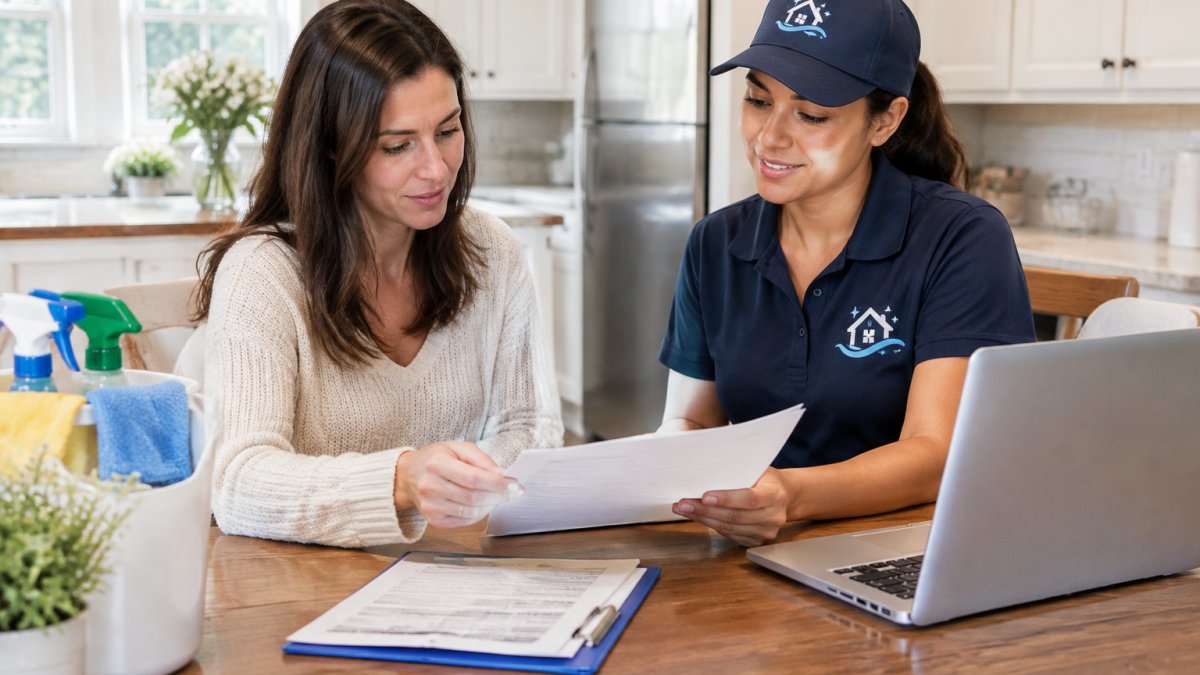
Ask for a certificate of insurance and confirm the policy is current. A legitimate company will share it without hesitation. If a provider dodges the question or says “we’re covered” without paperwork, that is your answer. For a deeper walkthrough of how vetting and insurance work, see our guide to background checked house cleaners.
Scope of Work: What a House Cleaner Checklist Should Cover
A written house cleaner checklist prevents disputes. General cleaning and deep cleaning are different jobs, and a one-time cleaning usually costs more per visit than recurring service. Ask exactly what is included, room by room.
Confirm these items in writing:
- Inside the oven and fridge (often extra)
- Baseboards, blinds, and ceiling fans
- Inside cabinets and closets
- Bed linen changes
- Pet hair removal on furniture and floors
Our standard house cleaning checklist breaks down what a professional reset actually includes so you can compare scopes line by line.
What Drives the Average Cost of House Cleaning Services
The average cost of house cleaning services depends on home size, condition, frequency, and add-ons, not on a single flat number. Most companies quote either a flat rate per visit or an hourly rate, and each model shifts the risk differently. Understanding that trade-off is the difference between comparing quotes intelligently and comparing them on price alone.
Flat Rate vs. Hourly: Who Carries the Risk
A flat-rate quote fixes your cost before the cleaner arrives. The company absorbs the risk if the job runs long, which is why flat rates usually include a defined scope and a walkthrough or square-footage estimate up front. An hourly quote shifts that risk to you: if the work takes longer than expected, the bill grows. Hourly pricing can be fair for one-time or unusually dirty jobs where scope is hard to predict, but it rewards slow work on recurring service.
Ask these pricing questions:
- Is the quote flat rate or hourly, and what scope does it assume?
- What happens if the job runs long, is there a cap or a change-order process?
- Are supplies and equipment included, or billed separately?
- Is there a fee for the first deep clean versus recurring visits?
- What is the cancellation and rescheduling policy, and is there a late-cancel fee?
- Is there a minimum visit charge or a travel fee?
What Actually Moves the Number
Four variables drive most of the price difference between quotes:
- Frequency. Recurring weekly or biweekly service usually costs less per visit than a one-time clean because the home stays maintained and each visit takes less time. A one-time or move-out clean typically carries a premium because it includes built-up soil, inside appliances, and detail work.
- Condition and clutter. A home that has not been professionally cleaned in a year takes longer than the same square footage cleaned two weeks ago. Clutter adds time because surfaces must be cleared before they can be cleaned.
- Add-ons. Inside the oven, inside the fridge, interior windows, baseboards, and laundry are commonly priced as extras. Confirm which add-ons are included in the base quote and which are billed separately.
- Home size and layout. Square footage matters, but so do the number of bathrooms, pets, and floors. Two homes of equal size can quote differently based on how many rooms require detail work.
Get the Quote in Writing
Ask for the quote in writing before the first visit, with the scope, frequency, and add-ons listed. A written quote is the document you compare against the next company’s quote line by line.
Watch out: an unusually low flat rate often signals a narrower scope than you assume, confirm what is excluded before you book, because add-on fees can erase the savings.
For a full breakdown of cost factors, read our 2026 pricing guide.
Four variables explain most of the price gap between cleaning quotes.
| Factor | Effect on price | Note |
|---|---|---|
| Frequency | Recurring weekly or biweekly costs less per visit | One-time or move-out clean carries a premium |
| Condition and clutter | Longer work time raises the quote | Clutter must be cleared before cleaning |
| Add-ons | Oven, fridge, interior windows, baseboards, laundry priced as extras | Confirm what is in the base quote |
| Home size and layout | Square footage, bathrooms, pets, and floors all matter | Equal-size homes can quote differently |
Supplies, Products, and Chemical Sensitivity
Ask who provides the cleaning supplies and equipment. Some companies bring everything; others expect you to stock the products. Ensuring these materials are safe for household pets is just as vital when booking upholstery cleaning to maintain a healthy environment for every member of your family.
Eco-friendly products handle everyday soil, pet hair, and odors well when applied correctly. If you want a non-toxic approach, our guide to chemical-free home cleaning services explains how it works in practice.
Home Access, Key Management, and Digital Security
This is where most guides stop, and where modern homeowners should start. Ask how the company handles keys, alarm codes, and smart-home access.
A written key management policy matters. Find out:
- Who holds the key, and whether it is coded
- Whether smart locks or lockboxes are supported
- How access codes are stored and destroyed
- What the policy is if a key is lost
Get the home access and key management process in writing. It is a simple question that reveals a lot about how seriously a company treats your security.
Hiring a Cleaner for the First Time: Consistency, Communication, and Tipping
When hiring a cleaner for the first time, the questions that matter most are the ones about what happens after the first visit: who shows up next time, how you reach the company, what happens when something is missed, and whether a tip is expected. These are the operational details that determine whether the relationship lasts.
Consistency of Staff
Ask whether you get the same professional housekeeper each visit and how the company handles a substitute. Consistency matters more than most people expect: the same cleaner learns your home, your preferences, and which surfaces need care. A company that rotates staff without notice may still clean well, but you will repeat instructions every visit.
Follow-up questions worth asking:
- Is the assigned cleaner an employee or a subcontractor?
- How much notice do you get if a substitute is sent?
- Are substitutes background-checked to the same standard?
- What is the turnover rate among the cleaning staff?
Communication Preferences
Set the communication channel before the first visit. Ask whether scheduling changes, feedback, and issue reports go through text, email, a company app, or phone calls. A company that only answers the phone during business hours may be hard to reach when you notice a problem the evening after a clean.
Confirm three things: how to report a missed area, how quickly you should expect a response, and who your point of contact is. A written service agreement should spell out scheduling, feedback, and service quality expectations.
Satisfaction Guarantees and Re-Cleans
Ask what the satisfaction guarantee actually covers and how fast a re-clean happens. Ask what the satisfaction guarantee covers and how fast a re-clean happens. Get the window and the reporting method in writing, because a guarantee with no deadline is hard to enforce.
Tipping Etiquette
Tipping is a common source of uncertainty and rarely addressed in hiring guides. Tipping practices vary by company. Ask the company directly whether tips are expected, whether they are pooled, and whether they can be added to the invoice. Confirming the policy up front means you are not guessing, and it tells you how the company treats its staff.
Pet and Security Protocols
If you have pets or a security system, ask how the cleaner handles both. Confirm whether pets should be secured, how alarm codes are managed, and what the policy is if an alarm is triggered. These details belong in the service agreement, not in a verbal aside.
Our buyer’s guide to hiring a cleaning service walks through the full vetting and booking process.
Request a Free Estimate from AlphaLux Cleaning
Screening a cleaner comes down to a few clear answers about insurance, vetting, scope, access, and communication. Ask the questions above, get the answers in writing, and you will know whether a company deserves your trust.
AlphaLux Cleaning is locally owned and operated, licensed and insured, and fully bonded, with a vetted team and eco-friendly products. We back every job with a 100% satisfaction guarantee or we re-clean. Get started with AlphaLux Cleaning and request your free estimate today.
Frequently Asked Questions
What should I ask a house cleaner before hiring them?
Start with insurance and bonding, then ask how employees are vetted through background checks. Ask for a written house cleaner checklist so you know exactly what each visit includes, and confirm whether supplies and equipment come from the company or from you. Get the pricing model in writing, whether flat rate or hourly rate, along with the cancellation policy and satisfaction guarantee. Finally, ask how they handle home access, key management, and who your point of contact will be for scheduling changes.
Are house cleaners required to be bonded and insured?
Liability insurance covers accidental damage to your home, and bonding protects you if something goes missing. Worker compensation matters too, because if an uninsured cleaner is injured in your home, the cost can fall on you. Ask for a certificate of insurance and confirm the policy is current before the first visit.
Should I provide my own cleaning supplies?
It depends on your priorities. Company-supplied products mean the team arrives ready and uses proven equipment, but you may not control what chemicals touch your surfaces. If anyone in the home has asthma, allergies, or chemical sensitivity, ask specifically which cleaning products are used and whether fragrance-free or eco-friendly options are available. AlphaLux Cleaning uses eco-friendly products.
What is the difference between an independent cleaner and a cleaning service?
An independent cleaner is typically self-employed and may not carry liability insurance, a bond, or worker compensation. A cleaning service employs a vetted team, carries coverage, and can send a replacement if your regular cleaner is sick or on vacation. The tradeoff is usually price versus protection. For first-time buyers especially, a licensed and insured company removes the risk of an injury or damage claim landing on your homeowners policy.
The best time to ask hard questions is before the first cleaning, not after. Reach out to AlphaLux Cleaning for a free estimate and a personalized cleaning plan built around your home, your schedule, and your pets.