A vague cleaning agreement leads to missed tasks, finger-pointing, and spaces that never quite look right. An office cleaning scope of work fixes that by spelling out exactly what gets cleaned, how often, and to what standard, so both the client and the cleaning provider are on the same page from day one. Without one, you’re guessing. With one, you’re holding everyone accountable.
At AlphaLux Cleaning, we build detailed scopes of work into every commercial cleaning contract we handle across New York State. It’s how we keep our service consistent and our clients confident that nothing falls through the cracks. That hands-on experience with commercial cleaning agreements has taught us what belongs in a scope of work, and what’s often missing from the ones we see.
This article breaks down the key components of a solid office cleaning scope of work, including ready-to-use templates, task checklists, and service standards you can adapt for your own contracts. Whether you’re a facility manager drafting an RFP or a business owner vetting cleaning proposals, you’ll walk away with a clear framework to define expectations and protect your investment.
Why an office cleaning scope of work matters
When you hire a cleaning service without a written scope, you rely entirely on assumptions. You assume the cleaner knows to sanitize door handles and wipe down light switches. They assume you only want the restrooms and break room addressed. Those gaps compound quietly over weeks, and by month two you’re paying for a service that doesn’t actually match what your office needs. A well-written office cleaning scope of work closes those gaps before the first mop hits the floor.
It protects both sides of the agreement
A scope of work gives you a concrete reference point when something goes wrong. If a cleaning crew skips the conference room two weeks in a row, you can point directly to the document that says conference rooms are cleaned on every scheduled visit. On the other side, it also protects the cleaning provider from unfair claims. If you say the baseboards were never dusted, the provider can reference the contract and show you that baseboard dusting is listed as a monthly task, not a weekly one. Both sides operate with clear, documented boundaries instead of memory and guesswork. Without that document, disputes become he-said-she-said conversations that almost never resolve cleanly, no matter how long the relationship has been in place.
A scope of work isn’t just a task list. It’s the foundation of a professional relationship built on shared, written expectations.
It keeps cleaning quality consistent over time
Cleaning crews change. Staff turn over, call in sick, or get reassigned to other accounts. Without a detailed written scope, a new cleaner walking into your office for the first time has no reliable guide to follow. They’ll do what they personally consider thorough, which may not align with the standards your business actually requires. A well-built scope acts as both a training reference and a quality benchmark, keeping service levels stable regardless of who shows up on any given day.
Consistency also matters for regulatory compliance. If your business operates in a sector like healthcare, food service, or legal services, you may need to demonstrate that specific areas are cleaned on a documented, repeatable schedule. A scope of work delivers that paper trail without adding extra administrative burden to your team.
What to include in an office cleaning scope of work
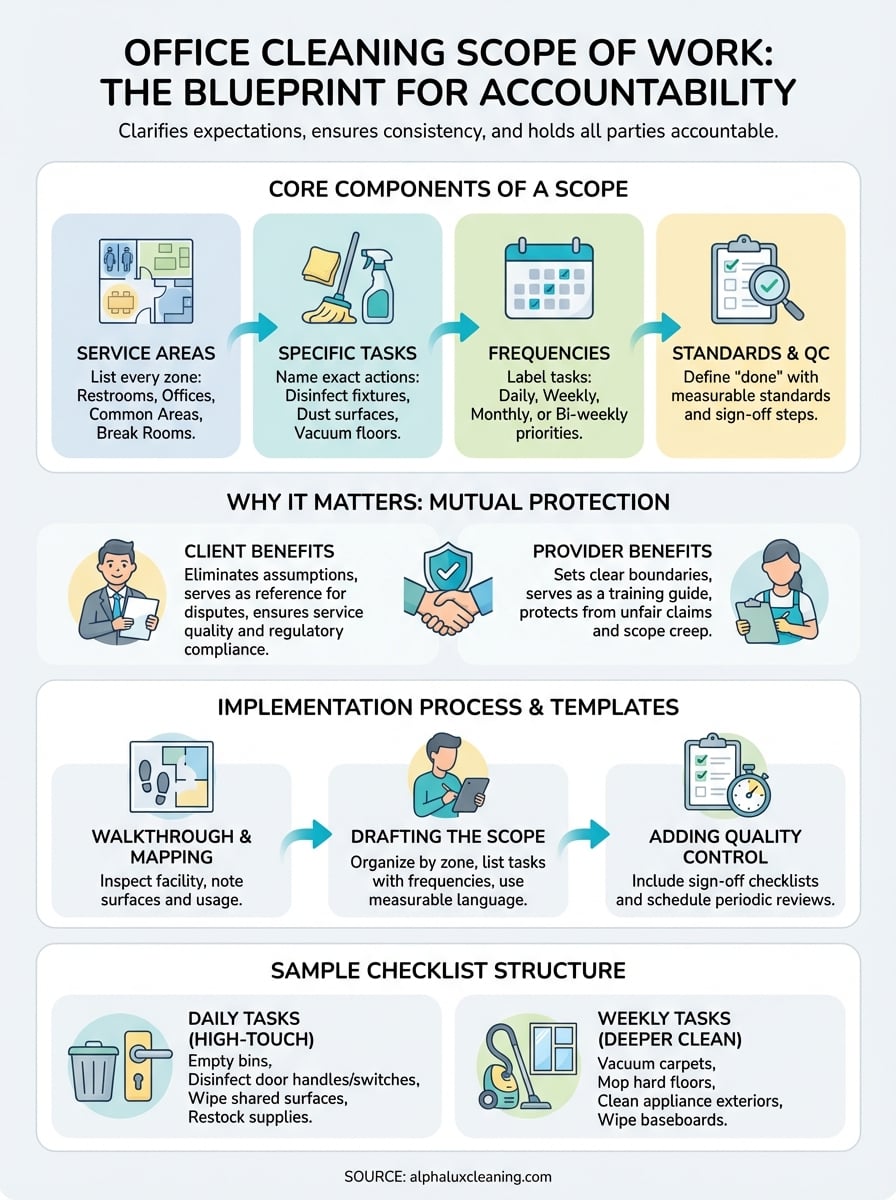
A complete office cleaning scope of work covers four core elements: the areas being serviced, the specific tasks required in each area, how often each task gets done, and the standard that defines a finished job. Leave any of those out, and you invite the kind of vague expectations that lead to inconsistent results.
Service areas and specific tasks
List every zone in your facility separately: restrooms, private offices, open workspaces, conference rooms, break rooms, lobbies, and hallways. Under each zone, name the exact tasks. For restrooms: disinfect fixtures, restock supplies, mop floors. For workspaces: dust surfaces, empty bins, and vacuum. Specific task names eliminate guesswork about what the cleaning crew is responsible for on each visit.
- Restrooms: disinfect fixtures, restock supplies, mop floors
- Break rooms: wipe appliances, clean sinks, sanitize tables
- Offices and workspaces: dust, vacuum, empty trash
- Common areas: spot-clean glass, wipe high-touch surfaces
Frequencies, access details, and special requirements
Task frequency separates a professional scope from a rough checklist. Label each task as daily, weekly, or monthly so the crew knows exactly what to prioritize on every visit. Your scope should also include access instructions, such as entry codes, check-in procedures, and any restricted areas that require approval before cleaning.
Note any special product requirements here too. If your office serves clients with chemical sensitivities, document fragrance-free or allergen-safe product requirements directly in the scope. Capturing these details upfront keeps both sides aligned without the need for mid-contract clarifications.
A detailed scope prevents most disagreements before they start.
How to write an office cleaning scope of work
Writing a strong office cleaning scope of work starts with a physical walkthrough of your facility before you draft a single line. Walk every room yourself and note what surfaces exist, how each space gets used, and how quickly it gets dirty. An open workspace with 30 employees needs a different task list than a private office used twice a week. Your observations during that walkthrough drive every decision that follows.
Start with a room-by-room task list
Once you’ve completed your walkthrough, organize the document by zone rather than by task type. List each room at the top, then write out every specific task required underneath it. This structure makes the document easier to use during actual cleaning because the crew moves through the building room by room rather than trying to remember what surfaces qualify for which task. Assign a clear frequency label to every item: daily, weekly, bi-weekly, or monthly.
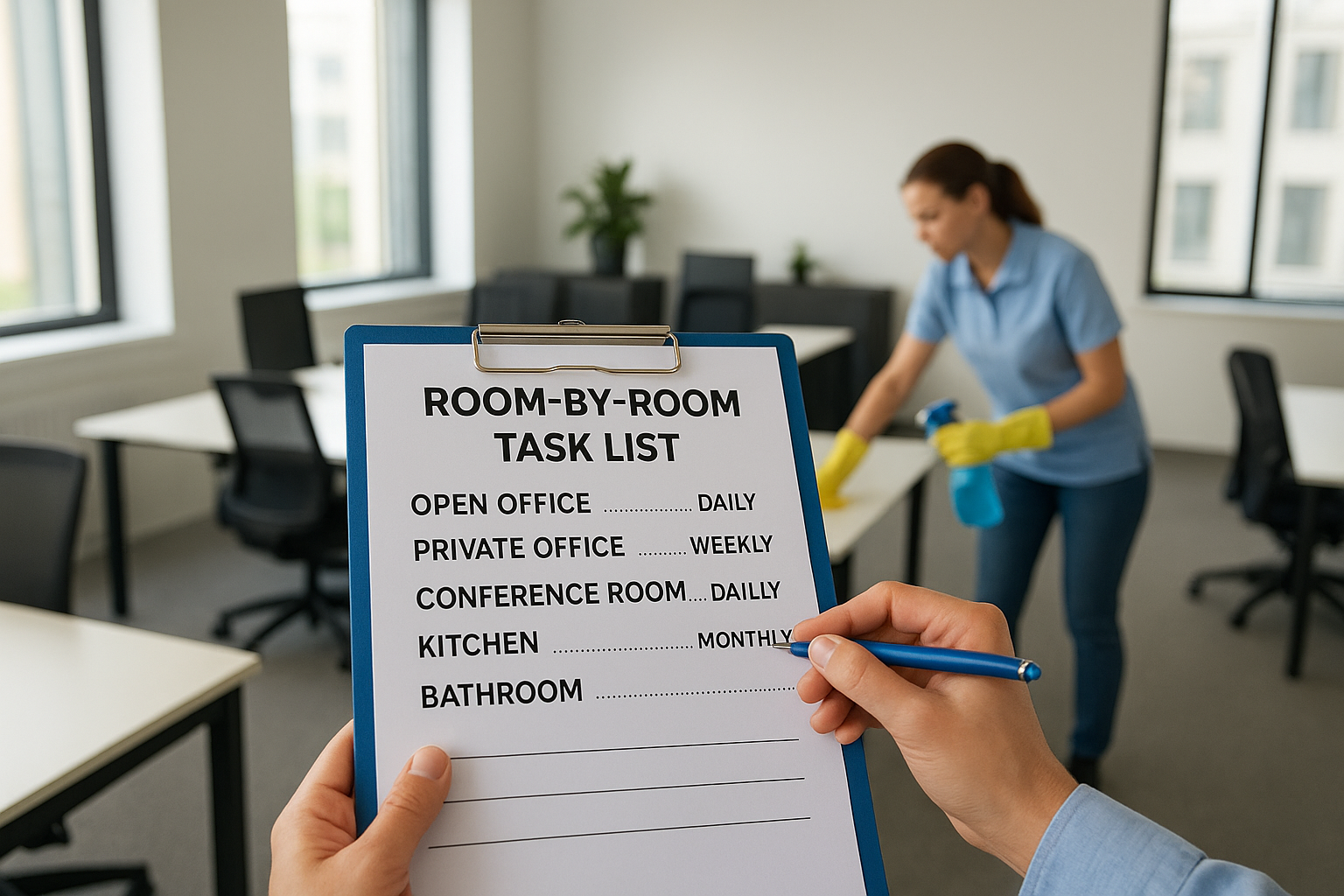
A scope built around how your building actually functions will hold up far better than one copied from a generic template.
Add measurable standards and sign-off steps
Vague language creates wiggle room that no one benefits from. Instead of writing "clean restrooms," write "disinfect all fixtures, restock paper products, mop floors with a disinfectant solution." That level of detail gives your cleaning provider a clear finish line and gives you a concrete measure to inspect against. Include a sign-off or verification step at the end of each visit, such as a checklist the crew completes on-site, so accountability is built directly into the process.
Office cleaning scope of work templates and checklists
Starting from a blank document is harder than it sounds, especially when you’re under pressure to finalize a contract quickly. A ready-made template gives you a reliable starting structure that you can adjust to match your facility’s actual layout and service needs. The key is to treat any template as a starting point, not a finished product. Every office is different, and your scope of work should reflect that.
A template saves you time on structure so you can spend more energy on the details that actually matter for your building.
A basic template structure
A solid office cleaning scope of work template opens with general information: facility name, address, service start date, and the name of the cleaning provider. Below that, you list each service zone with its associated tasks and frequencies. Here’s a simple framework you can build from:
- Facility details: name, address, total square footage, number of floors
- Service zones: restrooms, offices, conference rooms, break rooms, lobbies
- Task list per zone: specific cleaning actions assigned to each area
- Frequency column: daily, weekly, bi-weekly, or monthly next to each task
- Special requirements: product restrictions, restricted access areas, security protocols
A sample daily and weekly checklist
Your checklist should split tasks by how often they need to happen. Daily tasks typically cover high-touch, high-traffic items: emptying trash bins, disinfecting door handles and light switches, wiping shared surfaces, and restocking restroom supplies. Weekly tasks go deeper: vacuuming carpets, mopping hard floors, cleaning appliance exteriors in break rooms, and wiping down baseboards and window sills. Separating the two layers keeps your crew focused and prevents lower-priority tasks from crowding out the urgent ones.
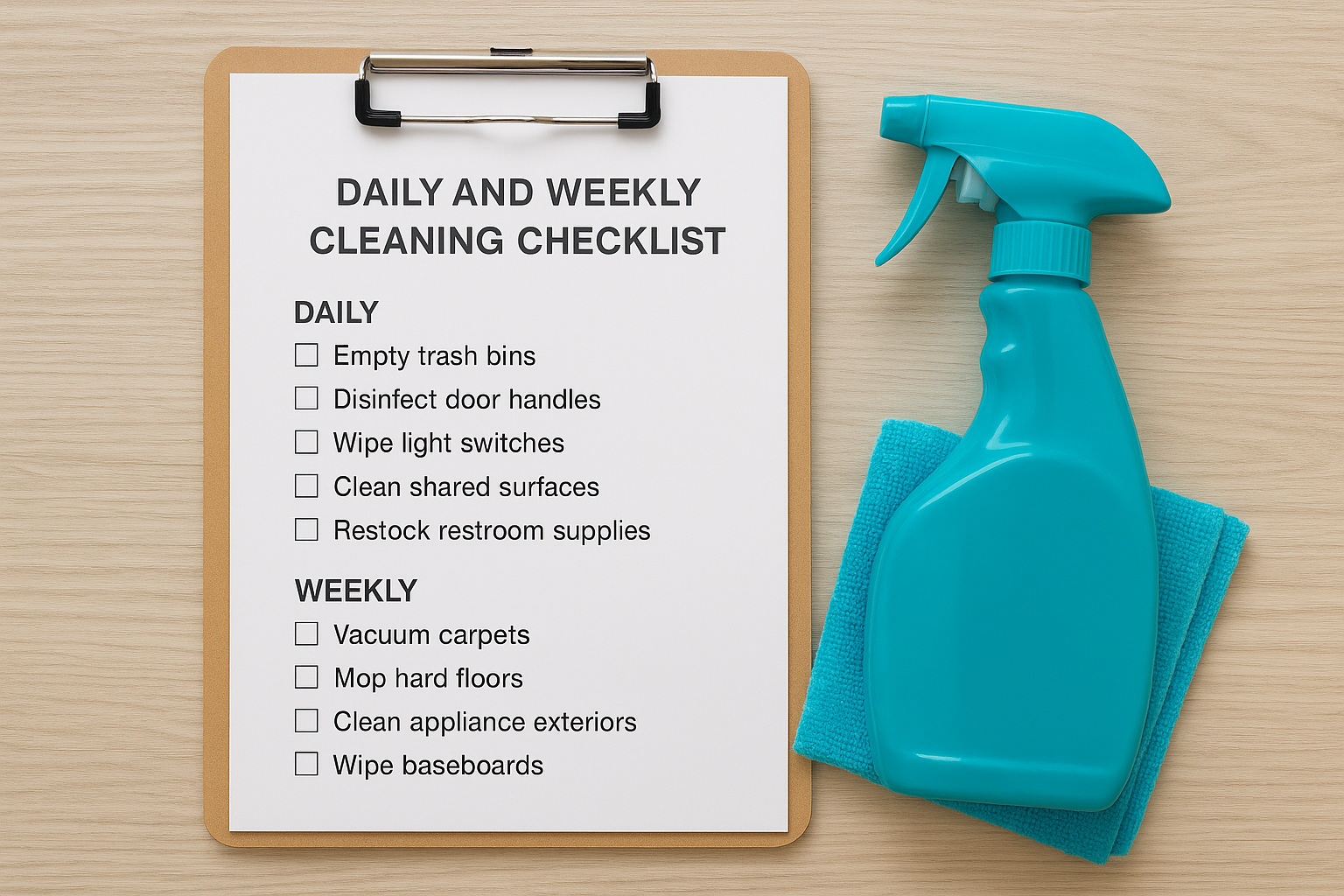
Putting both layers on the same document, side by side, lets facility managers review service coverage at a glance and spot any gaps before they sign the contract.
Standards, frequencies, and quality control
Your office cleaning scope of work only holds up long-term if it includes measurable standards and a quality control process. Without both, you’re left hoping the work meets your expectations rather than verifying it does. Standards define what "done" looks like, and a quality control process confirms that definition is being met on every scheduled visit.
Define measurable cleaning standards
Measurable standards replace subjective language with specific, verifiable outcomes. Instead of writing "clean the break room," write "wipe all countertops with a food-safe disinfectant, clean the microwave interior and exterior, and empty the trash." That level of detail gives your cleaning crew a clear finish line and gives you an objective measure to inspect against when you review the work. Tie every standard directly to its frequency: daily disinfection of door handles, weekly mopping with a diluted cleaning solution, and monthly deep cleaning of vents and ceiling fixtures.
Specific language in your standards section prevents almost every performance dispute before it starts.
Build in quality control checks
Quality control steps keep your written standards from becoming decoration on paper. Include a sign-off checklist that the cleaning crew completes at the end of every visit, confirming which tasks were finished and by whom. Schedule periodic walkthroughs with your cleaning provider, at least once a month, to compare actual results against the written standards in your contract. When you spot a gap during those reviews, update the scope right away rather than waiting for the same problem to show up again.
Wrap-up and next steps
A well-built office cleaning scope of work removes the guesswork from every cleaning contract you sign. It defines exactly which areas get cleaned, lists the specific tasks required in each zone, assigns a clear frequency to every item, and gives you measurable standards to verify the work against. When you put all of that in writing before the service starts, you protect your budget and your workspace at the same time.
Your next step is to take the structure from this article and apply it to your own facility. Walk your building, map your zones, and write out your task list before you finalize any agreement. If you want a professional cleaning team that already works from detailed scopes on every job, request a free estimate from AlphaLux Cleaning and see what a documented, accountable cleaning plan looks like in practice.