
Summary:
You run a business. Your time is already spoken for. The last thing you want to spend mental energy on is whether your cleaning company actually showed up — or whether they cleaned the right things when they did. A lot of Long Island business owners hire a cleaning service without realizing there’s a meaningful difference between someone who cleans homes and someone equipped to properly maintain a commercial space. That gap matters more than most people think. This page is here to clear it up so you can make a smarter decision — and stop dealing with the frustration of a cleaning situation that never quite works.
What Commercial Cleaning Actually Means — and What It Doesn't
Commercial cleaning is not just house cleaning done in a bigger space. The equipment is different, the products are different, the protocols are different, and the service model is built around how businesses operate — not how households do.
A residential cleaning service is designed for living spaces. They work on a fixed schedule, use residential-grade products, and clean around your furniture. That works fine for a home. It doesn’t work well for a medical office in Baldwin where cross-contamination is a real concern, or a retail space on Jericho Turnpike in Commack where foot traffic leaves the floors looking rough by Wednesday.
We build our commercial cleaning service around the reality of running a business — variable schedules, industry-specific requirements, higher-traffic surfaces, and a level of consistency that a home cleaning model simply isn’t designed to deliver. Whether you’re operating in Amityville, Bay Shore, Babylon, or anywhere else on Long Island, the fundamentals stay the same: your space needs to be cleaned to commercial standards, not residential ones.
What Does Commercial Cleaning Include That Standard Cleaning Doesn't?
The scope difference is significant, and it starts with the details most standard cleaning services skip entirely. High-touch surface disinfection — door handles, light switches, shared equipment — is a baseline in our commercial cleaning work, not an add-on. Restroom sanitation in a business setting means something different than in a home. Grout lines, dispensers, fixtures, and odor control are part of the job, not afterthoughts.
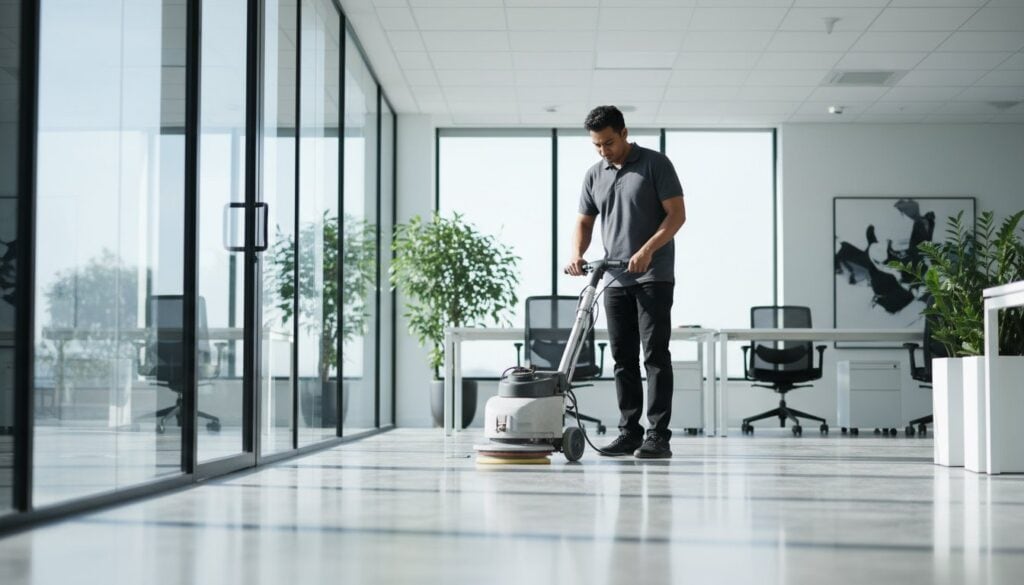
Floor care is another area where the gap shows up fast. Long Island winters are rough on commercial floors. Salt and sand get tracked in from parking lots and sidewalks across every community from Amityville to Medford, and that grit does real damage to tile, hardwood, and luxury vinyl plank over time. We account for this with appropriate equipment and techniques. A mop-and-bucket approach doesn’t cut it.
Breakrooms, conference rooms, lobbies, and shared workspaces each have their own cleaning requirements — and we address them specifically, not generically. When we build a cleaning plan for a business, we start by understanding the actual space: how many people use it, what surfaces need what treatment, and what your schedule actually looks like. That’s not something a standard residential cleaning service is set up to do.
There’s also the matter of products. We use non-toxic, eco-conscious cleaning products across all our commercial work — not because it sounds good on paper, but because the people in your building are breathing that air and touching those surfaces all day. Harsh chemical residues on a conference table or a reception desk aren’t a neutral choice. For medical offices, businesses with allergy-sensitive staff, or any customer-facing space, the product question matters.
Janitorial Service vs. Commercial Cleaning — Is There a Difference?
Yes, and it’s worth understanding before you sign anything. Janitorial service typically refers to ongoing, scheduled maintenance — the recurring work that keeps a facility clean day to day. Trash removal, restroom sanitation, surface wiping, vacuuming — that’s janitorial territory. It’s the steady drumbeat that keeps your space functional between deeper cleans.
Commercial cleaning is a broader term that includes janitorial work but also covers project-based services: post-construction cleanup after a renovation, deep cleaning before a big client visit, move-in or move-out cleaning when a commercial tenant changes, carpet and hard floor restoration, and specialized work in medical or industrial environments.
Most businesses need both — a consistent janitorial program running in the background and periodic commercial cleaning for the heavier work. The mistake we see often is businesses hiring a janitorial service and expecting commercial-cleaning-level results, or hiring a one-time deep clean service and wondering why the space doesn’t stay that way.
Bay Shore’s downtown has seen significant commercial growth in recent years, and with that comes a lot of businesses moving into newly renovated spaces. Post-construction cleaning is a specific discipline — drywall dust, adhesive residue, and construction debris require different tools and techniques than routine maintenance. Similarly, a medical practice opening near Southside Hospital in Bay Shore needs to establish a cleaning protocol from day one that meets healthcare-grade sanitization standards, not a residential-adjacent approach that gets adjusted later.
Understanding the distinction between janitorial and commercial cleaning helps you ask better questions when you’re evaluating providers — and it helps you avoid paying for one when you actually need the other.

What Long Island Business Owners Should Actually Look for in a Commercial Cleaning Company
The commercial cleaning market on Long Island is crowded. You’ve got national franchises, regional operators, and local independents all competing for the same clients. The range in quality, reliability, and accountability is enormous.
The decision isn’t just about price. It’s about what happens when something goes wrong — and what the day-to-day relationship actually looks like after the first few weeks. Here’s what matters most, and why each piece is worth asking about before you commit.
Is the Cleaning Company Fully Insured — and Can They Prove It?
This is the question most business owners don’t ask until something goes wrong. A cleaning crew is in your facility, often after hours, with access to your equipment, your files, and your space. If something is damaged, if a cleaner is injured on your property, or if something goes missing — who’s responsible?
A legitimate commercial cleaning company carries general liability insurance and workers’ compensation. General liability covers property damage. Workers’ comp covers injuries. Without both, the exposure lands on you.
We’re fully insured, and we’ll hand you a Certificate of Insurance before you sign anything. That shouldn’t be a special request — it should be standard practice. Every business owner in Babylon, Glen Cove, Bayport, or anywhere else on Long Island deserves to know that before a crew sets foot in their building.
Background checks are the other piece of this. Commercial cleaning crews access your space when you’re not there. For a dental office in Baldwin, a law firm in Commack, or a financial services business in Medford, that after-hours access is a real security consideration. We background-check every cleaner on our team — not as a formality, but because it’s the responsible way to run this kind of operation.
If a cleaning company you’re considering can’t quickly confirm both of these things, that’s your answer.
Why Consistency and Customization Matter More Than a Low Quote
The most common complaint we hear from businesses switching cleaning companies isn’t about price — it’s about reliability. The crew stopped showing up on time. The quality was great for the first month and then faded. They kept sending different people who didn’t know the space. These aren’t minor inconveniences. They’re the reason cleaning becomes a management burden instead of something that just works.
Consistency starts with the same crew servicing your facility regularly. When the same people clean your space week after week, they learn it. They know which areas take the most traffic, which surfaces need extra attention, and what your priorities are. You stop re-explaining things. The relationship becomes invisible in the best possible way.
Customization matters because no two Long Island businesses are the same. A small professional practice in Bayport has different needs than a high-traffic retail space in Bay Shore’s revitalized downtown corridor. A medical office near the Northwell Health ecosystem in Nassau County has sanitization requirements that a warehouse in Medford simply doesn’t. Forcing both into the same cleaning package is how things get missed.
When we take on a new commercial client, we build the plan around the actual space — the industry, the foot traffic, the schedule, and the specific surfaces involved. If your business operates across multiple Long Island locations, we can coordinate that too. The schedule works around your hours, not ours. And the scope of work is written down, agreed on, and doesn’t change without a conversation.
New York’s minimum wage is hitting $17.00 per hour in 2026, which has made the math on in-house cleaning staff increasingly unfavorable for a lot of small and mid-size businesses. Between wages, workers’ comp, supplies, equipment, and the time it takes to manage someone in that role, outsourcing to a professional commercial cleaning company is often the more cost-effective choice — especially when you factor in what consistent, quality cleaning actually costs when it’s done right.
Choosing the Right Commercial Cleaning Service on Long Island
The difference between commercial cleaning and standard cleaning isn’t a technicality — it’s the difference between a space that actually stays clean and one that just looks clean until it doesn’t. For businesses across Long Island, from Amityville’s Broadway corridor to Commack’s professional office hubs to the growing commercial districts in Bay Shore and Glen Cove, the stakes are real. Your clients notice. Your employees notice. And eventually, you notice the cost of getting it wrong.
What you’re looking for is a cleaning company that shows up every time, knows your space, uses products that are safe for the people in it, and handles the details without you having to manage them. That’s not a high bar — it just requires hiring the right kind of company for the job.
If you’re ready to stop thinking about your cleaning situation and just have it handled, reach out to us. We’ll take a look at your space, talk through what you actually need, and build something that works.