
Summary:
Before a client hears your pitch, reads your proposal, or shakes your hand, they’ve already made a judgment call. The lobby. The conference room. The restroom down the hall. Every surface in your office is telling a story about how you run your business — and you don’t always get to control the narrative.
On Long Island, where the competition is real and the professional standards are high, a clean office isn’t a luxury. It’s part of how you show up. This page covers what professional office cleaning actually looks like, what separates a reliable service from a frustrating one, and what Long Island business owners specifically should know before making a decision.
What Professional Office Cleaning Actually Covers
There’s a version of office cleaning that means someone vacuums the carpet and empties the trash. And then there’s the version that actually makes a difference — the kind that covers high-touch surfaces, restroom sanitation, floor care, break room deep-cleaning, and the corners that always get skipped.
Professional office cleaning is systematic. It works from a plan built around your space, your schedule, and the specific demands of your environment. A law firm in Garden City has different needs than a medical suite in Melville. A small professional office in Huntington runs differently than a multi-floor corporate space near the Route 110 corridor. The cleaning plan should reflect that — not a generic checklist pulled from a template.
What Does a Commercial Office Cleaning Service Include?
At the daily level, professional office cleaning covers the things that accumulate fast — vacuuming, dusting surfaces, wiping down desks and counters, sanitizing restrooms, removing trash, and cleaning the kitchen or break room. These aren’t glamorous tasks, but when they’re done consistently and done right, the difference is immediately noticeable.
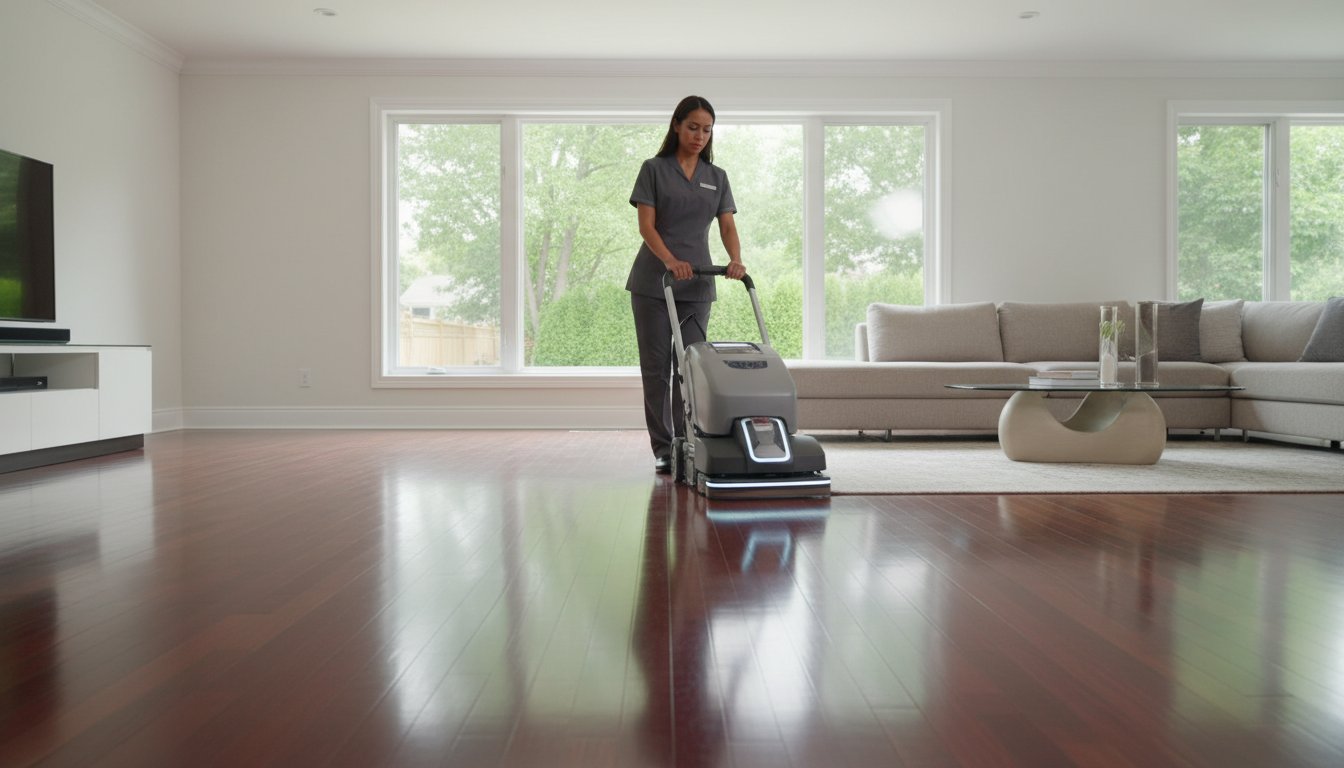
Beyond the daily routine, a thorough cleaning program includes floor maintenance — mopping, polishing, or treating floors based on the material — along with deep restroom disinfection, conference room resets, and attention to high-touch surfaces like door handles, light switches, elevator buttons, and shared equipment. These are the surfaces where viruses and bacteria can survive for extended periods, which is why regular disinfection isn’t just about appearances. It directly affects how often your team gets sick, and by extension, how often they’re not at their desks.
Periodically, a complete commercial cleaning plan also includes tasks like baseboard cleaning, vent dusting, window sill wiping, and deep kitchen scrubs. These are the things that don’t need to happen every week but absolutely need to happen — and tend to get skipped entirely when there’s no formal plan in place.
What makes the difference between a cleaning that feels thorough and one that just looks like something happened? Documentation, training, and accountability. A well-run cleaning service works from a defined scope, trains its team to that standard, and has a process for catching anything that gets missed. That’s the gap between a professional janitorial service and someone who shows up with a mop.
For Long Island offices specifically, there are a few environmental factors worth noting. The salt air along the South Shore and the North Fork accelerates surface soiling and can affect entryways, windows, and HVAC vents faster than you’d expect. Pollen season in the spring hits hard across Nassau and Suffolk counties, and during the colder months — October through March — the enclosed office environment becomes a much more efficient vehicle for spreading illness. A cleaning schedule that accounts for these seasonal realities isn’t overthinking it. It’s just smart.
How Often Should an Office Be Professionally Cleaned?
The honest answer is: it depends on how many people are using the space and what kind of work happens there. A solo practitioner working out of a small Nassau County office has very different cleaning needs than a 40-person firm in Hauppauge or a healthcare practice in Mineola. Frequency should match reality, not a default schedule.
For most professional offices with regular foot traffic, weekly or bi-weekly cleaning covers the baseline. High-traffic environments — reception areas, shared conference rooms, restrooms, and break rooms — may need attention more frequently even if the rest of the space is cleaned on a standard schedule. Medical offices and healthcare-adjacent environments typically require daily cleaning to meet the sanitation standards those spaces demand.
The mistake most businesses make is setting a cleaning frequency based on what seems reasonable and never revisiting it. If your office has grown, if your team has expanded, or if your client-facing spaces are getting more use, the cleaning schedule should reflect that. A plan that made sense two years ago might be leaving gaps today.
One thing worth addressing directly: having employees handle light cleaning is not a reasonable alternative to a professional service. It’s not just that the results are different. A $30-an-hour employee spending two hours cleaning is $60 in lost productivity — and the cleaning still isn’t done to a professional standard. The math doesn’t work, and more importantly, it’s not what your team was hired to do. People notice when they’re asked to clean the bathroom. It affects morale in ways that are hard to quantify but easy to feel.
The right cleaning frequency is one that keeps your space looking and functioning at the level your clients and your team expect. That’s the standard worth aiming for — not the minimum you can get away with.

How to Choose a Reliable Office Cleaning Company on Long Island
The commercial cleaning industry has a well-documented problem with consistency. Industry data suggests that cleaning companies lose more than half their clients every year — mostly because the quality that showed up in the first few weeks didn’t stick around. For business owners on Long Island, that track record is a reason to ask harder questions upfront. Not just “how much does it cost” but “how do you handle it when something gets missed” and “who exactly is coming into my office.” The answers to those questions tell you more than any sales pitch.
What Should You Look for in a Long Island Commercial Cleaning Service?
Insurance and bonding are the starting point, not a differentiator. Any cleaning company operating on Long Island should carry general liability insurance, workers’ compensation, and property damage protection. If a company can’t confirm this quickly and clearly, that’s your answer.
Background checks on every team member matter more than most people realize. Commercial cleaning happens after hours, in spaces where confidential documents, equipment, and client information are sitting out. You’re not just hiring a cleaning service — you’re granting access. The people entering your office should be vetted, trained, and accountable to someone. That’s not an unreasonable expectation; it’s the baseline for a professional service relationship.
Beyond the credentials, pay attention to how a company handles pricing and communication. Vague quotes, delayed responses, and contracts with no clear exit terms are all warning signs. A cleaning company that’s confident in its work will give you transparent pricing based on your actual square footage and service needs, respond to questions promptly, and be straightforward about what’s included and what isn’t. The companies that hedge on these things are usually the ones where the quality hedges too.
Customization is another factor that separates a good fit from a frustrating one. Long Island businesses operate across a wide range of industries and environments — corporate offices in Garden City, industrial spaces in the Hauppauge business park, medical practices throughout Nassau and Suffolk counties, professional service firms along the Route 110 corridor in Melville. A cleaning plan that works for one of these spaces won’t necessarily work for another. You want a company that asks questions about your specific situation rather than slotting you into a package that was designed for someone else.
Finally, consider what products are being used in your space. Harsh industrial chemicals leave odors that linger well into the workday, and for employees with allergies or sensitivities — which is not an uncommon situation in a shared office environment — those chemicals can cause real discomfort. Non-toxic, eco-friendly cleaning solutions have come a long way. They clean effectively without the chemical smell, and they’re a meaningful consideration for any employer who takes workplace wellness seriously.

FAQs About Office Cleaning Services in Long Island, NY
**How much does office cleaning cost on Long Island?**
Pricing varies based on the size of your space, how frequently you need service, and what the scope of cleaning includes. On Long Island, where operating costs are generally higher than in other parts of the state, you should expect pricing to reflect that reality. We base our quotes on square footage, frequency, and your specific service requirements, so there are no surprises — you know the number before you commit, not after the first invoice arrives.
**Can office cleaning be scheduled after hours or on weekends?**
Yes, and for most Long Island businesses, that’s exactly how it should work. Anyone who’s sat on the LIE during a Tuesday afternoon knows that Long Island schedules are rarely simple. We clean before you arrive, after you leave, or on weekends — whatever keeps your operation running without a cleaning crew in the background during your workday. Flexibility here isn’t a bonus feature; it’s how a professional cleaning service should operate.
**Are the cleaning products safe for my employees?**
We use non-toxic, eco-friendly cleaning solutions across all of our services. No harsh chemical odors, no residues that irritate eyes or airways, nothing that requires your team to air out the office before they can work in it. For offices in medical or wellness-adjacent environments — and there are a lot of them across Nassau and Suffolk counties — this matters even more.
**What’s the difference between office cleaning and janitorial services?**
In practice, the terms overlap significantly. Janitorial services typically refer to ongoing, scheduled maintenance — the recurring work that keeps a space functional day to day. Office cleaning can refer to the same recurring service or to one-time and periodic deep cleans. What matters more than the label is the scope: what’s included, how often, and who’s accountable for making sure it actually gets done.
**How do I know the quality will stay consistent over time?**
This is the right question to ask, and the fact that most people don’t ask it is part of why the industry has such a high client turnover rate. The answer comes down to whether a company has documented standards, trained staff, and a real process for catching missed work. We vet and train every cleaner on our team, work from a defined scope for each client, and stand behind the work we do. If something isn’t right, we want to know about it — and we’ll fix it.
Finding the Right Office Cleaning Service in Long Island, NY
Your office is one of the clearest signals your business sends to the outside world. Clients notice it. Employees feel it. Job candidates factor it in, even if they never say so out loud. A clean, well-maintained workspace communicates that you pay attention — and that kind of detail carries weight in a market as competitive and professional as Long Island.
The right cleaning service isn’t the cheapest one or the one with the flashiest website. It’s the one that shows up consistently, works to the standard your space actually requires, and makes the whole thing easy enough that you stop thinking about it. That’s what good office cleaning is supposed to feel like.
If you’re ready to stop settling for inconsistent results, we serve businesses across Long Island — from Nassau County to Suffolk County and beyond. Reach out to get a transparent quote built around your specific space and schedule.