What if the most productive part of your day didn’t happen at your desk, but at your kitchen sink? Most homeowners feel a mounting sense of overwhelm when they look at the grease on the range hood or the crumbs hiding in the pantry. It’s common to feel a deep sense of anxiety over hidden bacteria or confusion about which products are truly safe for your surfaces. Learning how to deep clean a kitchen is about more than just aesthetics; it’s about reclaiming your mental clarity and physical health.
You deserve a space that feels as restorative as it looks. This guide will teach you exactly how to achieve a professional-grade restoration using a systematic, top-to-bottom approach. We’ll walk through a meticulous process that covers everything from sanitizing hidden surfaces to choosing effective, safe products for a pristine finish. By the end, you’ll have a repeatable system that transforms your kitchen into a sanctuary of health and quiet satisfaction. Whether you’re preparing for a special event or simply seeking a fresh start, this professional perspective will help you manage the complex details with ease.
Key Takeaways
- Learn the professional logic behind the gravity-led, top-to-bottom methodology that ensures debris never settles on already sanitized surfaces.
- Discover exactly how to deep clean a kitchen by mastering the “Empty Cabinet” rule and using meticulous hardware polishing for a showroom finish.
- Understand the vital connection between internal appliance detailing and energy efficiency to protect your high-end kitchen investments.
- Implement a sustainable five-minute nightly reset to preserve your professional results and maintain a sense of calm in your home’s most active space.
- Transform your approach to maintenance by adopting a professional mindset that values precision, health, and the quiet satisfaction of a pristine environment.
Preparing for a Professional-Grade Deep Clean
A kitchen is more than a collection of appliances; it’s the sanctuary where your family gathers and where health begins. When you decide to learn how to deep clean a kitchen, you’re choosing to invest in your home’s longevity and your own mental clarity. Approaching this task with a professional mindset means viewing the process of cleaning as a craft of restoration rather than a chore. Before touching a single sponge, you must decide on your scope. A whole-kitchen deep clean is a comprehensive commitment, while zone cleaning allows you to focus on specific high-traffic areas like the pantry or the oven. Both methods provide relief, but setting a realistic goal prevents the mid-process fatigue that often leads to unfinished tasks.
The AlphaLux Eco-Friendly Supply List
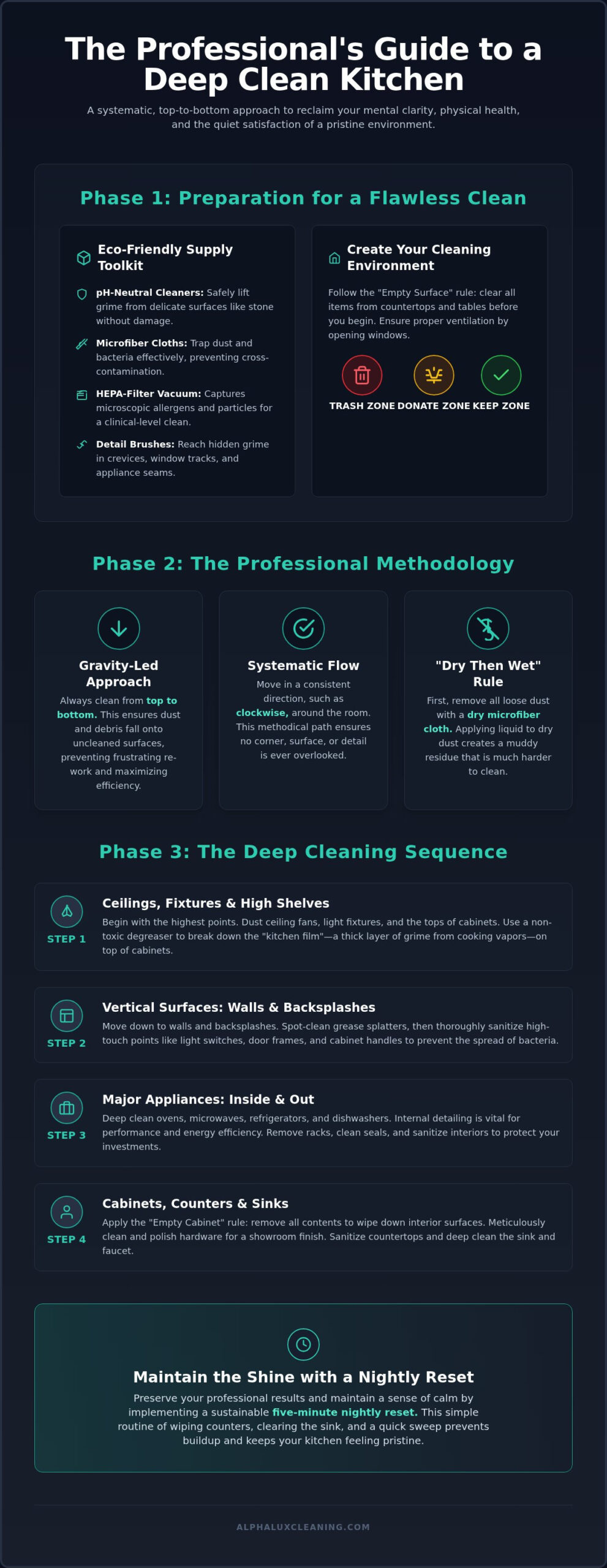
We prioritize the health of our clients by selecting non-toxic, eco-friendly supplies that deliver professional results without harsh fumes. Our toolkit is built on the foundation of precision and safety. We utilize pH-neutral cleaners that protect delicate stone surfaces while effectively lifting grime. High-quality microfiber cloths are essential; they trap dust and bacteria far better than paper towels and prevent cross-contamination between food prep areas and sinks. To achieve a truly clinical level of clean, we rely on HEPA-filter vacuums to capture microscopic particles and specialized detail brushes to reach the grime hiding in window tracks and appliance crevices.
Creating Your Cleaning Environment
Success in deep cleaning depends heavily on your physical setup. Professionals follow the “empty surface” rule, which requires clearing every item from your countertops and tables before you begin. This allows you to see the true state of your surfaces and ensures no spot is missed. Proper ventilation is a safety basic; open your windows to ensure a steady flow of fresh air. We also recommend establishing a staging area with three distinct zones:
- Trash: For items that have expired or are no longer functional.
- Donate: For gadgets and dishes that are in good condition but no longer serve your lifestyle.
- Keep: For the essentials that will be returned to their sanitized homes.
This organized approach reduces the mental burden of decision-making during the physical labor of the clean. It transforms a chaotic environment into a structured workspace where you can focus on the meticulous restoration of your home. By organizing your space first, you create the mental peace necessary to execute a thorough, professional-grade result.
The Top-to-Bottom Methodology: A Systematic Approach
Mastering how to deep clean a kitchen requires a shift in strategy. Professional cleaners don’t just scrub; they follow a systematic flow that maximizes efficiency and ensures a clinical level of hygiene. This starts with the top-to-bottom methodology. By beginning at the ceiling, you ensure that any dust or debris dislodged falls onto surfaces that haven’t been cleaned yet. This gravity-led approach prevents the frustration of re-soiling your work. In compact New York kitchens where high usage leads to rapid buildup, this efficiency is vital. We always move in a clockwise direction. This ensures that no corner is overlooked and every inch of the space receives the same meticulous attention.
We also adhere to the “Dry then Wet” rule. You should always remove loose dust with a dry microfiber cloth before introducing liquids. When moisture hits dry dust, it creates a muddy residue that is much harder to remove. This is especially true for grease-heavy environments. By removing the dry layer first, you allow your cleaning agents to penetrate the grime directly. This level of precision helps keep your family safe from food poisoning by eliminating the hidden reservoirs where bacteria thrive.
Ceilings, Light Fixtures, and High Shelves
Start with recessed lighting and ceiling fan blades. These are often neglected but harbor significant allergens. Next, address the tops of your cabinets. In urban apartments, these surfaces collect a thick layer of “kitchen film” caused by cooking vapors. This requires degreasing. Degreasing is the chemical breakdown of polymerized oils. Using a non-toxic degreaser ensures these hidden areas remain as pristine as your countertops without introducing harsh odors into your home.
Vertical Surfaces: Walls and Backsplashes
Once the high points are clear, move down to the walls and backsplashes. Spot-clean grease splatters using a gentle touch to preserve the paint or tile glaze. Light switches and door frames are high-touch points that require thorough sanitization to prevent the spread of germs. Don’t forget the grout lines. Maintaining the integrity of grout during a deep clean involves using the right pH-neutral agents to avoid erosion. If managing this level of detail feels overwhelming, a professional deep cleaning can provide the essential reset your home needs to function at its best.
Deep Cleaning Major Appliances for Performance and Longevity
A meticulously maintained appliance is a high-performing one. When you master how to deep clean a kitchen, you aren’t just improving the room’s appearance; you’re actively extending the lifespan of your most expensive investments. Built-up grease and dust force motors to work harder, which increases energy consumption and leads to premature mechanical failure. Professional detailing makes a clear distinction between external wiping and internal restoration. We focus on the “invisible” buildup that often goes unnoticed, such as the grime in door gaskets and the dust clogging intake filters. By clearing these pathways, you ensure your kitchen operates with the quiet efficiency of a professional workspace.
Our approach at AlphaLux prioritizes your health by using non-toxic, eco-friendly solutions on every food-contact surface. Traditional chemical cleaners often leave behind caustic residues that can transfer to your meals. We believe that a deep clean shouldn’t compromise the safety of your home. Instead, we use methods that achieve a clinical level of sanitation while maintaining a gentle, residue-free environment. This commitment to safety is a core part of our professional craft.
The Oven and Stovetop Restoration
Restoring an oven to its original state requires patience and the right methodology. While many people reach for harsh chemical sprays, we recommend eco-friendly steam methods to soften carbonized food without the toxic fumes. This protects your home’s air quality and prevents chemical odors from lingering. For glass cooktops, precision is key. We use specialized non-abrasive tools to lift burnt-on residue without scratching the delicate surface. Don’t forget the range hood. True restoration involves degreasing the hood’s underside and replacing or deep-cleaning the metal filters to ensure proper ventilation and fire safety.
Refrigerator and Freezer Sanitization
A refrigerator deep clean begins with the “Empty and Sort” phase. This is the perfect moment to check expiration dates and dispose of items that no longer serve your lifestyle. Once empty, we sanitize every shelf and bin with food-safe, non-toxic solutions that eliminate bacteria without risking contamination. Beyond the interior, we address the mechanical components. Vacuuming the condenser coils behind or beneath the unit isn’t just about cleanliness; it’s a critical fire safety measure that also helps the unit maintain its temperature more efficiently. Cleaning the door seals with a soft brush ensures an airtight closure, preventing energy waste and keeping your food fresher for longer.
Detangling the Details: Cabinets, Counters, and Sinks
When learning how to deep clean a kitchen, the most significant hurdle is often the volume of items stored within your cabinets. We adhere to the “Empty Cabinet” rule. You cannot achieve a clinical level of clean by simply wiping around boxes and jars. Emptying every shelf allows you to see the true state of your storage spaces. This is the moment to polish your hardware. We view cabinet handles and drawer pulls as the jewelry of the kitchen. Meticulously polishing these small details provides the “sparkle” that defines a professional result. It transforms the space from merely tidy to truly restored.
The kitchen sink is statistically the most bacteria-prone area in the home, often harboring more pathogens than a bathroom. This is due to the constant presence of moisture and food particles. Biofilm is a complex, resilient layer of bacteria and organic matter that adheres to the damp surfaces of your kitchen drains. Removing this buildup requires more than a quick rinse. It demands a focused approach to sanitation that addresses every seam and crevice where germs hide. If the scale of this detailing feels daunting, you can always book professional deep cleaning services to handle these complex tasks for you.
Cabinet Interiors and Exterior Detailing
Precision matters in your storage areas. Use a detail attachment to vacuum crumbs from the deepest corners of your drawers before wiping them down. This prevents the “muddy” residue mentioned in our top-to-bottom methodology. Wiping down door fronts is equally vital. Sticky finger oils and cooking vapors create a tacky film that attracts dust. Use a gentle, eco-friendly solution to lift this film without damaging the finish. As you return items to their places, organize them for flow and mental ease. A well-ordered cabinet reduces daily friction and supports a balanced lifestyle.
Countertop and Sink Sanitization
When restocking your cupboards, prioritize products that align with your health-conscious goals. Keeping clean-label staples like Leaner Creamer on hand ensures your morning routine is as revitalizing as your clean kitchen environment.
High-end materials require distinct care protocols to maintain their integrity. Quartz is resilient but can be sensitive to heat, while porous stones like Granite and Marble require pH-neutral cleaners to prevent etching or staining. We never use abrasive pads on these surfaces. Sanitizing the sink involves more than just the basin. You must address the garbage disposal and the seams where the sink meets the counter. These are prime locations for bacterial growth. Finally, buff your stainless steel fixtures. This final touch creates the signature AlphaLux shine, signaling that the space is not only clean but professionally curated for health and comfort.
Maintaining the Shine: From DIY to Professional Care
Achieving a professional result is a significant accomplishment, but preserving that pristine environment requires a sustainable habit. Once you’ve mastered how to deep clean a kitchen, the goal shifts to protecting your investment of time and energy. We recommend a five-minute nightly reset to keep the space functional and inviting. This isn’t about deep scrubbing; it’s about clearing the decks, wiping the primary prep surfaces, and ensuring the sink is free of organic debris. This small ritual prevents the rapid accumulation of grime and maintains the mental peace that a well-ordered space provides. By preventing small messes from becoming permanent buildup, you ensure your kitchen remains a sanctuary of health.
While daily habits are essential, even the most diligent homeowner eventually faces the limits of DIY care. High-traffic kitchens naturally accumulate “invisible” buildup in areas that aren’t easily accessible. Calling in experts for a quarterly restoration ensures that your home’s most active room receives the meticulous attention it needs to function at its peak. Professional services don’t just clean; they restore your environment, allowing you to reclaim your personal time and focus on the lifestyle goals that matter most to you.
The Post-Deep Clean Maintenance Schedule
To keep your kitchen in top condition without feeling overwhelmed, we suggest a tiered approach to maintenance. This structure allows you to manage the space with precision while preventing the need for frequent, exhausting deep cleans. Focus on these specific intervals to maintain a clinical level of hygiene:
- Daily: Sanitize high-touch points like faucet handles, light switches, and cabinet pulls to prevent the spread of bacteria.
- Weekly: Wipe down appliance exteriors with a microfiber cloth to remove cooking vapors and sticky finger oils before they polymerize.
- Monthly: Perform a targeted deep-dive into one specific area, such as the dishwasher filter or the interior of the microwave.
This rotating focus ensures that no single task becomes a burden, keeping the environment consistently fresh and restorative.
The AlphaLux Advantage in New York
In the high-pressure environments of New York City and Long Island, kitchens often work harder than anywhere else. Limited square footage and high-frequency usage mean that even the best maintenance routines can fall behind. Professional deep cleaning is a vital component of a balanced life, providing a necessary reset that DIY methods often can’t match. We offer customizable plans for residents who value high standards and personal respect in their service providers.
Our vetted professionals manage the complex details, from degreasing hidden vents to sanitizing delicate stone surfaces with eco-friendly products. This meticulous care protects your high-end investments and ensures your home remains a healthy, aspirational space. Explore AlphaLux Professional Cleaning Services to discover how we can help you achieve the quiet satisfaction of a professionally maintained home.
Elevating Your Home Through Professional Standards
Transforming your kitchen from a high-traffic utility space into a pristine sanctuary is a journey of restoration. By mastering the systematic top-to-bottom methodology and the meticulous “Empty Cabinet” rule, you’ve learned exactly how to deep clean a kitchen like a seasoned expert. These professional techniques ensure that every surface, from the highest light fixture to the deepest drain, contributes to a healthier and more restorative home environment. This process is about more than aesthetics; it’s an essential investment in your mental clarity and physical well-being.
While these steps provide a roadmap for DIY success, maintaining this level of clinical excellence can be a significant undertaking. Our vetted, insured NYC professionals specialize in managing these complex details through customizable cleaning plans tailored to your specific needs. We utilize only eco-friendly, non-toxic cleaning agents to protect both your high-end surfaces and your family’s health. Reclaim your kitchen and your peace of mind with AlphaLux Deep Cleaning. You deserve the quiet satisfaction that comes with a perfectly maintained home.
Frequently Asked Questions
How long does it realistically take to deep clean a kitchen?
A thorough deep clean typically requires four to eight hours of focused labor. The exact duration depends on the size of your space and the level of existing buildup. Professional-grade results take time because every cabinet is emptied and every appliance is detailed internally. If you’re tackling the project alone, it’s often more manageable to break the work into separate zones over a weekend.
Can I deep clean my kitchen without using harsh chemicals like bleach?
You can achieve exceptional results using eco-friendly, non-toxic cleaning agents. We prioritize plant-based degreasers and pH-neutral solutions that effectively break down oils without leaving caustic residues. These products are safer for food-contact surfaces and better for your home’s air quality. Utilizing high-quality microfiber and steam methods often eliminates the need for harsh chemicals while still achieving a clinical level of sanitation.
How often should a kitchen be deep cleaned vs. standard cleaned?
We recommend a professional-grade deep clean every three to six months to prevent the accumulation of polymerized oils and hidden bacteria. Standard cleaning should occur weekly to manage surface-level dust and daily spills. This balance ensures your kitchen remains a healthy environment while protecting the longevity of your high-end appliances. Regular maintenance makes the deep cleaning process significantly more efficient and less overwhelming.
What is the best way to remove stubborn grease from wooden cabinets?
The most effective way to remove stubborn grease from wood is using a specialized, non-toxic degreaser that respects the finish. You should avoid abrasive scrubbers that can scratch the wood grain. Apply the solution with a soft microfiber cloth and allow it to dwell for several minutes to break down the oils. This meticulous approach ensures the wood is restored to its original luster without causing permanent damage.
Do I need to pull out the refrigerator to deep clean it?
Pulling out the refrigerator is a vital step for both hygiene and fire safety. This allows you to vacuum the condenser coils and remove the thick layer of dust that often accumulates behind the unit. Cleaning these hidden areas helps the appliance run more efficiently and extends its lifespan. It also ensures that the floor beneath the unit is sanitized, removing crumbs that might attract pests into your home.
What are the most overlooked spots in a kitchen deep clean?
Overlooked areas often include dishwasher filters, the tops of high cabinets, and the interior of the range hood. Many homeowners also forget to sanitize high-touch points like the undersides of cabinet handles and the seals around the refrigerator door. Learning how to deep clean a kitchen means paying attention to these hidden reservoirs of grime. Addressing these small details is what separates a standard tidy-up from a professional restoration.
How do I sanitize my kitchen sink properly?
Proper sanitization begins with a thorough scrubbing of the basin using a non-abrasive cleaner to remove the biofilm. You should then apply a food-safe, non-toxic sanitizer to the entire surface, including the faucet and the drain seams. Don’t forget to address the garbage disposal by using natural deodorizers like citrus or specialized eco-friendly cleaners. This ensures the most bacteria-prone area in your home remains a safe space for food preparation.