
A winning construction bid is not a price list; it is a risk-mitigation document that proves technical precision. In the competitive New York City and Long Island markets, site superintendents aren’t just looking for the lowest number. They’re looking for a partner who understands that a single missed detail on a post construction cleaning checklist for contractors can delay a multi-million dollar handover. You’ve likely felt the frustration of losing a contract to a cut-rate, uninsured team, only to watch the project suffer from poor dust management and endless punch-list delays. It’s exhausting to see quality work undercut by those who don’t value the meticulous nature of the craft.
We believe that your proposal should reflect the same level of care you put into the build itself. This guide provides a clear path to crafting professional bids that win high-value contracts and protect your hard-earned margins. You’ll learn a repeatable framework for 2026 that clarifies your scope of work and eliminates the risk of costly scope creep. By the end of this article, you’ll have the tools to communicate your value with confidence, ensuring every site you touch meets the highest standards of health, safety, and mental clarity.
Key Takeaways
- Establish professional authority by treating your bid as a legally binding roadmap that defines clear expectations and protects your project margins.
- Utilize a comprehensive post construction cleaning checklist for contractors to separate the work into three distinct phases, preventing project delays and ensuring a flawless final handover.
- Identify hidden operational costs and logistical challenges through mandatory site visits, allowing you to price your proposal with technical precision.
- Navigate the complex landscape of NYC and Long Island compliance by securing the specific insurance and risk mitigation documents necessary for high-value commercial contracts.
- Accelerate the approval process by delivering a polished, digitally accessible proposal that reflects the premium quality of your cleaning services.
Anatomy of a Professional Post Construction Cleaning Bid Proposal
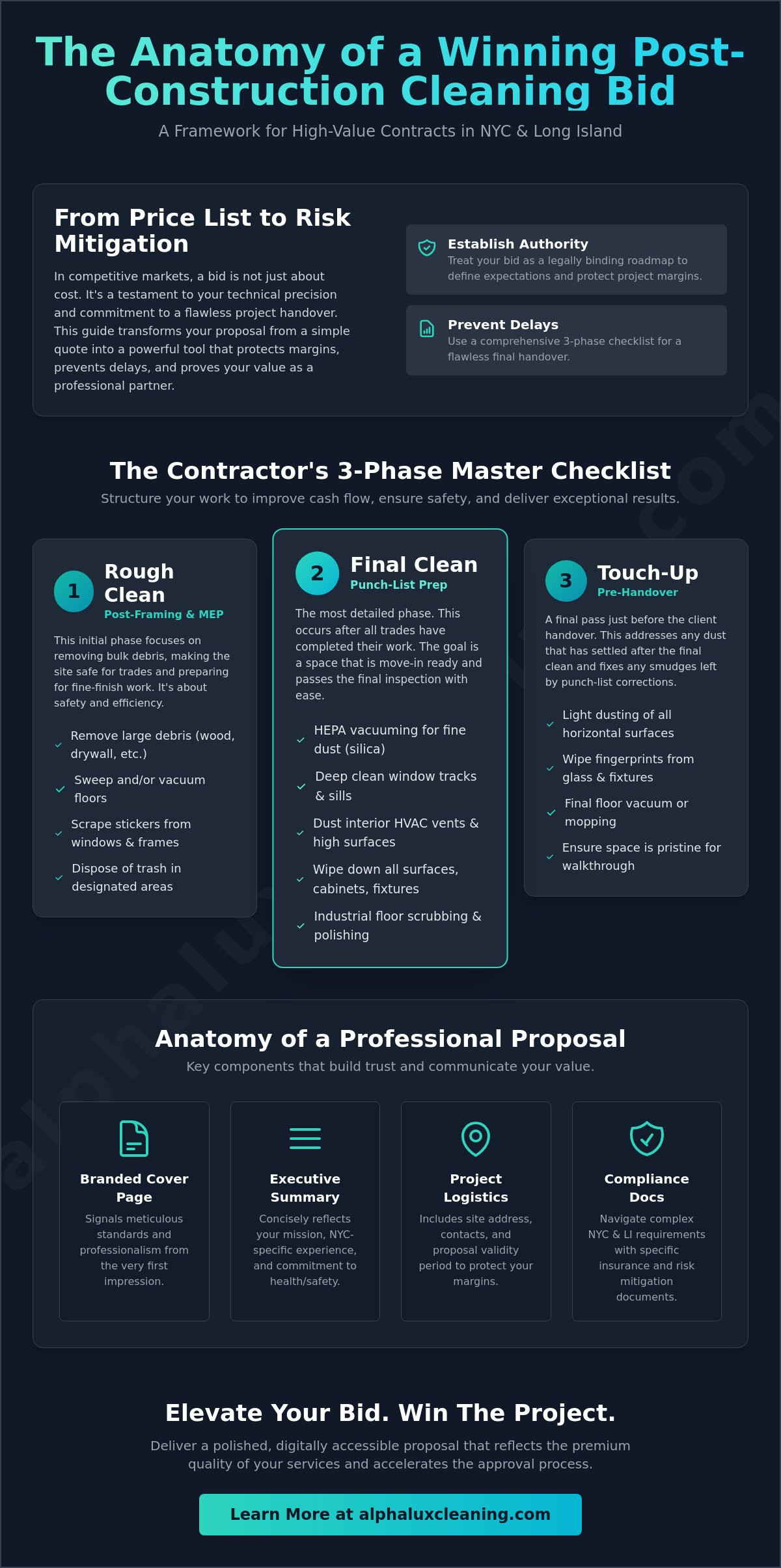
A professional bid is far more than a simple estimate of costs. It functions as a legally binding roadmap that establishes clear expectations between you and the project manager. Within the high-stakes environment of New York construction, your proposal serves as the first physical representation of your commitment to excellence. It bridges the gap between a chaotic job site and a pristine, habitable space. By utilizing a detailed post construction cleaning checklist for contractors within the bid itself, you eliminate ambiguity and ensure that every surface, from the ceiling vents to the baseboards, is accounted for before a single cloth touches a surface.
First impressions are vital for firms operating in Long Island and NYC. A visually clean, branded cover page signals that you are a meticulous partner who values professional standards. This level of presentation distinguishes a dedicated cleaning service from a casual laborer. While a residential renovation might focus on fine dust removal in a kitchen, a large-scale commercial build requires a more rigorous approach to debris management and safety compliance. Transparency in your proposal builds immediate trust. When you clearly outline your process, you prove that your price is based on technical precision rather than guesswork.
Executive Summary: Setting the Professional Tone
Your executive summary should be a concise reflection of your company’s mission and specialized experience. It’s your opportunity to highlight your familiarity with the unique construction standards of the New York metropolitan area. We prioritize a service-oriented approach that emphasizes high standards and personal respect for the property. Mentioning your commitment to using eco-friendly, non-toxic cleaning agents isn’t just a trend; it’s a promise to protect the health and mental clarity of the building’s future occupants. This section should leave the reader feeling understood and reassured that their project is in expert hands.
Contact Information and Project Logistics
Clarity in logistics prevents the friction that often plagues the final punch-list phase. Your proposal must include site-specific details, such as the general contractor’s name and the exact project address. It’s essential to state the proposal’s validity period clearly. In an era where labor and material costs can shift, protecting your margins is a sign of a responsible business. Define the primary point of contact for both parties to ensure communication remains smooth and logical. This structure allows the site superintendent to manage complex details without the burden of chasing down information, framing your service as a vital component of a well-managed project.
Defining the Three-Phase Scope: The Contractor’s Master Checklist
A common mistake in bid proposals is treating the entire project as a single event. This “one and done” approach often leads to significant project delays because it ignores the reality of construction timelines. A structured post construction cleaning checklist for contractors should instead be divided into three distinct phases. By categorizing work this way, you can bill for each phase separately, which helps maintain a healthy cash flow throughout the project’s duration. This phased approach also ensures compliance with safety regulations like the OSHA Housekeeping Standard 1926.25, which requires that debris be cleared from work areas at regular intervals.
Precision requires the right tools. We utilize specialized equipment like HEPA-rated vacuums to capture fine silica dust and industrial floor scrubbers to restore surfaces to their intended state. A truly professional bid addresses often overlooked extras such as deep cleaning window tracks and dusting interior HVAC vents. This level of detail establishes the professional cleaning services near me standard for detail work, ensuring the space is not just visually clean but truly healthy for occupancy.
Phase 1: The Rough Clean Checklist
The rough clean occurs after the heavy framing and electrical work are finished. This phase focuses on major debris removal to prepare the site for flooring, painting, and cabinetry. Tasks include removing large trash, scraping stickers from windows or appliances, and sweeping subfloors to ensure a level surface for the next trade. This stage serves as the essential foundation that allows light cleaning to begin safely.
Phase 2: The Final (Light) Clean Checklist
This is the most labor-intensive stage where the focus shifts to meticulous detail. We address every surface in kitchens and bathrooms, utilizing dust suppression techniques to prevent particles from resettling. Our post construction cleaning checklist for contractors at this stage includes wiping down baseboards, cleaning the interiors of all cabinetry, and polishing light fixtures. If you’re looking for a partner to manage these complex details, consider our specialized post-construction cleaning solutions.
Phase 3: The Fluff and Buff (Touch-up)
The final phase is a high-end walkthrough performed just before the owner takes possession. Even after a light clean, fine dust can settle or fingerprints may appear as the last contractors finish their punch lists. This stage aligns perfectly with the general contractor’s final inspection. It provides that quiet satisfaction of a well-maintained environment, ensuring the client experiences the sensory relief of a truly finished space.
Conducting the Site Visit and Pricing Your Proposal
Bidding on a project without walking the site is a gamble that rarely favors the contractor. In the complex architecture of Long Island and NYC, what looks simple on a blueprint often involves logistical hurdles that can erode your margins. Identifying hidden costs during an initial walkthrough is essential for maintaining professional excellence. For instance, a lack of working elevator access in a mid-rise development or a restricted water supply can triple the labor time required for a standard clean. These logistical factors must be documented in your post construction cleaning checklist for contractors before you finalize any numbers.
Precision in pricing also requires a clear distinction between total square footage and actual cleanable surface area. A 5,000-square-foot office with floor-to-ceiling glass partitions requires significantly more labor than an open-plan warehouse of the same size. You must also assess the “Dust Factor.” Drywall projects produce a fine, pervasive powder that settles for days, while masonry work involves heavier debris and potential mineral staining. Understanding these nuances ensures your proposal is a reflection of technical reality. It transforms the bid from a hopeful estimate into a reliable promise of quality.
Pricing Strategies: Square Foot vs. Hourly
Choosing the right pricing model is a strategic decision that impacts both your competitiveness and your profitability. Flat-rate pricing is often preferred for large New York developments because it provides the project manager with a predictable cost. However, for unpredictable touch-up requests near the move-in date, hourly rates offer better protection for your time. When calculating these rates, it’s vital to factor in the cost of specialized commercial cleaning services nyc equipment. Using construction-grade HEPA vacuums and industrial scrubbers is a standard requirement for high-end builds. For those looking to refine their bidding process for larger projects, the SBA Contracting Guide offers valuable insights into professional proposal structures.
The Walkthrough Checklist for Contractors
Your physical walkthrough should be methodical and unhurried. Check for high-ceiling access that might require specialized scaffolding or lifts, and evaluate the condition of the windows for any paint overspray or silicone residue. It’s also important to determine if you’ll be working on an active site alongside other trades or a finished site ready for the final polish. Engaging with the site superintendent about the move-in deadline allows you to gauge the urgency and adjust your staffing plans. This level of meticulous planning is what transforms a routine task into a professional craft, ensuring the final result provides the relief and clarity your client expects.
Compliance, Insurance, and Risk Mitigation in New York
In the high-stakes world of New York construction, professional credentials are not optional. You cannot rely on standard residential insurance when bidding on commercial projects in Manhattan or across Long Island. Site superintendents require proof of General Liability and Workers’ Compensation that specifically covers the unique risks of an active build. Without these formal protections, your bid is likely to be discarded before the technical details are even reviewed. Including these certifications in your post construction cleaning checklist for contractors demonstrates that you are a responsible partner who manages complex details to alleviate the client’s burden.
Proving that your team is OSHA-compliant and properly vetted is a significant differentiator. It’s about more than just checking a box; it’s about providing the quiet satisfaction of knowing the site remains a safe environment. A Hold Harmless agreement should be a standard part of your proposal terms to protect both parties from unforeseen liabilities during the cleaning process. For a deeper look at what to look for in a professional partner, our how to choose a cleaning company guide offers a complete roadmap for evaluating industry standards.
Vetted Professionals and Safety Standards
We believe that the quality of the results is directly tied to the quality of the people performing the work. AlphaLux maintains a strict commitment to employing only insured and background-checked staff who are trained in the specific hazards of construction sites. This includes the mandatory use of Personal Protective Equipment (PPE) such as hard hats, high-visibility vests, and N95 respirators when dealing with fine dust. Highlighting your impeccable safety record in your bid isn’t just a formality. It’s a competitive advantage that proves your technical precision and respect for the site’s integrity.
Terms and Conditions: Protecting Your Margins
Protecting your margins requires clear boundaries established from the very beginning. Scope creep is a common issue during the final punch-list phase, where additional requests can quickly erode your profits if not managed correctly. Your proposal should clearly define what is included and how extra tasks will be billed. We recommend structured payment terms, such as an initial deposit followed by progress payments and final net-30 terms. Given the frequency of construction delays, having a clear cancellation and rescheduling policy is essential for maintaining a balanced and predictable business life. To ensure your next project is handled with this level of care, consider our post-construction cleaning services for your final handover.
Finalizing and Delivering Your Bid with AlphaLux Quality
The final stage of your proposal is as critical as the site visit itself. Before you hit send, you must review the document for absolute clarity and professional formatting. A bid with typos or inconsistent layout suggests a lack of attention that could translate to the job site. In a competitive market, your proposal is the primary evidence of your meticulous nature. The post construction cleaning checklist for contractors isn’t truly finished until the proposal is delivered and signed. Utilizing a digital “Accept” button is a modern necessity that provides a faster turnaround for busy project managers. It removes friction and allows the superintendent to secure your services with a single click, which is often the deciding factor when timelines are tight.
The Follow-Up Sequence
Wait 48 hours before your first check-in after sending the bid. This period allows the project manager enough time to review your technical specifications without feeling pressured. Use this follow-up as an opportunity to ask if the project timeline has shifted, which shows you’re adaptable and focused on their specific needs. It’s a chance to confirm they’ve received the post construction cleaning checklist for contractors included in your bid. This professional persistence is part of why we’ve built a reputation as a trusted cleaning company in new york city. You aren’t just selling a one-time task; you’re offering a partnership that ensures the sensory experience of the space is perfect upon handover.
Transitioning to Recurring Services
Success in post-construction cleaning is the perfect gateway to long-term maintenance contracts. Once the dust is cleared and the owner sees the pristine results, they’ll naturally want to maintain that level of health and mental clarity. We recommend offering a strategic discount on recurring cleaning services for the first several months after the final construction clean. This approach helps the client manage the transition from a messy build to a fully occupied, well-managed environment. It transforms your role from a temporary contractor into a vital lifestyle partner who maintains the integrity of the space. To start this journey with a team that values precision and reliability, Request a custom post-construction bid from AlphaLux Cleaning today.
Elevate Your Handover Standards
Mastering the bid process is about more than just numbers; it’s about proving you are the most reliable partner for the job. By implementing a phased approach and conducting thorough site visits, you eliminate the risks that lead to project delays. Using a technical post construction cleaning checklist for contractors ensures that no detail is overlooked, from the initial debris removal to the final polish. This level of precision builds the trust necessary to win larger commercial projects in the competitive New York landscape.
Since 2012, we’ve helped contractors across Long Island and NYC achieve the quiet satisfaction of a perfect site handover. Our fully insured and vetted professionals utilize specialized HEPA-filtration equipment to ensure every space is healthy and ready for occupancy. Don’t let your hard work be undercut by poor presentation or missed details. Get Your Professional Post-Construction Cleaning Bid Today and experience the relief of a partnership built on excellence. We look forward to helping you deliver your next masterpiece with confidence and clarity.
Frequently Asked Questions
What should be included in a post-construction cleaning bid?
A professional bid must include a clearly defined scope of work, proof of specialized insurance, and a detailed breakdown of costs. It’s essential to specify which cleaning phases are included and provide a realistic timeline for completion. This level of transparency establishes trust and ensures that both the contractor and the client are aligned on expectations before the first cloth touches a surface.
How do you calculate the price for a construction cleaning proposal?
Pricing is typically calculated by assessing the cleanable square footage and the intensity of the construction debris. You should use a post construction cleaning checklist for contractors to estimate the labor hours required for each specific phase. Factors such as high ceilings, delicate surfaces, and the “Dust Factor” from drywall or masonry will influence the final proposal amount.
What is the difference between a rough clean and a final clean in a bid?
A rough clean focuses on removing large debris and preparing the site for the next trade, while a final clean involves meticulous detail work for occupancy. The rough clean happens after framing or electrical work is finished. The final clean is a deep scrubbing of all surfaces, including windows, cabinets, and light fixtures, to ensure the space is habitable and pristine.
Do I need special insurance for construction cleaning in New York?
Yes, New York construction sites require higher levels of General Liability and Workers’ Compensation insurance than standard residential cleaning. Many project managers in NYC and Long Island will not allow a team on-site without specific commercial endorsements. It’s essential to verify that your policy covers the unique risks associated with an active build to protect your business and your client.
How long is a cleaning bid proposal typically valid?
Most cleaning bid proposals are valid for 30 calendar days from the date they are issued. This limited timeframe protects your margins against shifts in labor costs or changes in the site’s condition. If a project is delayed significantly, you may need to re-evaluate the site to ensure the original pricing still reflects the actual work required after months of inactivity.
What is a punch list in the context of construction cleaning?
A punch list is a document used during the final walkthrough to identify any remaining minor tasks or touch-ups needed before handover. In construction cleaning, this often includes removing stray fingerprints or fine dust that settled after the light clean. Aligning your touch-up phase with the general contractor’s punch list ensures a seamless transition and the quiet satisfaction of a completed project.
Can I use a template for my post-construction cleaning bid?
You can certainly use a template as a starting point, but it must be meticulously customized for every project. A generic bid fails to account for site-specific challenges like lack of elevator access or specialized window needs. Customizing your proposal demonstrates that you’ve performed a thorough site visit and understand the technical requirements of the build, which builds immediate professional authority.
How do I handle debris removal in my cleaning proposal?
Debris removal should be clearly defined in your proposal as either light trash collection or the disposal of heavy construction waste. If you’re responsible for hauling away large materials, you should include specific disposal fees to cover your costs. Clarifying these details in the initial bid prevents confusion and ensures you’re properly compensated for the physical labor and logistical management involved.