Moving out is chaotic enough without scrubbing baseboards and chasing down security deposit checklists at midnight. If you’re weighing professional move out cleaning services against doing it yourself, you’re probably trying to figure out what you actually get for the price and whether it’s worth handing off the last item on your moving list.
Here’s the short answer: a legitimate move-out cleaning covers everything from inside cabinets and appliances to baseboards, light fixtures, and bathroom grout, and pricing in New York typically runs by square footage and property condition rather than a flat rate. Landlords and property managers look for specific things during a walkthrough, and knowing what’s included before you book saves you from paying for a service that skips the details that actually get your deposit back.
This guide breaks down exactly what’s covered in a standard move-out cleaning checklist, how pricing works across different home sizes, and what separates a thorough job from a rushed one. You’ll also see how to compare quotes so you’re not surprised by add-on fees once the crew shows up.
Why professional move-out cleaning matters for your move
Moving out triggers a legal and financial checkpoint that most renters underestimate. Your security deposit sits on the line the moment you hand over the keys, and how clean you leave the unit often decides whether that money comes back to you or gets deducted for "cleaning fees." Landlords aren’t being petty when they scrutinize grout lines and oven interiors during a walkthrough. Most lease agreements spell out a cleanliness standard, and failing to meet it gives property managers a legitimate reason to hold back part or all of your deposit.
Your deposit depends on cleanliness, not just condition
New York treats security deposits as tenant property that landlords must return within 14 days of move-out, minus itemized deductions for damage or excessive dirt beyond normal wear. That distinction matters. Normal wear covers faded paint or worn carpet paths. It doesn’t cover grease-caked stovetops, moldy grout, or dust-caked vents, and those are exactly the details a professional crew targets. You can read the specifics on tenant rights and deposit rules directly from the New York State Attorney General’s office. Skipping a thorough clean isn’t just risky, it’s often the single biggest reason renters lose deposit money they were otherwise entitled to.
A spotless walkthrough is the cheapest insurance you’ll ever buy for your security deposit.
What a walkthrough actually checks for
Property managers and landlords tend to follow a fairly consistent inspection pattern, even if they never hand you a written checklist. Knowing what they’re looking for helps you understand why a full move-out cleaning checklist goes so far beyond a quick wipe-down:
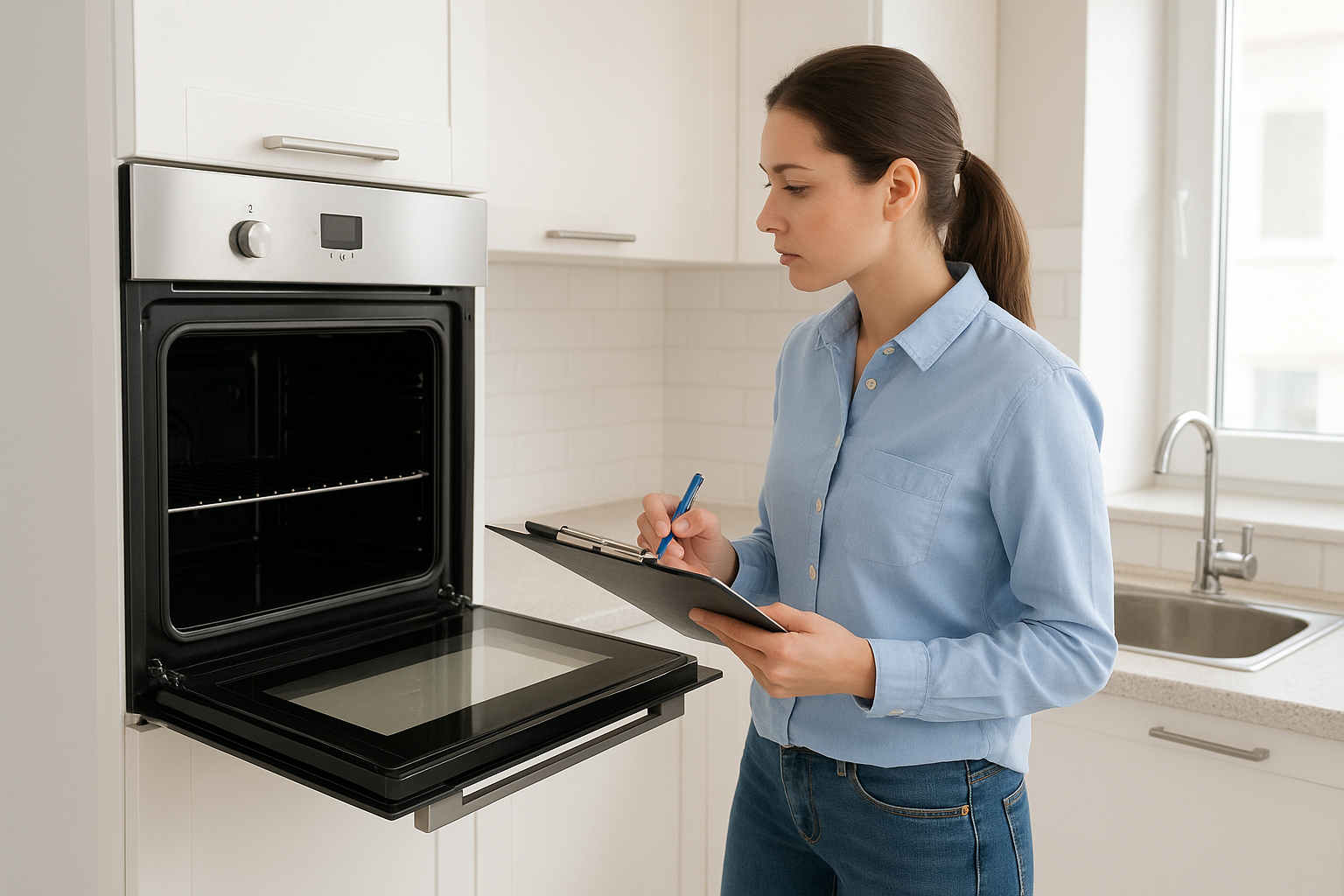
- Interior of ovens, refrigerators, and microwaves
- Cabinet and drawer interiors, including kitchen and bathroom
- Baseboards, window sills, and light fixtures
- Grout, tile, and bathroom fixtures for mineral buildup
- Floors vacuumed and mopped, including closets
- Windows and mirrors free of streaks
- Vents and ceiling fans dusted
Miss even two or three of these, and you’re handing the landlord a reason to charge you for a cleaning crew after you’ve already left.
The time and physical toll of moving
Between packing boxes, coordinating movers, transferring utilities, and juggling work or kids, cleaning is usually the task that gets rushed or skipped entirely. Scrubbing baseboards and degreasing an oven takes hours you probably don’t have on your last day in a unit, and doing it while exhausted from lifting furniture rarely produces the deep clean a landlord expects. Physically, deep cleaning involves bending, reaching, and repeated exposure to harsh chemicals in poorly ventilated spaces, which is a rough way to spend your final hours in a home you’re trying to leave behind. Hiring out this last task means you walk away with your energy intact for the actual move.
Peace of mind for the next tenant and your reputation
Finally, a clean handoff matters beyond your own deposit. If you’re a business vacating a commercial space, a spotless exit protects your company’s standing with the property manager and makes it easier to negotiate future leases or get positive references. Residential tenants benefit the same way. Landlords remember renters who leave a unit ready for the next occupant without a fight over cleaning charges, and that goodwill can matter if you ever need a reference or want to rent from the same landlord again. Treating the final clean as a professional obligation, not an afterthought, protects both your money and your reputation.
How to hire a professional move-out cleaning service
Hiring the right crew takes more than a quick Google search and a phone call. You want a company that shows up with the right insurance, trained staff, and a clear scope of work before you hand over your keys or your credit card. Skipping this vetting step is how renters end up with a rushed job that fails the landlord’s walkthrough anyway, defeating the entire purpose of paying for help.
Vet credentials before you book
Start by confirming the company carries general liability insurance and runs background checks on every employee who enters your home. A legitimate cleaning company will tell you this without hesitation, often listing it right on their website. Ask how long they’ve operated in your area and whether they specialize in move-out jobs specifically, since a crew used to weekly maintenance cleans may not know what a landlord’s final inspection actually demands.
If a company won’t confirm insurance and background checks upfront, that’s your answer before you even ask for a quote.
Run through this quick checklist before booking anyone:
- Proof of insurance and bonding
- Background-checked, trained staff
- Written, itemized quote (not a vague estimate)
- Clear cancellation and rescheduling policy
- Satisfaction guarantee or re-clean policy
- Availability that matches your move-out date
Compare quotes line by line
Request quotes from at least two or three companies and compare what’s actually included, not just the bottom-line price. A cheaper quote that skips inside-appliance cleaning or baseboards isn’t cheaper once you factor in the deposit deductions you’ll face later.
| What to check | Why it matters |
|---|---|
| Square footage pricing basis | Prevents surprise charges at the door |
| Included tasks list | Confirms ovens, cabinets, grout are covered |
| Add-on fees (carpets, windows) | Avoids inflated final invoice |
| Estimated crew size and time | Signals whether the job gets rushed |
| Payment and cancellation terms | Protects you if your move date shifts |
Ask questions that reveal quality
Quality companies answer specifics without dodging. Ask how many cleaners will show up, roughly how long the job takes for a home your size, and what happens if the landlord flags something missed during the walkthrough. Reputable services usually offer a re-clean guarantee within a set window, which tells you they stand behind the work rather than treating it as a one-and-done transaction.
Online booking has made this process faster, letting you get a free estimate based on square footage and property type before committing. Use that speed to your advantage, but don’t skip the credential check just because the booking form was quick.
What’s included in a typical move-out cleaning
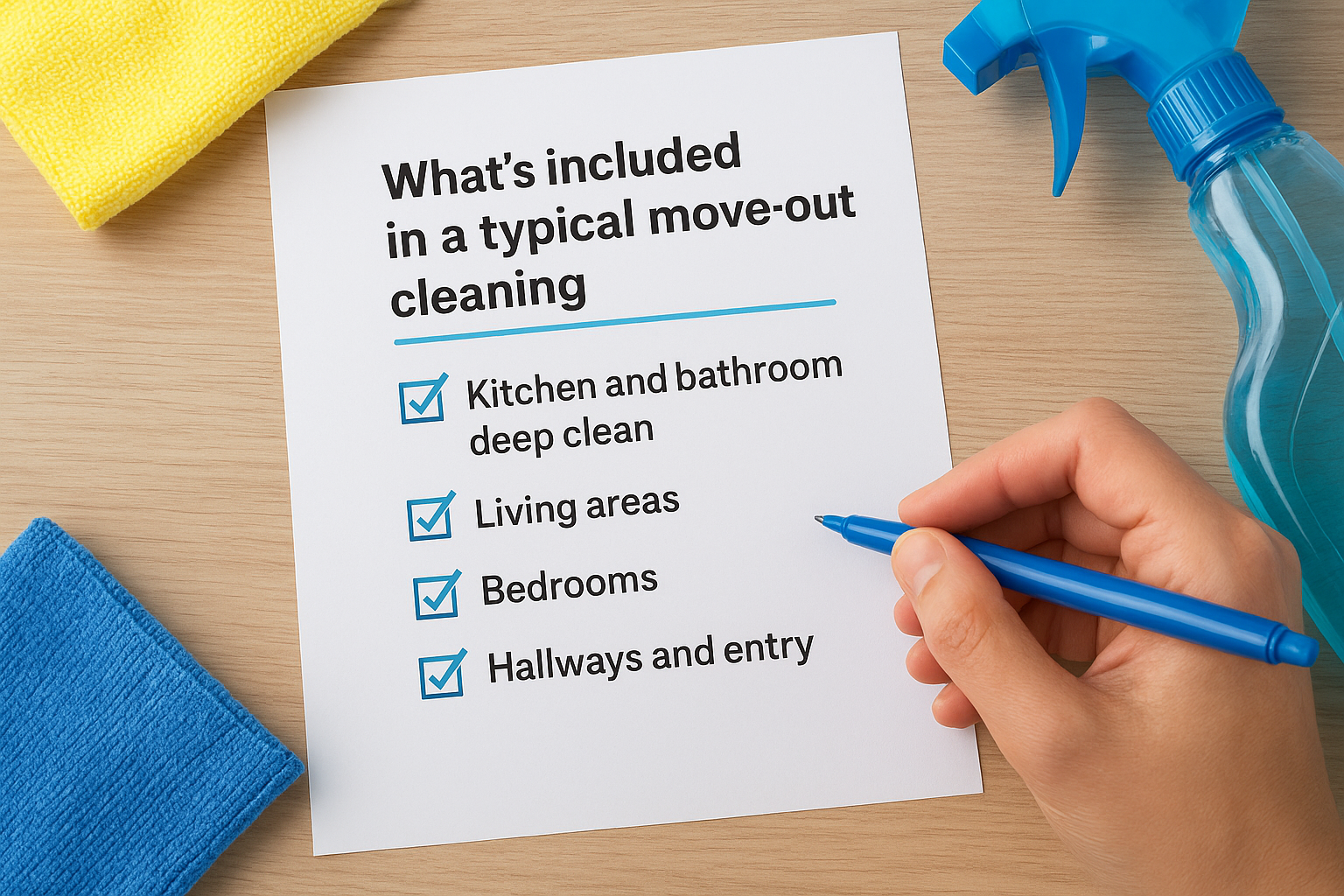
Every move-out cleaning checklist should read like a room-by-room inventory, not a vague promise to "clean the place." Reputable companies break the job into kitchen, bathrooms, bedrooms, and common areas, then list exactly which surfaces get attention in each. Knowing this breakdown before you book lets you compare quotes accurately and catch a company trying to charge full price for a partial job.
Kitchen and bathroom deep clean
Kitchens and bathrooms carry the heaviest grease, grime, and mineral buildup, so they demand the most detailed work. A thorough crew tackles the inside of ovens, refrigerators, microwaves, and cabinets, along with grout lines, faucets, and tile that accumulate soap scum over months or years.
- Interior and exterior of oven, stovetop, and range hood
- Refrigerator interior, including shelves and drawers
- Cabinet and drawer interiors, kitchen and bathroom
- Sink, faucet, and countertop degreasing and sanitizing
- Toilet, tub, shower, and grout scrubbing
- Mirror and glass surfaces free of streaks
If the quote doesn’t mention appliance interiors and grout by name, assume they’re not included.
Whole-home details that landlords check
Living areas and bedrooms get less grease but still need the fine-detail work that separates a professional job from a surface wipe. Dusting extends beyond furniture to baseboards, window sills, blinds, ceiling fans, and light fixtures, all spots that collect dust invisibly until someone runs a finger across them during a walkthrough. Floors get vacuumed and mopped in every room, including closets, and windows get wiped for streaks on both accessible sides.
| Area | Typical tasks included |
|---|---|
| Living areas | Dusting, baseboards, vents, floors |
| Bedrooms | Closets, window sills, floors, light fixtures |
| Hallways/entry | Floors, switch plates, door frames |
| Laundry area | Behind/under machines if accessible |
Notice how closets and behind-appliance spaces make the list. Landlords check these spots specifically because tenants tend to skip them, so a professional crew treats them as standard, not optional.
What usually costs extra
Some tasks fall outside the standard scope and show up as add-ons on your invoice. Carpet steam cleaning, exterior window washing, wall washing, and garage or basement cleaning typically get quoted separately since they require different equipment or significantly more time. Ask upfront whether your unit needs any of these, especially carpet cleaning, since many leases require it explicitly and landlords check for receipts. Confirming this before your appointment prevents a surprise charge showing up after the crew has already started working.
How much professional move-out cleaning services cost
Pricing for professional move out cleaning services in New York typically runs by square footage and condition rather than a flat rate, so a 600-square-foot apartment costs less than a 2,500-square-foot house even with the same checklist. Expect most companies to quote a range up front, then confirm the final number after seeing photos or details about your specific unit. Studios and one-bedrooms usually land on the lower end, while larger homes with multiple bathrooms and heavy buildup push toward the top of the range.

Typical price ranges by home size
General pricing across New York tends to follow this pattern, though your exact quote depends on the company and your property’s condition:
| Home size | Typical price range |
|---|---|
| Studio/1BR apartment | $150-$250 |
| 2-3BR apartment or condo | $250-$400 |
| Single-family home (3-4BR) | $400-$600 |
| Larger home (5BR+) | $600-$900+ |
Square footage sets the baseline, but grease, mold, and clutter are what actually move your final price.
What drives your final price up
Beyond size, several factors push a quote higher than the base range. Cleaners charge more when a kitchen shows heavy grease buildup, when bathrooms have mineral deposits that need scraping instead of wiping, or when pet hair and dander cover carpets and vents. Vacant homes sometimes cost less since crews move faster without furniture in the way, while occupied units near your move date often cost slightly more because cleaners work around boxes and remaining belongings.
Here’s what commonly adds to your base quote:
- Carpet steam cleaning (often $30-$60 per room)
- Exterior window washing
- Wall or ceiling spot cleaning
- Garage, basement, or attic add-ons
- Excessive pet hair or heavy grease removal
- Same-day or rush scheduling
Factoring these in before you book prevents the sticker shock that comes from comparing an incomplete quote against a full one.
Getting an accurate free estimate
Most reputable companies, including AlphaLux Cleaning, offer a free estimate based on square footage, number of bathrooms, and any known problem areas like ovens or carpets. Provide honest details when requesting your quote rather than underselling the condition, since an inaccurate estimate just means a higher final invoice or a rushed job that misses the walkthrough standard. Online booking tools speed this process up significantly, letting you get a number within minutes instead of waiting on callbacks.
Always ask whether the quoted price is fixed or subject to change once the crew arrives on site. A trustworthy company sticks to its written estimate unless you add services on the spot, and any legitimate adjustment should come with a clear explanation rather than a surprise line item on your final bill.
How to prepare your home before the cleaners arrive
Preparing your space before the crew shows up isn’t about pre-cleaning, it’s about clearing the way so they can focus every minute on the actual move-out cleaning checklist instead of navigating around your belongings. A little prep work on your end translates directly into a more thorough job and fewer surprises when the landlord does the final walkthrough.
Clear out everything first
Getting all your furniture, boxes, and personal items out before the crew arrives makes the biggest difference in how deep they can clean. Cleaners can’t scrub baseboards hidden behind a couch or mop a floor covered in moving boxes, so an empty unit lets them treat every corner as accessible rather than working around obstacles. If you can’t fully vacate before the appointment, at least clear out one room at a time so the crew always has a clean starting point.
An empty unit gets a deeper clean than a full one, every single time.
Confirm utilities stay on
Water and electricity need to stay connected through your cleaning appointment, since crews rely on running water for bathrooms and kitchens and often need lighting to spot grime in dim corners. Contact your utility providers before scheduling your final walkthrough date so service doesn’t get cut early. Losing water mid-job means the crew can’t finish tasks like scrubbing tubs or wiping down sinks, which pushes the job into a second visit you’ll likely pay for again.
Handle personal and fragile items yourself
Professional cleaners typically won’t move heavy furniture or handle personal valuables, so take care of these yourself beforehand:
- Remove jewelry, documents, and small valuables from drawers and closets
- Take down wall art, mirrors, and curtains you’re keeping
- Empty the refrigerator and take out trash before the crew arrives
- Disconnect and move any appliances you’re taking with you
- Set aside anything fragile that shouldn’t be handled by cleaning staff
Skipping this step often means the crew works around clutter instead of cleaning through it, and that limits how thorough the final result can be.
Communicate problem areas upfront
Tell the company about specific trouble spots before the appointment, whether that’s a grease-heavy stovetop, mold in bathroom grout, or pet stains on carpets. This lets them allocate the right amount of time and bring any specialized products needed, rather than discovering the issue mid-job and running out of time for the rest of the unit. A quick text or note in your booking confirmation covers this without needing a phone call.
Provide access instructions
Finally, make sure the crew has a clear way in. Leave a key with the property manager, share a lockbox code, or plan to meet them briefly at the door. Confirming access the day before avoids a delayed start that eats into the time allotted for your cleaning, especially if your move-out date has a tight turnaround before new tenants arrive.
DIY cleaning vs hiring a professional move-out crew
Running the numbers yourself is the only honest way to decide if a DIY move-out clean actually saves you money. On paper, buying your own supplies looks cheaper than paying $250-$600 for a crew. In practice, you’re trading cash for hours you probably don’t have on your last day in a unit, plus the risk of a failed walkthrough that costs you far more than the cleaning fee ever would.
What DIY actually costs you
Supplies alone run $50-$100 if you’re buying degreaser, grout cleaner, glass spray, and a decent vacuum attachment you don’t already own. Add in the time: a thorough clean of a two-bedroom apartment, including ovens, cabinets, and grout, takes most people 6-8 hours when they’re not rushing. That’s on top of packing, loading a truck, and handling utility transfers on the same day. Physically, you’re bending into ovens and scrubbing tubs while exhausted from moving furniture, which is exactly when corners get cut and spots get missed.
The real cost of DIY isn’t the supplies, it’s the hours and the deposit risk if the job falls short.
Where professional crews pull ahead
A trained crew brings commercial-grade products, the right tools for grout and grease, and a checklist built around what landlords actually inspect. They work faster because they do this daily, and most reputable companies back the job with a re-clean guarantee if something gets flagged during your walkthrough. That guarantee alone offsets a lot of the price difference, since a failed inspection on a DIY job means paying a company anyway, on shorter notice and often at a rush rate.
| Factor | DIY cleaning | Professional crew |
|---|---|---|
| Time investment | 6-8+ hours | 2-4 hours (crew handles it) |
| Upfront cost | $50-$100 in supplies | $150-$900 depending on size |
| Deposit risk | Higher if details get missed | Lower, often guaranteed |
| Physical toll | High, on top of moving | None |
| Consistency | Varies by energy and time left | Standardized checklist |
When DIY makes sense
DIY can work if you’re vacating a small studio in good condition, have a full day free before your walkthrough, and don’t mind the physical work. It also makes sense if you’re staying in the same building or working with a landlord who’s flexible about minor wear. But for larger homes, tight moving timelines, or landlords known for strict inspections, hiring out the final clean protects both your time and your deposit far more reliably than pushing through it yourself on no sleep.
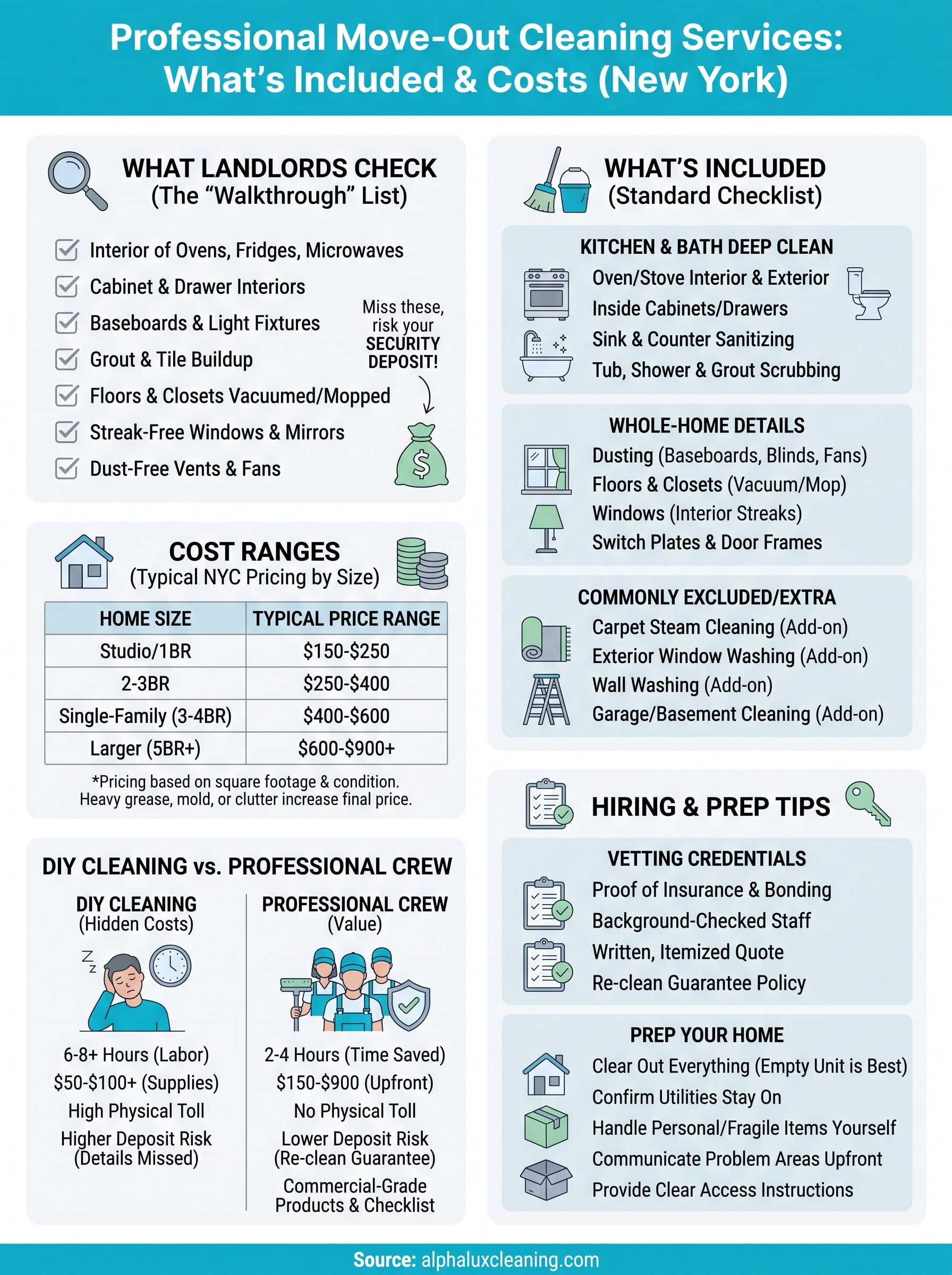
One less thing to worry about on moving day
Moving day already asks enough of you between boxes, trucks, and utility deadlines. Handing off the final scrub to a trained crew means you walk away with your deposit intact and your energy saved for everything else on your list. Professional move out cleaning services cover the details landlords actually check, oven interiors, grout, baseboards, cabinet shelves, in a way that a rushed DIY pass rarely matches once exhaustion sets in.
You now know what belongs on a proper checklist, what a fair quote looks like, and how to prep your space so the crew can work fast and thorough. That knowledge alone puts you ahead of most renters walking into a final inspection.
If you’re moving anywhere in New York and want the last item off your list handled right, get a free estimate from AlphaLux Cleaning and book a crew that treats your deposit like it’s their own money on the line.