
You’re about to let a stranger into your house or hand them keys to your office. Before that happens, you want to know who they actually are, not just who their resume says they are. That’s exactly what an employee background check does: it verifies a person’s identity, history, and trustworthiness before they ever put on a uniform or clock in for a shift. For anyone hiring cleaners, contractors, or staff who’ll work unsupervised in someone else’s space, skipping this step is a real gamble.
At its core, a background check is a screening process that confirms details a candidate provides on their application and uncovers information they might not volunteer. It typically covers criminal history, employment verification, identity checks, and sometimes credit or driving records, depending on the role. The goal isn’t to dig up dirt for its own sake. It’s to answer one practical question: can this person be trusted with access to homes, offices, and the people inside them?
In this article, we’ll break down exactly what shows up on a background check, how the process works, and why it matters so much in industries like cleaning services, where trust is the entire product. It’s also the reason AlphaLux Cleaning background-checks every team member before they ever step through a client’s door.
Why employee background checks matter
Trust isn’t something you can fake your way into, especially when a stranger is scrubbing your kitchen floor or emptying trash cans in your office after hours. Client safety sits at the center of every hiring decision in the cleaning industry, and a background check is the tool that turns a gut feeling into verified fact. Without one, you’re relying on a resume, a smile, and hope. With one, you’re making a decision backed by real records, which matters just as much for legal liability as it does for peace of mind.
Protecting clients and their homes
Homeowners hand over house keys, alarm codes, and access to everything they own when they hire a cleaning service. That level of access demands more than a good interview. A thorough background check confirms that the person walking through the door has no history that would put a client’s family, pets, or belongings at risk. This is especially true for services that send workers into homes unaccompanied, where there’s no manager standing nearby to catch a problem before it happens.

Reducing liability for the business
Employers who skip background checks expose themselves to a specific kind of risk called negligent hiring liability. If a company places an unscreened worker in a client’s home and that worker causes harm or theft, the business can be held responsible for not doing due diligence. Courts have consistently sided against employers who failed to take reasonable steps to vet employees before granting them access to private property.
A single unscreened hire can cost a business its reputation, its clients, and a lawsuit it never saw coming.
Insurance carriers pay close attention to this too. Many general liability and bonding policies require documented screening procedures before they’ll cover claims related to employee misconduct. Skip the check, and you might discover your coverage doesn’t apply exactly when you need it most.
Meeting client and industry expectations
Today’s customers ask questions before they book. They want to know who’s coming into their space and whether that person has been vetted. Background checks have become a baseline expectation, not a bonus feature, across several industries:
- Residential cleaning: clients expect verified, insured staff before granting home access
- Commercial cleaning: office managers require screening as part of vendor compliance
- Healthcare-adjacent facilities: stricter checks are often mandated by regulation
- Childcare and eldercare settings: background checks are typically non-negotiable
Companies that build screening into their hiring process from day one tend to attract more repeat clients and referrals, because word travels fast when a service feels safe and dependable. The U.S. Equal Employment Opportunity Commission also outlines how employers should conduct these checks fairly and consistently, which protects both the business and the applicant from discriminatory practices. Getting this right isn’t just about avoiding bad hires. It’s about proving to every client that safety was never an afterthought.
How employers conduct a background check
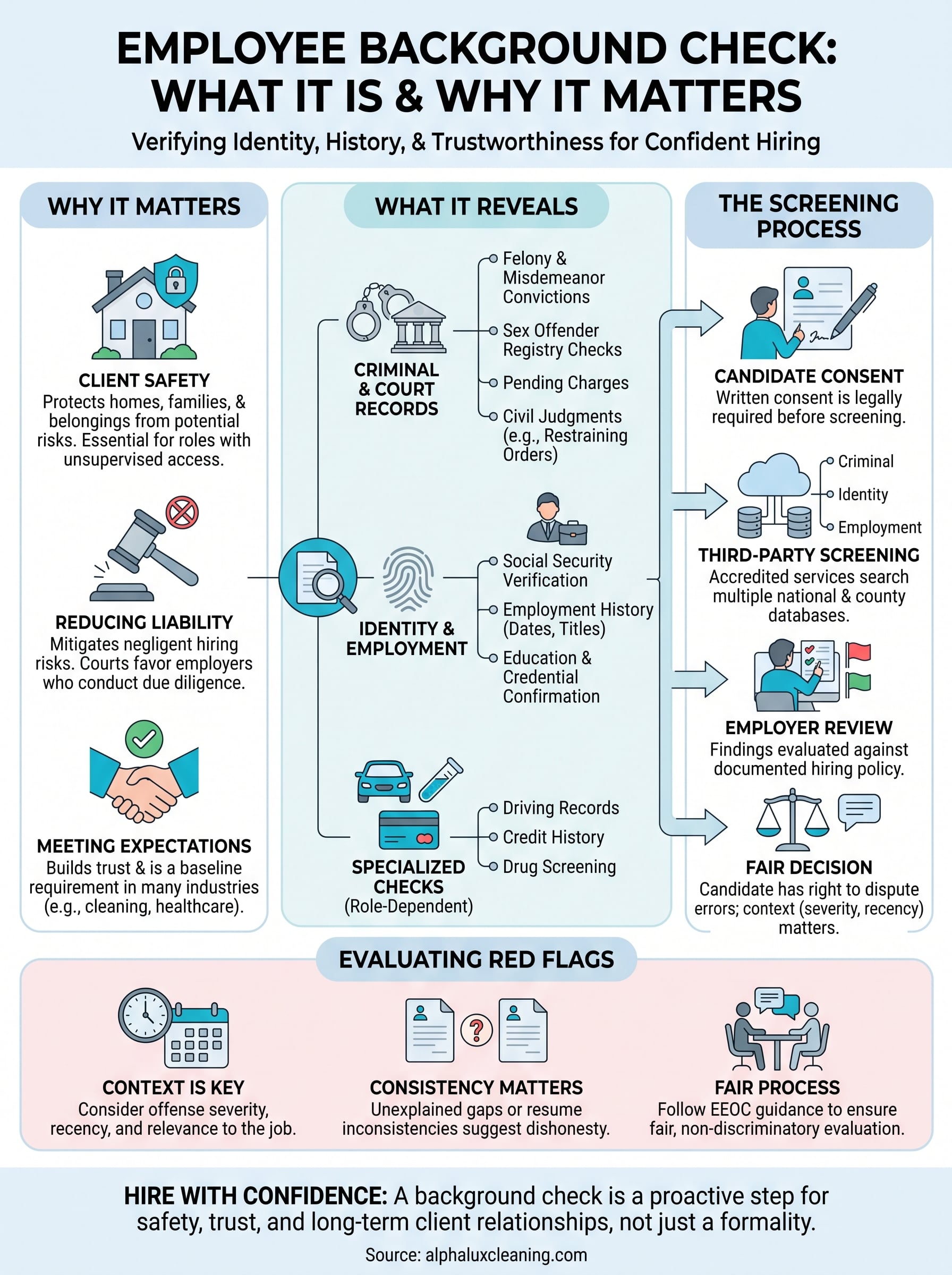
Running a background check isn’t a single action, it’s a sequence of steps that starts the moment a candidate signs a consent form. Written consent is a legal requirement under the Fair Credit Reporting Act before any employer can pull records on an applicant, and skipping this step can expose a business to its own legal trouble. Once consent is in hand, most employers turn to a specialized screening company rather than trying to piece together records themselves, since state and county databases aren’t exactly designed for easy public access.
Choosing between in-house checks and third-party services
Small businesses sometimes attempt basic checks on their own, running a quick name search or calling a listed reference. That approach misses far more than it catches. Third-party background check companies pull from national criminal databases, sex offender registries, county courthouse records, and Social Security trace tools that flag aliases or address history a candidate might not disclose. AlphaLux Cleaning, like most professional cleaning companies, relies on accredited screening services precisely because they cross-reference multiple sources instead of trusting a single database that might be incomplete or outdated.
A background check is only as reliable as the sources behind it, which is why professional screening beats a quick internet search every time.
The typical screening workflow
Most employers follow a fairly consistent process, regardless of industry:
- Candidate signs a disclosure and consent form
- Employer submits identifying information to a screening provider
- Provider searches criminal, employment, and identity databases
- Results return within one to five business days, depending on scope
- Employer reviews findings against a documented hiring policy
- Candidate receives a chance to dispute inaccurate information before a final decision
That last step matters more than people realize. Under federal law, applicants have the right to see what was found and challenge errors before an employer can legally deny them a position. Employers who skip this step risk violating Fair Credit Reporting Act rules, which can lead to fines and legal exposure regardless of how clean the rest of their hiring process looks.
Timing also varies by role. A basic criminal history search might return same-day, while a check that includes employment verification, education confirmation, and driving records can take closer to a week. Companies hiring for positions with home access, like cleaning staff, typically opt for the more comprehensive route, since the cost of a bad hire far outweighs the extra day or two of waiting.
What information a background check can reveal
Most people assume a background check just means a criminal record search, but the actual report covers far more ground. Comprehensive screening pulls together identity confirmation, employment history, and sometimes financial or driving records, giving an employer a full picture instead of a single data point. What actually gets checked depends on the role, but for anyone entering homes or offices unsupervised, employers usually request the widest scope available.
Criminal and court records
National and county-level searches turn up felony and misdemeanor convictions, pending charges, and in some states, arrest records that never led to a conviction. Sex offender registry checks are standard for any role involving home access, since this is the single most important safeguard for client safety. Some reports also flag civil judgments, like restraining orders or lawsuits tied to theft or property damage, which matter just as much in a hiring decision as a criminal conviction would.
A criminal record search isn’t a formality, it’s the single check that protects clients from the worst-case scenario.
Identity and employment verification
Screening providers confirm that a Social Security number matches the name and birthdate on file, which catches identity fraud before it becomes a liability. Employment verification contacts previous employers directly to confirm dates, titles, and sometimes reasons for leaving, catching resume inflation that a quick phone call to a listed reference would never uncover.
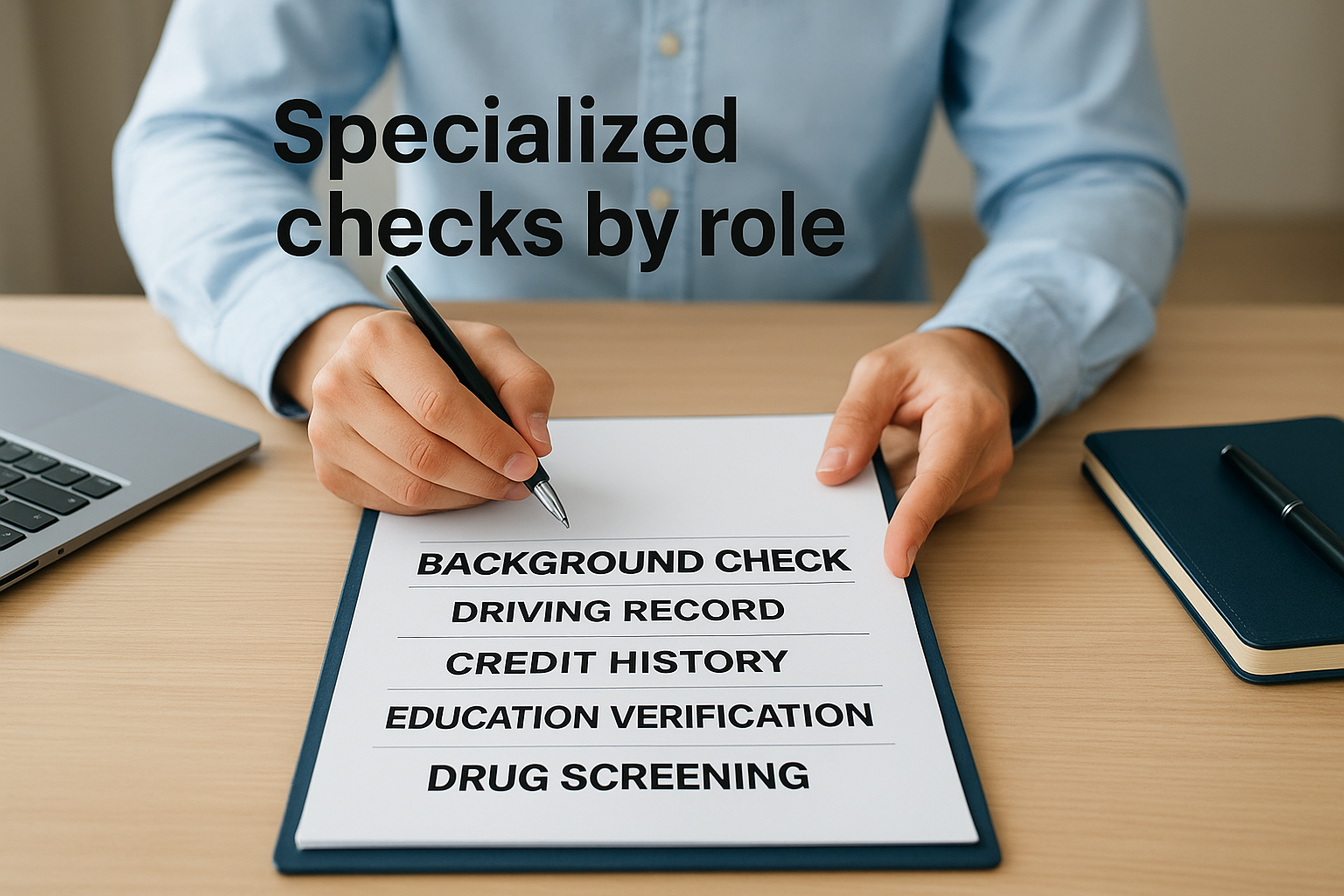
Specialized checks by role
Certain positions call for additional layers of screening beyond the basics:
| Check Type | What It Shows | Common Use |
|---|---|---|
| Driving record | Traffic violations, license status | Roles requiring travel between job sites |
| Credit history | Debt, bankruptcy filings | Roles with financial access |
| Education verification | Degree or certification claims | Roles requiring specific credentials |
| Drug screening | Substance use | Safety-sensitive positions |
Together, these layers turn a resume into a verified profile, which is exactly what a client deserves before someone steps foot in their home or business.
Common red flags and what they mean for hiring
Not every red flag on an employee background check should end a candidacy, but every red flag deserves a closer look before you decide. Context matters more than the flag itself. A misdemeanor from a decade ago carries different weight than a theft conviction from last year, and a responsible hiring policy treats those two situations very differently.
Criminal history that raises real concern
Felony convictions involving theft, assault, or property crimes deserve the most scrutiny for roles that involve entering someone’s home. Violent offenses and any hit on a sex offender registry are near-universal disqualifiers across the cleaning industry, since the risk to client safety outweighs almost any mitigating explanation. Older, minor offenses with no repeat pattern usually warrant a conversation rather than an automatic rejection, which is exactly what the EEOC recommends to avoid discriminatory hiring practices.
The severity and recency of an offense matter more than the fact that one exists at all.
Inconsistencies that suggest dishonesty
Gaps between what a candidate claims and what a check confirms often matter more than the underlying record itself. Employment gaps left unexplained, job titles that don’t match what a former employer reports, or an address history that doesn’t line up with stated residency can all signal a candidate who’s being less than straightforward. Dishonesty during the hiring process is frequently a bigger warning sign than a minor past mistake, because it predicts how that person will behave once they’re working unsupervised.
Building a fair evaluation process
Rather than reacting to a single flag, most experienced employers weigh a short list of factors before making a call:
- How relevant is the offense to the specific job duties?
- How much time has passed since the incident?
- Is there a pattern of repeated issues, or a single event?
- Did the candidate disclose the issue voluntarily?
Evaluating red flags this way protects both the business and the applicant. It also keeps hiring decisions defensible if a rejected candidate ever challenges the outcome, which is a real possibility under current employment law.
What this means for hiring with confidence
An employee background check isn’t paperwork you file away and forget. It’s the difference between hoping a hire works out and knowing you’ve done the legwork to protect your clients, your business, and your reputation. Every piece we’ve covered, from consent forms to red flag evaluation, exists to answer one question honestly: does this person deserve access to someone else’s home or office?
Companies that treat screening as a formality end up learning the hard way why it matters. Companies that treat it as a non-negotiable step build trust that clients notice and remember. That trust is what turns a one-time booking into a long-term relationship.
If you’re looking for a cleaning team that takes this seriously, not just as a policy but as a promise, see how AlphaLux Cleaning screens every team member before they ever step through your door.