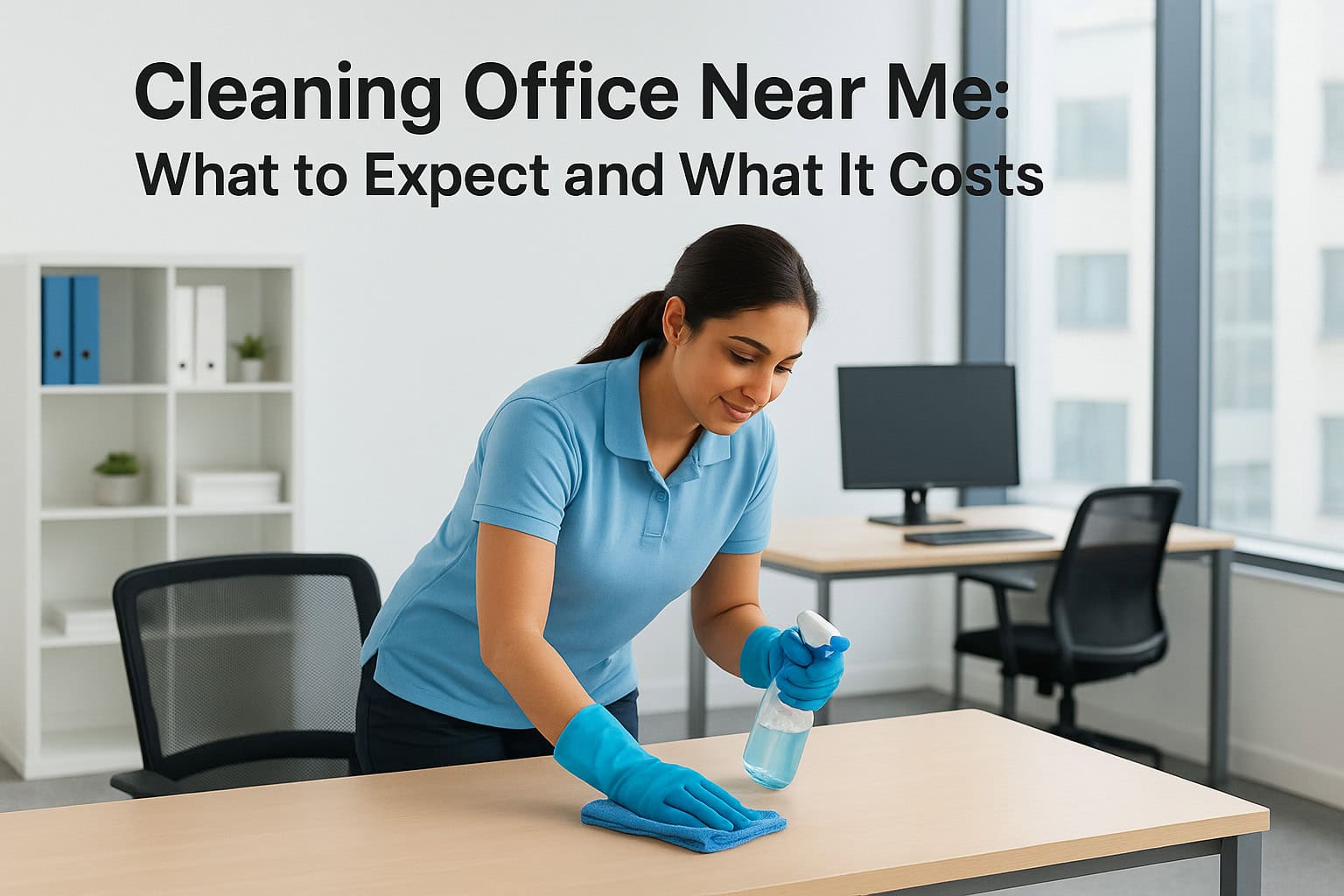
You typed cleaning office near me because your workspace looks worse every week and nobody on staff has time to fix it. Maybe a client is visiting Friday, or your employees keep mentioning the dusty vents and sticky break room counter. Whatever pushed you to search, you want real answers: who services your area, what they actually do during a visit, and what it’s going to cost you.
This article gives you those answers straight. We’ll walk through what a typical office cleaning visit includes, from trash removal and surface disinfecting to deeper tasks like carpet care and window cleaning, so you know exactly what you’re paying for. You’ll also get a realistic breakdown of office cleaning costs in New York, based on square footage, frequency, and the type of clean you need.
We work with businesses across New York State every day, so we know what office managers actually ask before booking. By the end, you’ll understand how to compare quotes, spot what separates a reliable cleaning company from a risky one, and decide whether a one-time deep clean or a recurring schedule fits your space better.
Why professional office cleaning matters for your business
A dirty office does more damage than most managers realize. Dust builds up on keyboards, bacteria spreads across shared surfaces, and within weeks the whole space starts to feel neglected. When you search for a cleaning office near me, you’re not just chasing tidiness. You’re trying to protect employee health, client perception, and the physical assets you’ve invested in. Skipping professional cleaning doesn’t save money long term, it just moves the cost somewhere else, usually into sick days, replaced furniture, or a client who never books a second meeting.
Health and productivity take a direct hit
Offices are breeding grounds for germs because so many people touch the same surfaces all day. Doorknobs, keyboards, break room microwaves, and shared coffee makers carry more bacteria than most employees expect. The Centers for Disease Control and Prevention notes that routine cleaning of high-touch surfaces reduces the spread of illness-causing germs in shared spaces (cdc.gov). Fewer sick days translate directly into fewer disruptions and lower payroll losses from absenteeism.
A workplace that stays visibly clean also stays measurably healthier.
Air quality matters just as much as surfaces. Dust and allergens accumulate in carpets, vents, and upholstery when nobody addresses them on a schedule. Employees working in that environment report more headaches, fatigue, and difficulty concentrating, especially in offices with poor ventilation. A consistent cleaning routine keeps allergens down and helps your team stay focused instead of distracted by a stuffy, dusty room, one of the clearest benefits of a clean office for morale and productivity.
First impressions decide whether clients come back
Clients and visitors form an opinion about your business within seconds of walking through the door, which is why office cleaning doubles as your best marketing tool. Sticky floors, overflowing trash bins, or a grimy reception desk send a message you never intended: that you don’t pay attention to detail. That impression sticks, whether it’s fair or not, and it colors how people judge the quality of your actual product or service.
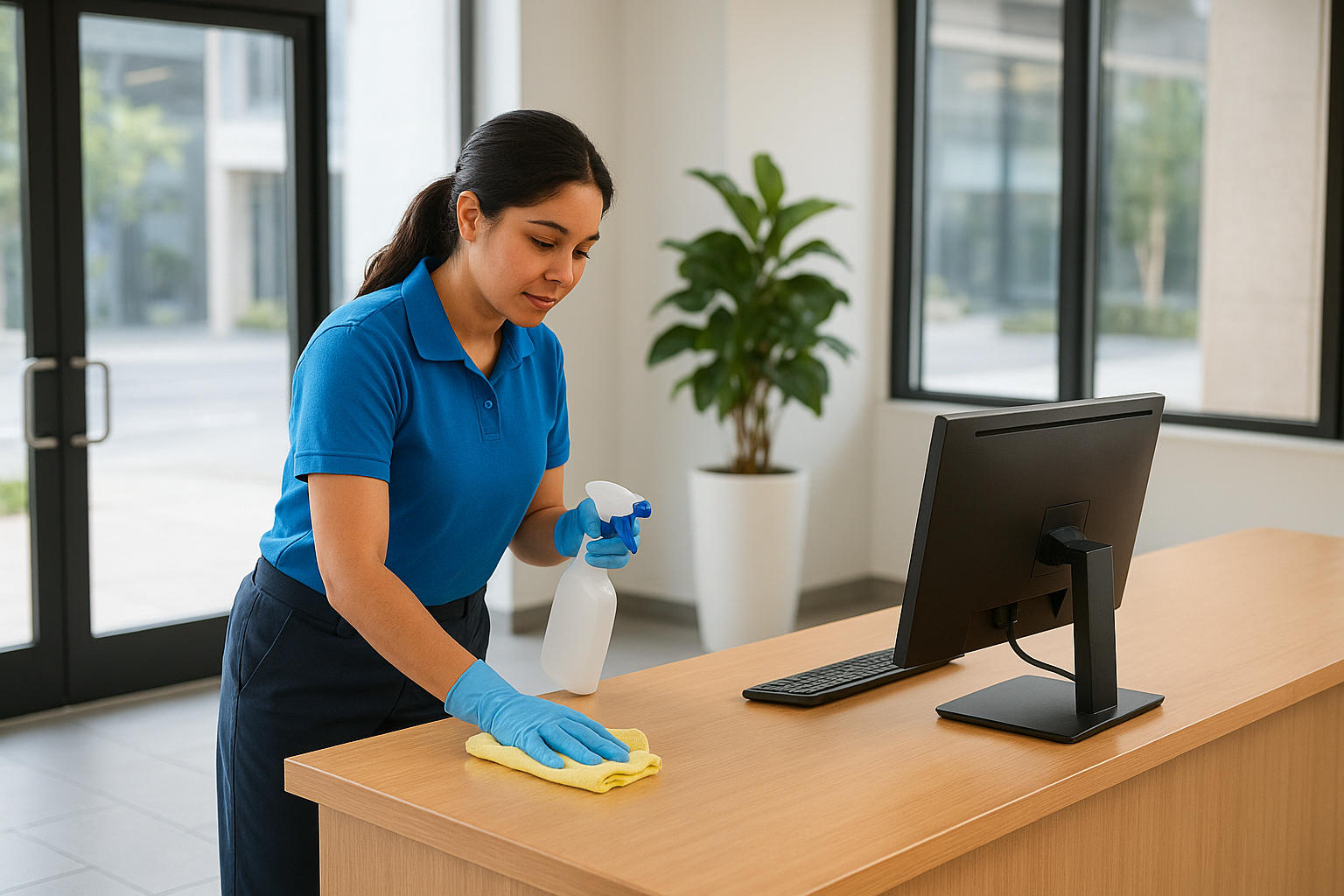
Consider the difference these two scenarios make on a potential client:
| Office Condition | Likely Client Perception |
|---|---|
| Spotless lobby, clear surfaces, fresh air | Organized, trustworthy, detail-oriented |
| Dusty furniture, visible trash, stained carpet | Disorganized, careless, low standards |
Regular commercial cleaning removes that risk entirely. You stop worrying about last-minute walkthroughs before a big meeting because the baseline standard is already high. That peace of mind alone is worth the monthly cost for most businesses that rely on in-person client visits.
Protecting your furniture, floors, and equipment
Office furniture, carpet, and flooring represent real money. Carpet fibers trap grit that acts like sandpaper every time someone walks across it, wearing down the material faster than most people expect. Left untreated for months, that damage becomes permanent, and replacing carpet or refinishing hardwood costs far more than a recurring cleaning contract ever would.
Equipment suffers too. Dust buildup inside computer towers, printers, and HVAC vents forces those systems to work harder and fail sooner. Sticky residue on desks and shared equipment accelerates wear on surfaces that were never designed to handle daily grime without maintenance. Trained cleaning crews know which products and techniques protect these surfaces instead of degrading them, something a rushed weekly wipe-down from staff rarely accomplishes.
Ultimately, the case for professional office cleaning services comes down to protecting three things: your people’s health, your company’s reputation, and your physical assets. Cutting corners on any of those categories costs more in the long run than hiring a dedicated team from the start. If you want a closer look at how a professional approach handles these priorities, our commercial cleaning services page breaks down exactly what a customized plan looks like for offices across New York.
How to find a reliable office cleaning service near you
Searching "cleaning office near me" hands you a list of options, but that list doesn’t tell you who actually shows up on time, brings the right supplies, and treats your space with care. Finding a trustworthy commercial cleaning company takes a bit more digging than clicking the first result. You need to verify credentials, read between the lines on reviews, and ask questions before you sign anything.
Start with reviews, but read them critically
Google reviews and Yelp ratings give you a starting point, not a final answer. Look past the star average and read the actual comments, especially the ones from businesses similar to yours in size and industry. A five-person law firm and a fifty-desk call center have different needs, so a glowing review from one doesn’t guarantee the same experience for the other. Pay attention to recurring complaints too. If three separate reviewers mention missed appointments or rushed jobs, that pattern tells you more than any overall score.
The best office cleaning company near you is the one whose reviews match your specific building type, not just the one with the most stars.
Verify insurance, bonding, and background checks
Any company you let into your office after hours should carry liability insurance and bond their staff. This protects you if something breaks, goes missing, or gets damaged during a cleaning visit. Ask directly whether employees go through background checks before being assigned to client sites, and use a full security and quality guide to vetting a cleaning company if you want a deeper screen. A legitimate company will answer without hesitation and often lists this information right on their site. AlphaLux Cleaning, for example, background-checks every technician and insures every job, and we tell clients that upfront because it’s the first thing office managers ask.
Compare local providers against national chains
Local cleaning companies tend to know the building codes, climate challenges, and business districts of your specific area better than a national franchise operating from a call center in another state. When you search for an office cleaning company near me, prioritize providers based in your region who can send the same crew to your office each visit, rather than a rotating pool of subcontractors, the same logic behind finding the best office cleaning company on Long Island.
Before you request quotes, run through this quick checklist:
- Confirm the company services your specific city or county in New York
- Check that they carry general liability insurance and worker’s compensation coverage
- Ask if staff undergo background checks before placement
- Read at least five recent reviews from businesses your size
- Request a written quote that itemizes tasks and frequency
- Confirm whether they use eco-friendly or non-toxic products, if that matters to your team
Once you’ve narrowed your list to two or three companies, request a free estimate from each and compare not just price, but what’s actually included in that price.
What’s included in a standard office cleaning service
Ask five different companies what "standard cleaning" means and you’ll get five different answers. That’s why a written office cleaning scope of work matters more than a sales pitch. Standard office cleaning almost always covers the basics that keep a workspace sanitary and presentable between visits, but the specifics vary based on your square footage, layout, and how often the crew comes through. Knowing the baseline helps you spot when a quote is missing something you’ll need.
Core tasks you should expect every visit
Regardless of which company you hire, a routine visit should hit the same core checklist. These are the tasks that keep germs down and surfaces presentable without requiring specialized equipment:
- Emptying trash and recycling bins, replacing liners
- Wiping and disinfecting desks, counters, and shared surfaces
- Cleaning and sanitizing restrooms, restocking supplies
- Vacuuming carpets and mopping hard floors
- Dusting furniture, window sills, and reachable surfaces
- Cleaning glass on interior doors and entryways
- Sanitizing high-touch points like light switches, doorknobs, and elevator buttons
Most providers bundle these into a weekly or nightly service, and they form the foundation of any commercial cleaning contract you sign, much like a daily, weekly, and monthly office cleaning checklist.
If a quote doesn’t list restrooms, trash, and high-touch disinfecting by name, ask why before you sign anything.
Deeper tasks that usually cost extra
Beyond the core list, deeper tasks address the grime that builds up over months rather than days. Carpet shampooing, upholstery cleaning, and interior window washing typically fall outside a standard weekly visit and get scheduled quarterly or added as a one-time office deep cleaning service. Vent and duct dusting, floor stripping and waxing, and detailed break room appliance cleaning also fall into this category. These jobs take more time and specialized tools, so most companies quote them separately rather than folding them into a flat weekly rate.
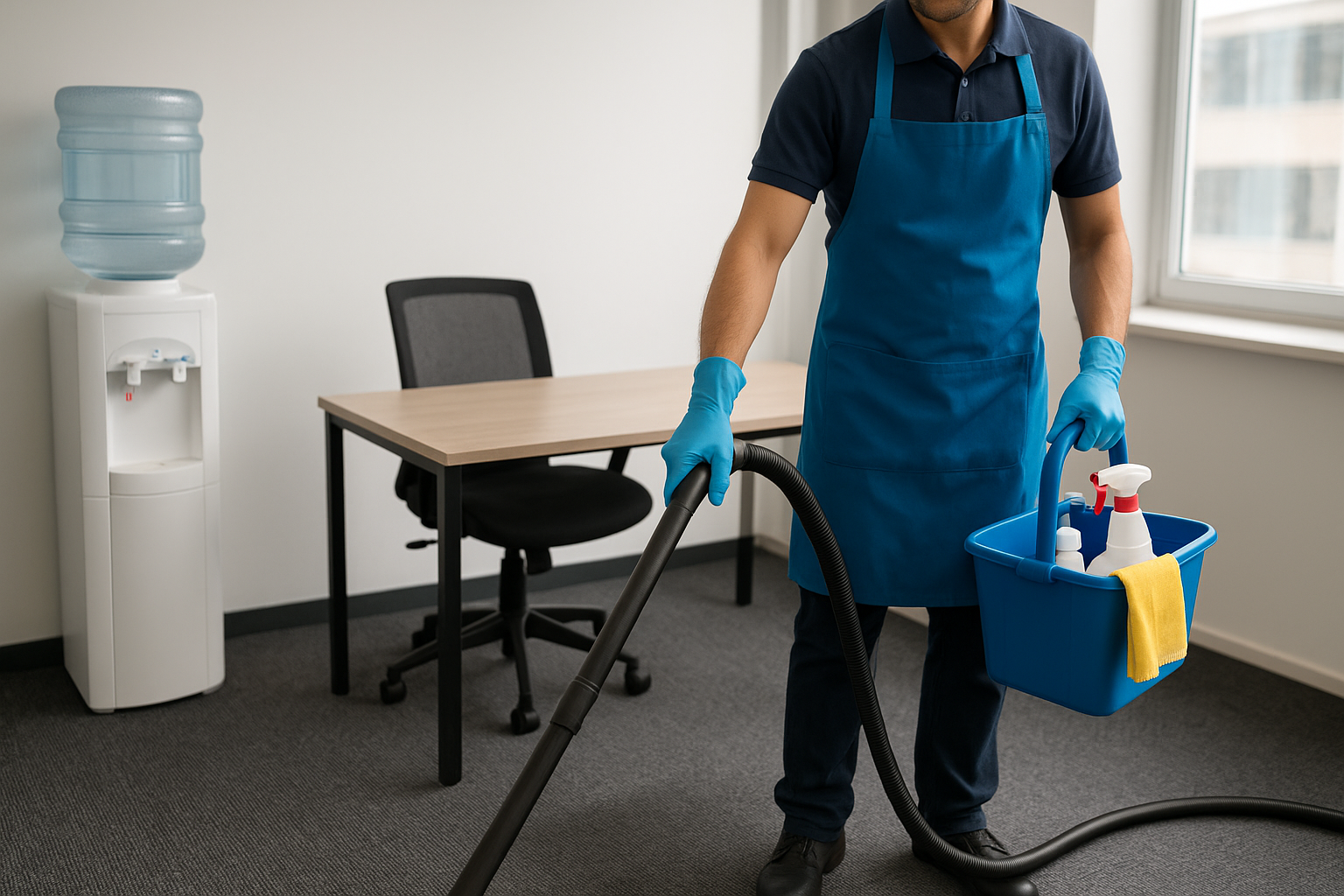
| Service Type | Typical Frequency | Usually Included in Base Rate |
|---|---|---|
| Trash removal, surface wiping | Every visit | Yes |
| Restroom sanitizing | Every visit | Yes |
| Vacuuming and mopping | Every visit | Yes |
| Carpet shampooing | Quarterly | No |
| Window washing (interior) | Monthly or quarterly | No |
| Floor stripping and waxing | Semi-annual | No |
Customizing the plan to your space
Every office has quirks a generic checklist won’t cover. A dental practice needs different disinfecting standards than a marketing agency, and a warehouse floor demands different flooring care than a carpeted corporate suite. Good providers ask about your industry, foot traffic, and specific pain points before drafting a plan, rather than handing you the same template used for every client. That’s the approach we take with every custom office cleaning plan in New York, matching the task list to how your space actually gets used, not just its square footage.
How much does office cleaning cost
Price depends on square footage, frequency, and how deep the clean needs to be, so nobody can give you an honest number without knowing your space. Still, when businesses search for office cleaning cost, they want a ballpark before they even request a quote. Most commercial cleaning in New York runs somewhere between $0.10 and $0.25 per square foot for a standard nightly or weekly visit, with deep cleans and one-time jobs priced higher because of the extra labor and equipment involved, as this office cleaning rates per square foot chart lays out.
The real cost of office cleaning isn’t the invoice, it’s what you pay when you skip it: sick days, worn carpet, and lost clients.
Typical price ranges by office size
Square footage drives most of the math, but frequency changes the total fast. A 2,000-square-foot office cleaned weekly costs far less per visit than the same space cleaned nightly, since crews build efficiency into repeat visits. Here’s a realistic range based on what New York businesses typically pay, and a fuller NYC office cleaning pricing guide if you want the detail:
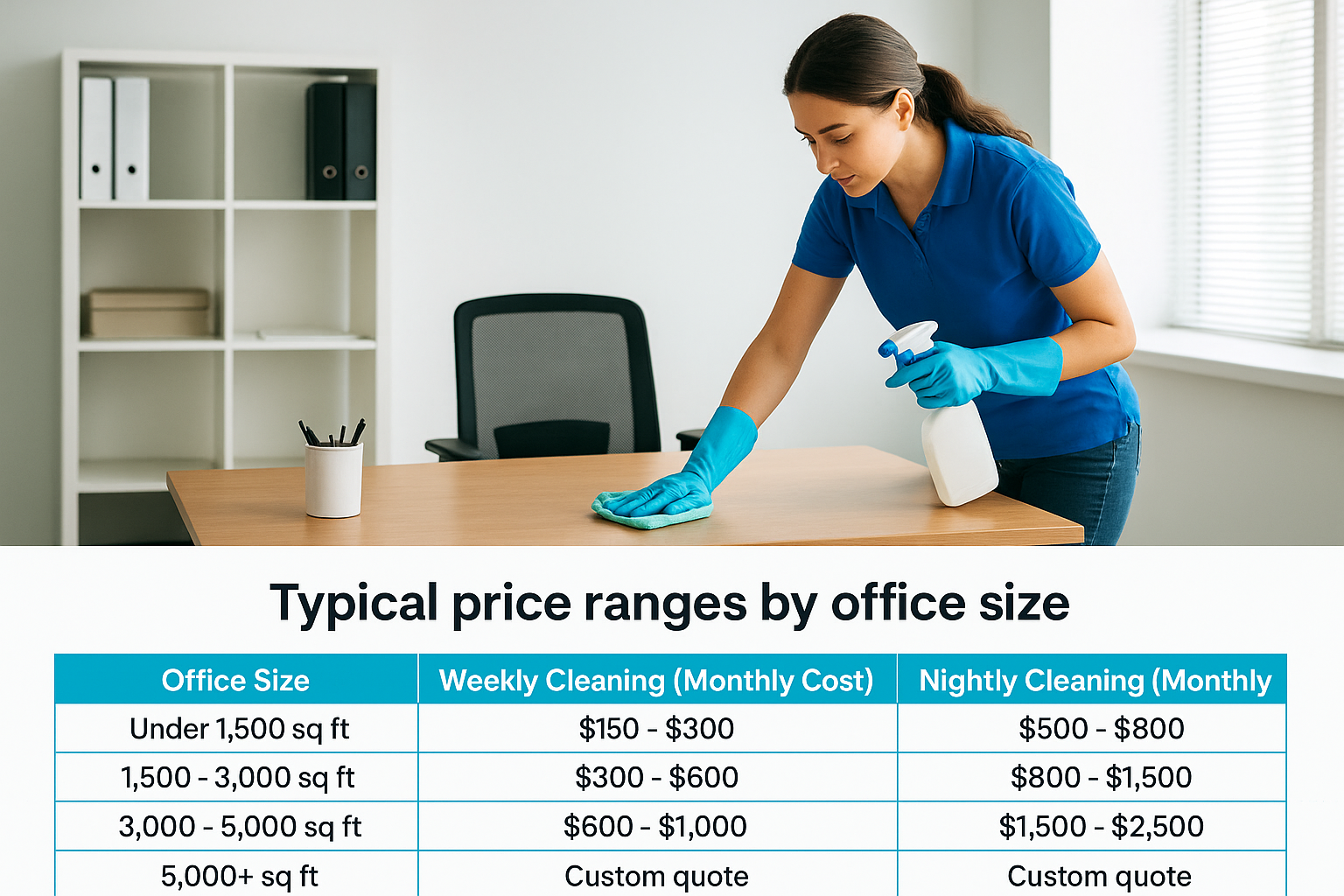
| Office Size | Weekly Cleaning (Monthly Cost) | Nightly Cleaning (Monthly Cost) |
|---|---|---|
| Under 1,500 sq ft | $150 – $300 | $500 – $800 |
| 1,500 – 3,000 sq ft | $300 – $600 | $800 – $1,500 |
| 3,000 – 5,000 sq ft | $600 – $1,000 | $1,500 – $2,500 |
| 5,000+ sq ft | Custom quote | Custom quote |
These figures assume a standard scope, trash, surfaces, restrooms, floors, without add-ons like carpet shampooing or window washing.
What pushes the price up or down
Several factors shift these numbers beyond raw square footage. Restroom count matters a lot, since sanitizing and restocking multiple bathrooms takes real time. Layout matters too: open floor plans clean faster than offices chopped into small private rooms and cubicles. Foot traffic, whether you have a break room with a full kitchen, and whether your team wants eco-friendly cleaning products instead of standard chemicals all factor into the final number. Businesses in dense areas like Long Island sometimes see slightly higher rates than more rural parts of the state, simply because labor and travel costs run higher there, as you’ll notice comparing Long Island office cleaning services.
Getting an accurate quote
Rather than relying on averages, request a walkthrough or send photos so the company can quote your actual space instead of a generic estimate. A provider that quotes blind, without asking about restroom count, square footage, or frequency, is guessing, and that guess usually turns into a higher bill once they see the real conditions. When you request a free estimate from AlphaLux Cleaning, we walk the space or review your floor plan first, then build a price around what your office actually needs rather than a flat per-square-foot rate that ignores your layout. That approach protects you from surprise charges once the crew shows up and finds three restrooms instead of one.
Choosing the right cleaning frequency for your workspace
No single schedule works for every business, and picking the wrong one wastes money in either direction. Too frequent, and you pay for visits that don’t accomplish much. Too rare, and dirt piles up faster than a crew can reasonably handle in one visit. How often an office should be cleaned depends on how many people walk through your space daily, what kind of work happens there, and how quickly grime actually becomes visible.
Match frequency to foot traffic and industry
Offices with heavy foot traffic, think call centers, medical offices, or retail-adjacent spaces, need cleaning more often than a quiet ten-person consulting firm. A medical or dental office should lean toward nightly service because of sanitation standards and patient contact with surfaces. A small creative agency with five employees might do perfectly well on a twice-weekly schedule. Industry matters just as much as headcount: a shared kitchen or break room used by fifty people generates mess far faster than a private office suite where three people work quietly at desks all day.
Match the schedule to how the space gets used, not to what a competitor down the street happens to book.
Signs you’re due for more frequent visits
Watch for a few warning signs that your current schedule isn’t cutting it. If employees start commenting on the state of the restrooms between visits, or trash bins overflow before the next scheduled cleaning, you’ve outgrown your current plan. A sticky break room counter that stays sticky for days, dust visibly collecting on monitors, or a lobby that looks tired by midweek all point to the same conclusion: bump up the frequency before it affects how clients see your business.
Comparing common frequency options
Most businesses land in one of four buckets. Here’s how they typically break down:
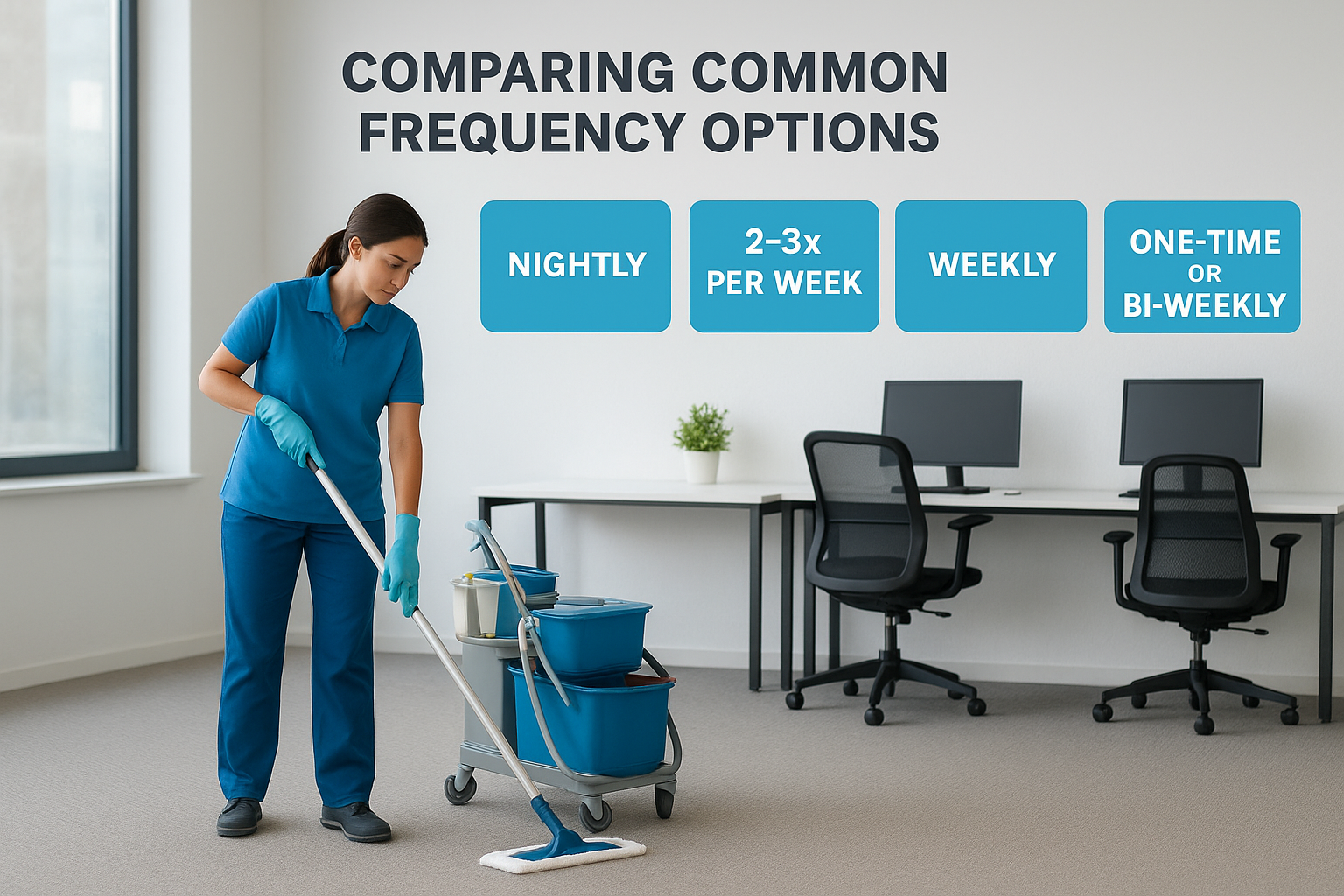
| Frequency | Best For | Typical Business Type |
|---|---|---|
| Nightly | High foot traffic, health-sensitive spaces | Medical offices, call centers |
| 2-3x per week | Moderate traffic, shared kitchens | Mid-size offices, agencies |
| Weekly | Low traffic, mostly desk work | Small offices, remote-heavy teams |
| One-time or bi-weekly | Special events, light use | Startups, seasonal spaces |
Adjusting later costs you nothing but a phone call, so don’t feel locked into whatever you choose on day one. Flexible cleaning schedules matter too, especially around seasonal spikes. Flu season pushes many offices to add disinfecting visits temporarily, while summer months with lighter staffing sometimes allow a scaled-back schedule. When you work with AlphaLux Cleaning, we revisit your cleaning plan every few months and adjust frequency based on what we actually observe on site, not a rigid contract that ignores how your business changes throughout the year.
Questions to ask before hiring an office cleaning company
A sales call tells you what a company wants you to hear. The right questions tell you what actually happens once the contract is signed. Before you commit to any office cleaning company, walk through a short list of questions that expose gaps most quotes leave out, like who shows up, what happens when something goes wrong, and how billing actually works month to month, the same standards that separate a real commercial cleaning company from the rest.
Questions about staffing and accountability
Getting a straight answer here separates companies that treat cleaning as a real business from ones running a loose network of subcontractors. Ask whether the same crew or technician comes to your office every visit, since rotating staff means retraining someone on your layout and preferences every few weeks. Find out who you call if a cleaner misses a visit or damages something, and whether that person is reachable outside business hours. A company that hesitates on these answers is telling you something important without saying it directly.
If a company can’t tell you who’s cleaning your office next Tuesday, don’t expect consistency after you sign.
Questions about pricing and contracts
Pricing structure matters as much as the number itself. Some companies lock you into a year-long contract with penalties for early cancellation, while others operate month-to-month with no strings attached. Confirm whether the quoted price includes supplies or whether paper towels, trash liners, and soap get billed separately, since the essentials on an office cleaning supplies list add up quickly. Ask what happens if you need to add a service, like a one-time deep clean before a big meeting, and how quickly they can accommodate that request.
Here’s a quick list worth running through before you sign anything:
- Is the price fixed monthly, or does it change based on visits?
- What’s the cancellation policy, and is there a minimum contract length?
- Are supplies and equipment included, or billed as extras?
- How do you handle a missed or rescheduled visit?
- What’s your response time if we need emergency cleaning?
Questions about products and safety standards
What goes into your office matters, especially if employees have allergies or sensitivities to harsh chemicals. Push for specifics on whether the company uses eco-friendly cleaning products as a default or only on request, and ask to see labels if that’s a priority for your team. Confirm that staff are trained on proper dilution and storage of chemicals, since improper handling creates real safety risks in a shared workspace. Finally, ask how the company handles background checks and insurance, since you already know from earlier in this article that both matter before anyone gets a set of keys to your building.
Getting these answers upfront saves you from surprises three months into a contract, when switching providers means disrupting a schedule your staff has already adjusted to.
In-house staff vs hiring a professional cleaning service
Some businesses handle cleaning by assigning it to whoever has a spare hour, or by hiring a part-time employee to wipe down surfaces at the end of the day. That approach feels cheaper on paper, but it rarely holds up once you factor in payroll taxes, supervision, equipment costs, and the reality that most in-house staff aren’t trained on commercial-grade sanitizing. Weighing in-house cleaning against a professional cleaning service comes down to more than just the hourly rate you’d pay someone to do it.
The hidden costs of doing it yourself
Hiring even one part-time cleaner means covering payroll taxes, workers’ compensation insurance, sick leave, and the time someone spends managing that person’s schedule. You also need to buy and store supplies, replace equipment when it breaks, and cover the gap when your cleaner calls out sick or quits without notice. None of that shows up in a simple hourly wage comparison, but it adds up fast over a year.
The cheapest option on paper is rarely the cheapest option once you add up insurance, supervision, and sick days.
What you gain by outsourcing
A professional cleaning company brings trained staff, commercial equipment, and backup coverage built into the contract, so a missed shift doesn’t leave your office dirty for a week. You also skip the liability of managing an employee’s schedule, taxes, and performance reviews for a task that isn’t part of your core business. Outsourcing shifts that entire burden onto a company whose only job is showing up and doing the work right, which frees your team to focus on what actually generates revenue and erases the hidden cost of a dirty workspace.
| Factor | In-House Staff | Professional Cleaning Service |
|---|---|---|
| Payroll taxes and benefits | Your responsibility | Not applicable |
| Coverage for sick days | Gaps likely | Built into contract |
| Equipment and supplies | You purchase and maintain | Provided by company |
| Training and standards | Inconsistent | Standardized across staff |
| Liability if damage occurs | Falls on you | Covered by insurance |
| Scalability | Difficult to adjust quickly | Easy to increase or reduce |
When in-house still makes sense
Occasionally, a very small office with two or three employees decides light daily tidying can happen internally, saving the recurring service for a deeper monthly visit instead. That hybrid setup works for some businesses, but it only holds up if someone actually enforces the routine, since informal arrangements tend to slip once deadlines pile up. For most offices searching for a reliable cleaning office near me solution, outsourcing the whole job to a dedicated crew removes that risk entirely and guarantees the standard stays consistent whether things get busy or not. If you’re weighing both options for your own space, our team can walk you through a customized plan that fits your headcount and budget without asking you to manage a cleaner yourself.
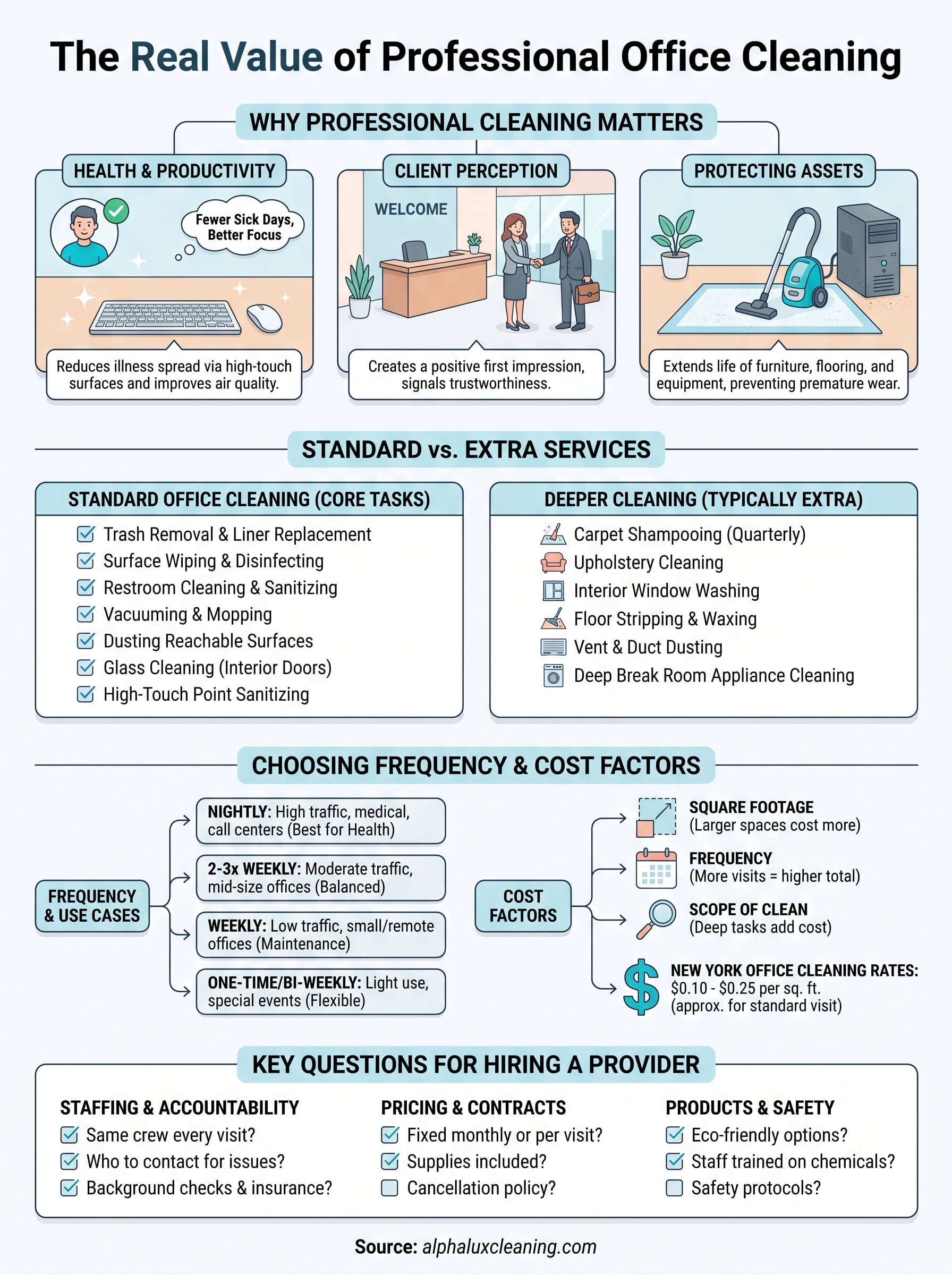
What a clean office really takes
A spotless office isn’t luck. It’s the result of a consistent schedule, a crew that actually shows up, and a company willing to answer your questions before you sign anything. You now know what standard cleaning covers, what deeper tasks cost extra, and how to spot the difference between a provider who guesses at pricing and one who quotes your actual space. That knowledge puts you ahead of most people typing "cleaning office near me" into a search bar.
Getting there doesn’t require guesswork on your end. Compare a few local providers, ask the staffing and pricing questions from earlier, and pick the option that matches your foot traffic and budget rather than whatever sounds cheapest upfront. If you’d rather skip the comparison shopping and get a straight answer for your space, see our office cleaning services and request a free estimate from AlphaLux Cleaning to learn what a customized plan actually costs for your office.