Grease traps that never get scrubbed. Hood vents caked in residue. Health inspectors who show up unannounced and start checking corners you forgot existed. If you run a restaurant in New York, you already know that regular mopping isn’t enough to pass inspection or keep your kitchen safe. That’s where commercial cleaning services restaurant owners rely on come in, and knowing what a commercial cleaning service includes and what it costs before you sign a contract saves you from costly surprises later.
A real restaurant cleaning service goes far beyond wiping counters. It covers deep degreasing of kitchen equipment, sanitizing prep surfaces, floor care that meets health code standards, and dining room detailing that keeps customers comfortable. The best providers also handle back-of-house specifics like walk-in coolers, exhaust systems, and trash areas that generic office cleaners typically skip.
In this article, we break down exactly what a commercial cleaning contract for a restaurant should cover, how often each task needs attention, and what separates a reliable provider from one that leaves you scrambling before an inspection. Whether you manage a diner on Long Island or a full-service restaurant elsewhere in New York, you’ll know precisely what to ask for.
Why professional cleaning matters for restaurants
Restaurants operate under a different set of rules than any other business. Grease builds up fast, bacteria multiply in warm kitchens, and one bad health inspection can shut your doors for days. Skipping professional cleaning isn’t a way to save money, it’s a bet against your own restaurant health inspection score, and it’s a bet you’ll eventually lose.
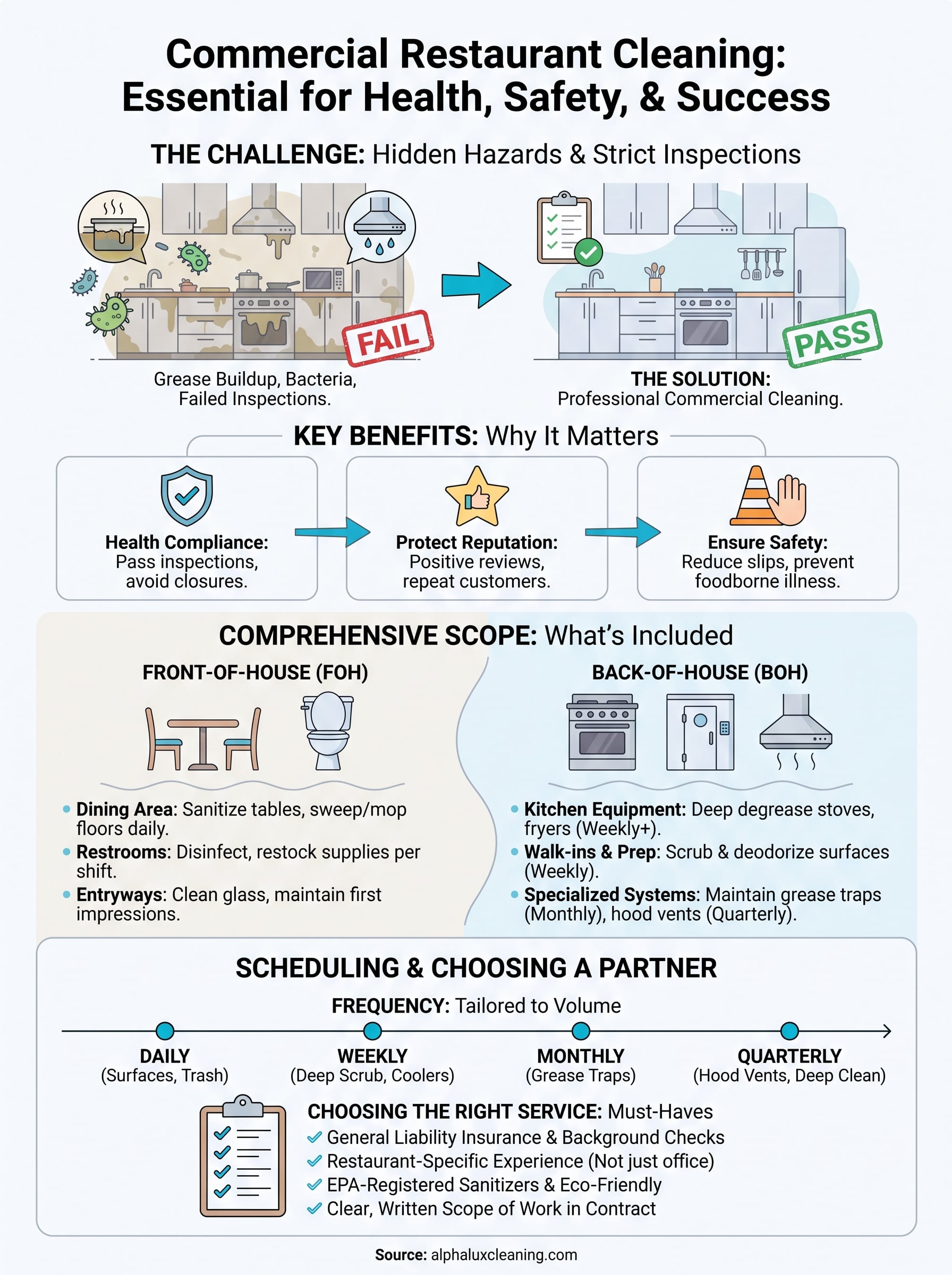
Health code compliance and inspections
Health departments in New York don’t grade on effort. They check grease traps, hood systems, walk-in coolers, and floor drains, and they write violations for buildup that homeowners would never notice in their own kitchen. A trained cleaning crew knows exactly what inspectors look for because they’ve seen the same checklists dozens of times. That kind of inspection readiness turns a stressful surprise visit into a routine walk-through.
A restaurant that passes inspection on the first try almost always has a professional cleaning schedule behind it, not luck.
Protecting your reputation and revenue
Online reviews move fast, and one photo of a dirty bathroom or a sticky table can undo months of good service. Diners judge cleanliness within seconds of walking in, and that first impression shapes whether they order an appetizer or walk right back out. Consistent commercial kitchen cleaning protects the revenue you’ve worked to build, because a spotless dining room and a odor-free kitchen keep customers coming back and keep them recommending you to friends.
Employee and customer safety
Grease on a kitchen floor causes slips. Bacteria on prep surfaces cause foodborne illness. Clogged exhaust systems raise fire risk every time the fryers run for a full dinner shift. According to the FDA Food Code, proper sanitation of food-contact surfaces is a baseline requirement, not an optional upgrade, and cutting corners here puts both staff and diners at real risk. Professional crews use commercial-grade degreasers and sanitizers that cut through buildup regular mopping can’t touch, which lowers injury risk and keeps your kitchen running the way the health code demands.
Taken together, these three factors explain why so many owners stop treating cleaning as an afterthought and start budgeting for it the same way they budget for food costs or payroll. Working with a provider that understands commercial cleaning for restaurants in NYC means you’re not just hiring someone to mop floors, you’re protecting your license, your reputation, and the people who walk through your doors every day.
How to choose a commercial cleaning service for your restaurant
Finding the right commercial cleaning services restaurant owners can trust takes more than a quick Google search and a low quote. You’re hiring someone to handle food-contact surfaces, grease-heavy equipment, and areas that directly affect your health inspection score, so the vetting process matters as much as the price tag.
Credentials that actually matter
Start by confirming the basics that protect your business if something goes wrong. Look for a provider that carries general liability insurance, runs background checks on staff, and trains employees specifically on restaurant sanitation, not just general janitorial work.
- Proof of liability insurance and workers’ compensation coverage
- Background-checked, trained cleaning staff
- Experience with commercial kitchens, not just offices or retail
- Use of EPA-registered sanitizers and eco-friendly products
- Flexible scheduling around your service hours, including overnight shifts
- A clear, written scope of work in the cleaning service agreement before you sign anything
The cheapest quote rarely covers grease traps, hood vents, or walk-in coolers, so read the scope before you compare prices.
Questions to ask before signing
Request references from other restaurants in your area, ideally ones with a similar kitchen setup and service volume. Verify whether the company supplies its own equipment and chemicals or expects you to stock supplies, since that changes what commercial cleaning really costs for you. Providers offering a free estimate will walk your space and give you a written plan instead of a vague monthly rate, which makes it much easier to compare apples to apples. Ask directly how they handle grease trap maintenance and hood cleaning, since those two tasks separate specialized restaurant cleaners from general commercial crews. If a company hesitates to answer, treat that as a warning sign rather than an oversight.
What’s included in a restaurant cleaning plan
A solid restaurant cleaning plan covers every zone of your building, not just the dining room floor. Providers who specialize in commercial kitchen cleaning break the work into front-of-house and back-of-house tasks, then assign a frequency to each one so nothing gets forgotten between visits.
Front-of-house detailing
Guests judge your restaurant the moment they sit down, so dining areas get attention every single visit. Booths, tables, and chairs need wiping and sanitizing, while floors get swept, mopped, and occasionally buffed depending on the surface. Restrooms demand restocking and disinfecting on every service, since a dirty bathroom sends customers straight to a review site. Entryways, windows, and host stands round out the list, because first impressions start at the door.
Back-of-house specifics
Kitchens require far more specialized work than any front-facing space. Deep degreasing of stoves, fryers, and prep tables removes buildup that regular wiping can’t touch, and walk-in coolers get scrubbed and deodorized to prevent bacteria growth. Grease traps and hood vents need scheduled maintenance, since both are common failure points during health inspections.
If your cleaning plan doesn’t list grease traps and hood vents by name, ask why before you sign.
| Area | Typical Tasks | Frequency |
|---|---|---|
| Dining room | Sanitize tables, sweep, mop floors | Daily |
| Restrooms | Disinfect, restock supplies | Daily |
| Kitchen equipment | Degrease stoves, fryers, prep surfaces | Daily to weekly |
| Walk-in coolers | Scrub, deodorize | Weekly |
| Grease traps | Pump and clean | Monthly |
| Hood vents | Deep clean exhaust system | Quarterly |
Comparing your current contract against this table quickly reveals gaps most owners never notice until an inspector points them out.
How often restaurants should schedule cleaning
Frequency depends on your kitchen’s volume, not a generic calendar. A busy diner running three meal services a day needs a different rhythm than a small café that closes at 3pm, and deciding how often to deep clean should account for that difference instead of applying a one-size-fits-all plan.
Daily, weekly, and monthly tasks
Certain jobs simply can’t wait. Floors, prep surfaces, and restrooms need daily attention because bacteria and spills don’t pause for a slow Tuesday. Others follow a longer cycle:
- Daily: dining room sanitizing, restroom disinfecting, trash removal, prep surface wipe-downs
- Weekly: walk-in cooler scrubbing, deep floor mopping, equipment degreasing
- Monthly: grease trap pumping, detailed baseboard and vent cleaning
- Quarterly: full hood and exhaust system cleaning, deep carpet or upholstery treatment
Grouping tasks this way keeps your restaurant cleaning frequency predictable, which makes budgeting and staffing far easier to plan around.
Skipping a monthly grease trap service almost always turns into a quarterly emergency instead.
Adjusting for seasonal demand and inspections
Summer patios, holiday rushes, and back-to-school season all push kitchen volume higher, and your cleaning schedule should flex with it. Restaurants that double their covers during peak months often need to shift hood cleaning from quarterly to every eight weeks, since grease accumulates faster when the fryers run longer. Timing also matters around your restaurant health inspection cycle. Scheduling an extra deep clean two weeks before your expected inspection date catches problems before an inspector does, rather than after a violation is already on paper. Talking through these adjustments with your provider during onboarding, rather than after a failed inspection, keeps the whole arrangement predictable instead of reactive.
Keeping your restaurant guest-ready every day
Running a restaurant means your kitchen and dining room get judged every single day, not just when an inspector shows up. Consistent professional cleaning turns that pressure into a routine you can plan around instead of a crisis you scramble to fix. Grease traps get pumped on schedule, hood vents stay clear, and your dining room stays spotless without you thinking twice about it.
Owners who treat cleaning as part of their operating budget, the same as payroll or food costs, spend less time worrying about surprise violations and more time running their business. A reliable cleaning partner who understands restaurant-specific needs, from grease traps to walk-in coolers, gives you back that peace of mind.
If you’re ready to stop guessing what your current contract actually covers, see what restaurant cleaning services from AlphaLux Cleaning include and get a plan built around your kitchen’s real volume and your next inspection date.