Your office looks fine on Monday and feels grim by Thursday. Dust builds up on desks, break room counters get sticky, and bathrooms start smelling like nobody’s touched them since last week. If you’ve started searching for commercial office cleaning services, you’re probably past the point of wondering whether you need help and onto the harder question: what should you actually be paying for, and what’s a fair price for your space.
This guide breaks down exactly what’s included in a standard office cleaning contract, from daily trash pickup and restroom sanitizing to periodic deep cleans like carpet shampooing and window washing. You’ll also get real cost ranges based on square footage, cleaning frequency, and building type, so you can spot a fair quote versus one that’s padded with extras you don’t need.
We’ll also cover how to compare providers offering office commercial cleaning services, what questions separate a reliable company from a risky one, and how to find trustworthy office cleaning services near me in New York. AlphaLux Cleaning works with businesses across the state, so we’ve built this guide around the details that actually matter when you’re hiring.
Why commercial office cleaning services matter for your business
A dirty office costs you more than appearances. Employees who work around visible dust, overflowing trash, and grimy break rooms report lower morale and take more sick days. Commercial office cleaning services aren’t a nice-to-have line item, they’re part of keeping your team healthy and your business looking like it has its act together.
The health case is bigger than most owners realize
Offices are breeding grounds for germs because so many people touch the same surfaces all day. Door handles, keyboards, shared coffee makers, and conference room tables collect bacteria and viruses that spread fast in close quarters. The CDC notes that routine cleaning of frequently touched surfaces reduces the risk of spreading infections in shared workplaces, which directly affects how many sick days your staff takes. When flu season hits or a stomach bug makes the rounds, an office that relies on professional office disinfecting services bounces back faster than one that doesn’t.
A clean office isn’t about appearances, it’s a direct line to fewer sick days and higher productivity.
Allergens matter too. Dust, mold spores, and pet dander from employees who bring their dogs in or track allergens on their clothes build up in carpets and air vents over time. Indoor air quality suffers when nobody’s vacuuming carpets deep enough or wiping down vents on a schedule, and that translates into headaches, fatigue, and reduced focus for people sitting at their desks eight hours a day.
First impressions happen before anyone speaks
Clients and job candidates form first impressions about your company within seconds of walking through the door. A lobby with streaked windows, a dusty reception desk, or a bathroom that smells off sends a message you don’t want to send, no matter how good your product or service actually is. Spotless floors and fresh-smelling common areas signal that you pay attention to detail, and that impression carries into how people judge your professionalism in meetings and negotiations.
This matters even more for businesses that host walk-in traffic, like medical offices, retail storefronts, or coworking spaces. Visitors notice grime faster than they notice good lighting or nice furniture, and a poor first impression is hard to walk back once someone’s already decided your business seems careless.
Productivity and retention tie back to a clean space
Employees who work in cluttered, dirty environments report more stress and lower job satisfaction, according to workplace studies cited by the Occupational Safety and Health Administration on maintaining sanitary conditions. When a business handles cleaning proactively instead of letting messes pile up, staff see real benefits of a clean office, spending less mental energy noticing the mess and more energy on actual work. It’s a small thing that adds up over months and years.
Retention ties into this too. Nobody wants to work somewhere that feels neglected, and word gets around when an office is consistently gross. Investing in office commercial cleaning services signals to your team that you care about their day-to-day experience, not just the bottom line.
The cost of skipping professional cleaning
Some businesses try to save money by having employees handle light cleaning themselves or by hiring cleaning help sporadically. This almost always backfires. Untrained staff miss high-touch areas, use the wrong products on sensitive surfaces like electronics or hardwood, and burn work hours on tasks outside their job description. Deferred maintenance also costs more later: carpets that go years without deep extraction need full replacement sooner, and HVAC systems clogged with dust work harder and break down faster.
Here’s what tends to happen when office cleaning gets skipped or handled inconsistently:
- Increased sick days from germs spreading through shared surfaces
- Faster wear on carpets and furniture from dirt grinding into fibers
- Lower client confidence when visitors notice grime in common areas
- Higher long-term costs from emergency deep cleans or equipment replacement
- Lower staff morale in a space that feels neglected
The math almost always favors consistent professional cleaning over the patchwork approach. A steady contract with a trained crew costs less over a year than the combined price of sick days, equipment repairs, and the occasional emergency deep clean after things get out of hand.
How to choose the right commercial office cleaning company
Finding a company that shows up on time and does thorough work takes more digging than picking the first name on a search results page. The cheapest quote often comes with corners cut on insurance, training, or staffing, and you won’t find out until something goes wrong in your building. Knowing how to vet a cleaning company properly upfront saves you from switching companies three times in a year.
Verify insurance, bonding, and background checks
Start by confirming the company carries general liability insurance and bonds its workers, since anyone entering your building unsupervised after hours needs to be someone you can trust. Ask directly whether staff undergo background checks before being assigned to client sites. A legitimate company will hand you proof of insurance without hesitation. If a provider dodges the question or can’t produce documentation, walk away.
The company that hesitates to show proof of insurance is the one you don’t want holding keys to your office.
Compare cleaning products and methods
Next, ask what products the crew actually uses. Harsh chemicals can trigger allergies and respiratory issues in employees, while eco-friendly, non-toxic products get the job done without leaving a chemical smell behind. Also ask how they handle sensitive equipment like computers, monitors, and glass partitions, since the wrong cleaner on the wrong surface causes damage that costs more than the cleaning contract itself.
Check references and request a walkthrough
Request references from current clients with similar buildings, ideally in your industry, and actually call them. A company confident in its work won’t mind the ask. Request a walkthrough of your space before signing anything so the estimate reflects your actual square footage, layout, and trouble spots instead of a generic guess. AlphaLux Cleaning offers a free estimate after walking the property, which is the standard you should expect from any provider you’re seriously considering.
Here’s a quick checklist to run through before you sign a contract:
- Proof of insurance and bonding
- Background-checked, trained staff
- Clear list of included tasks and frequency
- Non-toxic product options available
- References from similar-sized properties
- Written estimate after an in-person walkthrough
- Flexible scheduling for after-hours or weekend cleaning
Going through this checklist for choosing a professional office cleaning company takes maybe twenty minutes per company, and it filters out the operations that oversell and underdeliver before you’re locked into a contract.
What’s included in a commercial office cleaning service
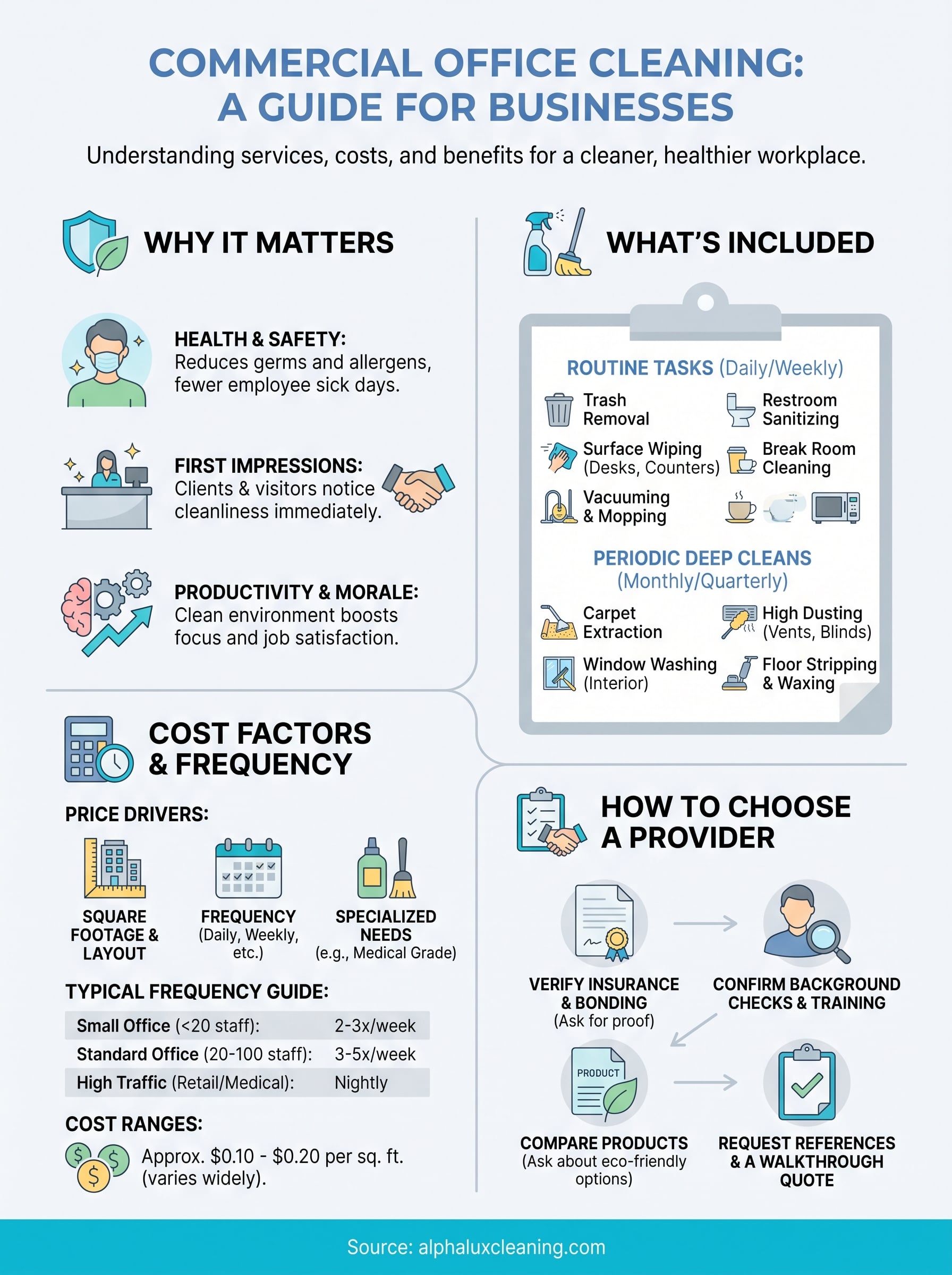
Most commercial office cleaning contracts split into two buckets: routine tasks handled every visit, and periodic deep-cleaning tasks scheduled monthly or quarterly. Knowing the difference helps you read a quote correctly and spot when a company is padding the basics or skipping things you actually need. Commercial office cleaning services vary by provider, but a solid contract should spell out both categories in writing before you sign anything.
Daily and nightly tasks
A solid office cleaning checklist for standard visits typically covers emptying trash bins, wiping down desks and common surfaces, vacuuming carpets, mopping hard floors, and sanitizing restrooms and break rooms. Kitchen areas get special attention since coffee makers, microwaves, and sink counters build up grime fast when dozens of people share them. Glass doors and entryway surfaces usually get wiped too, since smudges and fingerprints are the first thing visitors notice walking in.
If a quote doesn’t list restroom sanitizing and trash removal by name, ask why before you sign.
Periodic deep-cleaning tasks
Deeper work happens on a schedule instead of every visit, exactly the kind of detail a solid office cleaning scope of work should spell out. Carpet extraction, upholstery cleaning, and window washing usually run monthly or quarterly depending on foot traffic. High dusting for vents, light fixtures, and blinds falls into this category too, since those spots collect allergens that regular wiping never reaches. Floor stripping and waxing for tile or vinyl surfaces also gets scheduled periodically rather than nightly, since it takes longer and needs the space clear of foot traffic.
| Task | Typical Frequency |
|---|---|
| Trash removal, desk wiping | Every visit |
| Restroom and break room sanitizing | Every visit |
| Vacuuming and mopping | Every visit |
| High dusting (vents, blinds, fixtures) | Monthly |
| Carpet extraction | Quarterly |
| Window washing (interior) | Monthly to quarterly |
| Floor stripping and waxing | Quarterly to biannually |
Specialized add-ons worth asking about
Some buildings need extras beyond the standard list. Move-in and move-out cleaning gets requested when a business relocates and needs the old space returned spotless, or the new space cleared of dust before furniture arrives. Post-construction cleanup handles drywall dust and debris after renovations. Medical and dental offices often need stricter disinfecting protocols tied to specific health codes, so ask whether the provider has experience meeting those standards.
Understanding this breakdown matters when you’re comparing office commercial cleaning services across quotes, since two companies charging the same monthly rate might be delivering very different scopes of work. AlphaLux Cleaning builds every contract around a personalized cleaning plan that lists exactly what’s covered and how often, so nothing gets left to guesswork.
How much do commercial office cleaning services cost
Most commercial office cleaning services fall within typical office cleaning rates per square foot of $0.10 to $0.20 for standard nightly service, though the number swings based on how often you need visits, what condition the space is in, and whether your building requires specialized work like medical-grade disinfecting. A 3,000 square foot office cleaned three nights a week typically lands between $600 and $1,200 a month, while a smaller suite cleaned once a week can run closer to $150 to $300 a month. Nobody should quote you a flat number without first asking about your layout and frequency needs.
What drives the price up or down
Square footage is the biggest factor, but it’s not the only one. Buildings with more restrooms, kitchens, or glass surfaces take longer to service than open floor plans with the same square footage, and that extra labor shows up on the invoice. Frequency matters too: a five-night-a-week contract costs more in total but often comes with a lower per-visit rate than sporadic one-off cleanings, since the crew isn’t starting from scratch every time. Add-ons like carpet extraction, floor waxing, or post-construction cleanup get billed separately from the base contract in most cases.
Ask for a per-visit breakdown, not just a monthly total, so you know exactly what you’re paying for each service.
Typical price ranges by building type
Office type changes the equation because foot traffic and sanitation needs vary so much. Medical offices need stricter disinfecting protocols and often pay more per square foot than a standard corporate office with the same footprint. Retail spaces with heavy walk-in traffic need more frequent floor care than a back-office space where employees mostly sit at desks all day.
| Building Type | Size Range | Frequency | Estimated Monthly Cost |
|---|---|---|---|
| Small office suite | Under 2,000 sq ft | Weekly | $150 – $400 |
| Standard corporate office | 2,000 – 10,000 sq ft | 3x per week | $600 – $2,000 |
| Medical or dental office | 1,000 – 5,000 sq ft | Nightly | $800 – $2,500 |
| Retail or coworking space | 2,000 – 8,000 sq ft | Nightly | $1,000 – $3,000 |
Getting an accurate number for your own space means skipping the phone quote and requesting an in-person walkthrough, since square footage alone doesn’t capture how many restrooms, kitchens, or high-traffic zones your building has. When you’re comparing cleaning services for office buildings near me, a written quote tied to a walkthrough beats a ballpark figure every time. AlphaLux Cleaning provides a free estimate after seeing your property in person, so the number you get reflects your actual space instead of a generic average.
How often should you schedule professional office cleaning
How often should an office be cleaned depends on foot traffic, industry, and how many people share the space every day. A quiet law office with five employees doesn’t need the same schedule as a retail storefront with hundreds of visitors walking through daily. Getting the frequency right matters as much as picking the right provider, since too little cleaning lets grime build up and too much wastes money on visits nobody notices.
Matching frequency to your business type
General office spaces with under 20 employees usually do fine with cleaning three times a week, covering trash, restrooms, and common surfaces without letting dust pile up between visits. Businesses with heavier foot traffic, like medical offices, retail stores, or coworking spaces, typically need nightly service because so many people touch surfaces and track in dirt throughout the day. Warehouses and industrial spaces fall somewhere in between, often needing weekly deep attention to floors and loading areas paired with lighter daily upkeep in office sections.
The right cleaning frequency isn’t about a fixed rule, it’s about how many people touch your space every day.
A quick reference for scheduling decisions
Use this as a starting point, then adjust based on your actual traffic and any health-related requirements specific to your industry.
| Business Type | Typical Employee/Visitor Count | Recommended Frequency |
|---|---|---|
| Small professional office | Under 20 | 2-3x per week |
| Standard corporate office | 20-100 | 3-5x per week |
| Medical or dental office | Any size | Nightly |
| Retail or coworking space | High foot traffic | Nightly |
| Warehouse or industrial | Varies | Weekly deep clean + daily light upkeep |
Signs you need to adjust your schedule
Watch for a few practical signals that your current frequency isn’t cutting it. Trash bins overflowing before the next scheduled visit, sticky break room counters that stay sticky, or employees mentioning a stale smell in the bathroom all point to a schedule that’s falling behind actual need. On the other side, if a cleaning crew shows up and there’s genuinely nothing to do because the last visit still holds up, you might be paying for more frequency than the space requires.
Seasonal shifts matter too. Flu season, allergy season, and any stretch where more employees are out sick justify bumping up disinfecting frequency temporarily, even if you scale back afterward. Cleaning services for office buildings near me searches spike every fall for exactly this reason, since businesses realize their existing schedule doesn’t hold up once cold and flu season hits. A good provider will flex with you rather than locking you into a rigid contract that ignores these swings, and that flexibility is worth asking about before you sign anything long-term.
Keeping your workplace consistently clean
A clean office isn’t a one-time fix, it’s a routine that protects your team’s health, your building’s condition, and the impression you make on everyone who walks through the door. Commercial office cleaning services work best when you match the frequency to your actual foot traffic, verify the provider’s insurance and training upfront, and get a written scope that spells out exactly what’s covered every visit versus what’s scheduled quarterly. Skipping that homework is how businesses end up with vague contracts, surprise fees, and crews that miss the details that matter most.
Now you know what a fair quote looks like and what questions separate a reliable provider from a risky one. If you’re ready to stop guessing and get a number based on your actual space, request a free estimate through our office cleaning services and see what a properly scoped cleaning plan looks like for your building.