Your standard shop vac isn’t just failing to clean your new renovation; it’s likely recirculating microscopic silica dust that can linger in the air for weeks. It’s a common frustration for property owners who expect a flawless finish after months of construction. You’ve invested significantly in high-end materials, so the last thing you want is a standard cleaning tool scratching a fresh marble slab or failing to meet the strict OSHA silica standards. Mastering a professional post construction cleaning checklist nyc is about more than just tidying up. It’s a technical restoration process that requires specific, industrial grade equipment to ensure the air is as clean as the surfaces.
This guide provides the technical clarity you need to transition your space from a dusty site to a pristine sanctuary. We’ll detail the essential gear for 2026, from HEPA-filtered vacuums that capture particles as small as 0.3 microns to the latest smart cleaning technology. You’ll learn the difference between consumer-grade tools and the professional equipment necessary for move-in ready results. By the end, you’ll understand how to protect your investment and achieve the quiet satisfaction of a truly healthy, well-maintained environment.
Key Takeaways
- Learn why standard vacuum filters fail against fine silica dust and how HEPA-certified technology protects both your respiratory health and your property.
- Identify the specific industrial-grade equipment needed for each phase of the process, from heavy-duty debris removal to delicate glass detailing.
- Master the technical requirements of a professional post construction cleaning checklist nyc to ensure every high-end finish is handled with precision.
- Understand the critical differences between consumer and professional tools, focusing on motor durability and advanced multi-stage filtration systems.
- Discover how a structured, three-phase cleaning approach guarantees a move-in ready environment with superior air quality and visual perfection.
Why Standard Tools Fail: The Technical Demands of Post-Construction Cleaning
Post-construction cleaning isn’t just a more intensive version of a weekend tidy-up. It’s a multi-stage technical restoration. This process happens in three distinct phases: the rough clean, the light clean, and the final detail. Each stage requires a specific set of tools and a deep understanding of material science. Many property owners assume their existing equipment can handle the aftermath of a renovation, but construction debris presents unique challenges that general cleaning methods simply cannot address. When you consult a professional post construction cleaning checklist nyc, you’ll see a heavy emphasis on industrial-grade technology designed to manage the specific physics of construction waste.
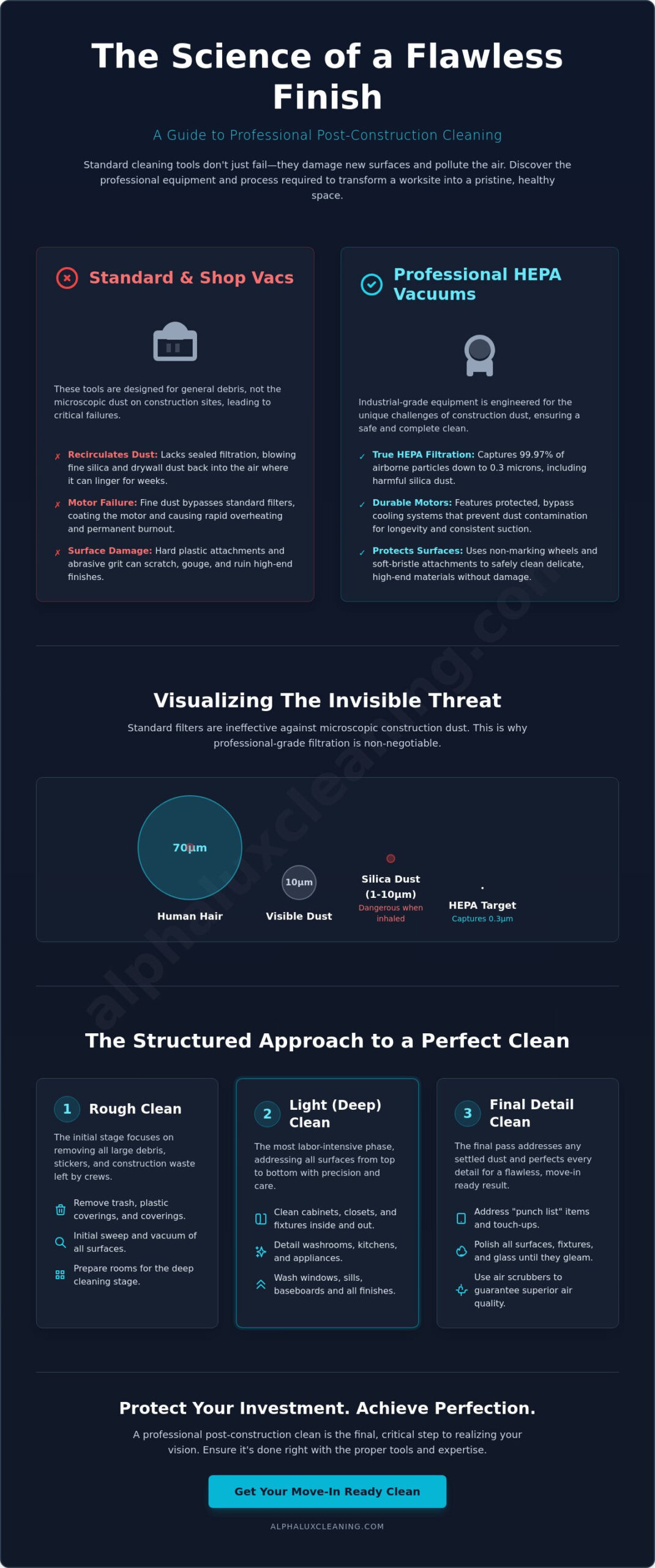
Standard household vacuums often fail because they rely on motors cooled by the air they pull in. When fine drywall dust enters these machines, it passes right through standard filters and coats the internal components. This leads to several critical issues:
- Immediate motor overheating and permanent mechanical failure due to dust accumulation.
- A rapid loss of suction as fine particles clog the porous structure of standard paper bags or foam filters.
- The risk of cross-contamination, where abrasive grit is spread across different surfaces, ruining high-end finishes.
Using the wrong tools doesn’t just result in a poor clean; it can actively damage your new investment. A professional approach treats the cleanup as a craft that prioritizes the integrity of your space.
The Danger of Fine Particulate Matter
Drywall and silica dust are remarkably small. While standard household dust is usually visible to the naked eye, construction particulates often measure between 1 and 10 microns. For context, a human hair is roughly 70 microns wide. Standard shop vacs or domestic uprights lack the HEPA certification required to trap these microscopic particles. Instead of removing the dust, they act as blowers. They exhaust the fine powder back into the air where it eventually settles into your building’s HVAC system. This creates a cycle of poor air quality and can lead to lingering respiratory irritation for anyone in the space. Professional-grade filtration is the only way to break this cycle.
Protecting New Surfaces from Tool Damage
The beauty of a new NYC renovation lies in its pristine surfaces, but these are exactly what standard tools often destroy. When abrasive dust gets trapped in the fibers of a traditional string mop, it acts like sandpaper. It leaves micro-scratches across new hardwood or polished stone that are difficult to buff out later. Similarly, the hard plastic attachments found on consumer vacuums are notorious for leaving permanent gouges on soft finishes. Professional post construction cleaning checklist nyc protocols require equipment with non-marking wheels and soft, natural-fiber brushes. These tools ensure that the process of cleaning doesn’t become a process of destruction, maintaining the quiet satisfaction of a flawless environment.
The Ultimate Post-Construction Cleaning Equipment List: Essential Gear for 2026
Transitioning to a professional-grade arsenal is the only way to meet the rigorous demands of a modern renovation. A comprehensive post construction cleaning checklist nyc must prioritize equipment that addresses both visible debris and invisible air pollutants. In 2026, the industry has shifted toward high-efficiency technology that integrates better filtration and smarter surface care. These tools don’t just clean; they preserve the integrity of high-end NYC properties while ensuring the health of the future occupants.
HEPA Vacuums and Air Filtration
A true HEPA-certified vacuum is the cornerstone of any professional gear list. To meet technical requirements, the machine must maintain 99.97% efficiency at capturing particles as small as 0.3 microns. You’ll often see consumer models labeled as “HEPA-ready,” but these lack the sealed gaskets and multi-stage filtration required to prevent silica leakage. For large-scale Manhattan commercial renovations, air scrubbers and negative air machines are essential. These units cycle the air through medical-grade filters, capturing airborne dust before it can settle into new upholstery or ventilation ducts. This level of care aligns with OSHA’s housekeeping standard, which demands the prompt and safe removal of hazardous debris.
Surface-Specific Cleaning Arsenal
Protecting delicate finishes requires a nuanced approach to fabrics and mechanics. Microfiber systems are categorized by GSM (grams per square meter) to ensure the right friction for the right surface. Low-GSM cloths are ideal for streak-free glass and mirrors, while high-GSM cloths trap heavier dust on textured stone. To maintain floor integrity, the “Two-Bucket” system is a non-negotiable standard. This method separates dirty rinse water from the clean solution, preventing the graying of grout lines that often occurs with traditional mopping. For architectural details and high-reach areas, specialized dusting kits with telescoping t-bars and natural fiber heads ensure no ledge is overlooked. If you prefer a team that already utilizes this advanced technology, you might consider the post-construction cleaning services provided by AlphaLux Cleaning.
Eco-Friendly Chemical Solutions
The chemistry of cleanup is just as vital as the hardware. Freshly installed marble, walnut, or brass can be permanently etched by acidic or alkaline cleaners. Professionals rely on pH-neutral solutions that lift construction film without compromising the material. In a freshly sealed environment, VOC-free products are mandatory to maintain indoor air quality and prevent the “new building” smell from becoming a chemical hazard. Using non-toxic degreasers is also essential for removing adhesive residue and protective films without damaging the underlying finish. This meticulous selection of chemicals ensures a move-in ready result that’s safe for children and pets.
Finally, different stone finishes require specific mechanical interventions. Auto-scrubbers are perfect for large porcelain tile expanses, providing consistent pressure and immediate water recovery. Conversely, high-speed buffers with specialized pads are necessary for restoring the luster of natural stone that may have been dulled during the construction phase. Integrating these tools into your post construction cleaning checklist nyc ensures a professional result that protects your investment for years to come.
Professional Grade vs. Residential Tools: Why the Investment Matters
Choosing between consumer-grade and industrial equipment isn’t just about power; it’s about endurance. Industrial motors are engineered for eight or more hours of continuous operation, whereas residential motors often overheat after sixty minutes of heavy suction. When you’re managing a post construction cleaning checklist nyc, this durability is the difference between finishing a project on time and dealing with equipment failure in the middle of a shift. Professional tools don’t just work harder; they work longer. They are the backbone of a reliable restoration process.
Professional equipment also features multi-stage filtration systems that outperform standard bagless models. These systems are designed to meet OSHA’s respirable crystalline silica standard, ensuring that hazardous dust is contained rather than redistributed. While a household vacuum might look clean on the outside, it often leaks microscopic irritants back into your freshly painted rooms. Industrial units use sealed gaskets to maintain a closed loop, protecting the air you breathe.
Efficiency is another critical factor where professional gear pulls ahead. Pro-grade floor scrubbers can save up to 70% of labor time compared to manual mopping. This allows for a deeper clean without extending the project timeline. Beyond speed, professional tools prioritize safety on active NYC sites. They include grounded, high-visibility cords and ergonomic designs that reduce worker fatigue. These features ensure that the cleaning team remains focused on the meticulous details of your property rather than struggling with inadequate hardware.
The Cost of Tool Failure
The hidden expenses of using inferior tools can quickly exceed the initial savings. If a consumer vacuum dies mid-project, the resulting downtime and the need for an immediate replacement disrupt the entire workflow. Even worse, using incorrect scrubbing pads or abrasive brushes can cause permanent surface damage that requires costly restoration. The total cost of ownership for professional gear reflects its long-term reliability and the protection it provides for your high-end finishes. It’s a strategic investment in the longevity of your space.
Air Quality Standards in NY Real Estate
High-end New York real estate often targets specific air quality certifications like LEED or WELL building standards. These require verifiable air quality metrics that only industrial-grade air scrubbers and HEPA vacuums can achieve. By using advanced technology, AlphaLux Cleaning exceeds local safety regulations, providing a level of care that prioritizes both the aesthetic and environmental health of your space. This meticulous approach ensures that the indoor environment is as refined as the architecture itself, providing you with true peace of mind.
Organizing Your Arsenal: Equipment Needs for the Three Stages of Cleanup
A professional post-construction cleanup is a chronological process that requires different tools at every turn. You can’t achieve a move-in ready finish by using the same equipment for the initial sweep as you do for the final polish. A robust post construction cleaning checklist nyc organizes these efforts into three distinct phases: the rough clean, the final clean, and the touch-up. This structured approach ensures that you aren’t just moving dust around; you’re systematically removing it from the environment to create a truly healthy space.
Phase 1: The Rough Sweep
During the rough sweep, the goal is the removal of bulk debris and hazardous materials. Industrial brooms and heavy-duty bags are the primary tools here. One essential piece of equipment often overlooked is the magnetic sweeper. These tools are critical for finding hidden metal shards, nails, and screws in subfloors before they can puncture new finishes or injure occupants. For bulk debris that is too large for a broom but too heavy for a detail vacuum, a high-capacity shop-vac is used. This stage also involves heavy-duty scrapers and specialized adhesive removers to clear floor surfaces of paint drips and construction film, preparing the foundation for finer work.
Phase 2 & 3: Precision and Polishing
Once the bulk debris is gone, the transition to precision tools begins. This is when HEPA-only vacuuming becomes mandatory to prevent the redistribution of fine particulates that we discussed in earlier sections. The final clean involves detailing every fixture, from recessed lighting to the interiors of HVAC vents. It’s a meticulous process that includes damp-mopping with pH-neutral solutions to ensure surfaces are residue-free and the air remains clear. Final floor buffing and sealing techniques are applied here to provide that signature move-in ready glow.
Even with the best equipment, the “dust settle” phenomenon is a reality in NYC renovations. Microscopic particles often linger in the air for days before finally resting on horizontal surfaces. A professional strategy includes a “powder puff” or touch-up clean approximately 48 hours after the final sweep. This pass uses microfiber polishers and air quality checks to ensure the space is truly pristine. If you want to ensure your property meets these exacting standards without managing the logistics yourself, you can book a professional post-construction cleaning with AlphaLux Cleaning.
Managing these stages requires a deep inventory of specialized gear and a disciplined timeline. By organizing your arsenal according to these phases, you ensure a safe, efficient, and visually stunning result that respects the high-end nature of your property. This methodical approach is what separates a basic cleaning from a professional technical restoration.
The AlphaLux Cleaning Advantage: Meticulous Post-Construction Cleaning in New York
AlphaLux Cleaning serves as a dedicated technical partner for property owners who demand more than a superficial sweep. We’ve made a significant investment in the industrial HEPA-certified technology and eco-friendly solutions required to meet the standards discussed throughout this guide. Our team consists of vetted, insured professionals who undergo rigorous training in specific post-construction protocols. This ensures that whether we’re managing a sprawling Long Island estate or a high-traffic Manhattan commercial space, the results are consistently exceptional. Our comprehensive approach to the post construction cleaning checklist nyc ensures that every square inch of your property is addressed with technical precision.
Why NY Builders and Homeowners Trust AlphaLux Cleaning
Builders and homeowners trust AlphaLux Cleaning because we understand the fragility of new finishes. We use non-toxic, pH-neutral products that protect your health and your home’s aesthetic integrity. We bridge the gap between the final contractor walkthrough and your first night in the space, providing the professional cleaning services necessary for a truly spotless environment. Our expertise with high-end materials allows us to execute the most demanding post construction cleaning checklist nyc with effortless precision. We take immense pride in our ability to handle complex details, from delicate light fixtures to expansive natural stone flooring, with the meticulous care they deserve.
Reclaim Your Time and Peace of Mind
Walking into a property that has just undergone months of renovation can be overwhelming. The emotional relief of entering a pristine, dust-free sanctuary is the ultimate goal of our work. By letting the experts at AlphaLux Cleaning handle the heavy lifting and technical filtration, you reclaim your time and mental clarity. We provide a lifestyle solution that allows you to focus on enjoying your new space rather than worrying about lingering silica or hidden debris. Our process is unhurried and informative, ensuring you feel catered to at every step of the restoration. We manage the complex details so you can enjoy the quiet satisfaction of a perfectly maintained home.
Ensure your project ends with perfection-book our post-construction services today.
Experience the Peace of a Pristine New Environment
Achieving a move-in ready finish requires more than just effort; it demands the right technical arsenal. The transition from a dusty construction site to a refined sanctuary depends on high-efficiency HEPA filtration and the disciplined, three-phase restoration process we’ve outlined. By prioritizing industrial-grade durability and surface-specific care, you protect your investment from the microscopic debris that standard tools often leave behind. Mastering your post construction cleaning checklist nyc is the final step in ensuring your property is as healthy as it is beautiful.
AlphaLux Cleaning provides the expertise and specialized equipment needed to manage these complex details for you. Our fully vetted and insured professional cleaners utilize eco-friendly, non-toxic products exclusively, ensuring a safe environment for your family or staff. We specialize in the meticulous care required for high-end New York residential and commercial properties, bridging the gap between construction and occupancy with a flawless white-glove finish. Request a Specialized Post-Construction Cleaning Quote and reclaim your time today. You’ve worked hard to build your vision; let us ensure it shines exactly as you intended.
Frequently Asked Questions
Can I use a regular Shop-Vac for post-construction cleaning?
You can use a standard Shop-Vac for the rough clean phase to remove large debris like wood scraps or metal shards. However, it’s inadequate for fine drywall or silica dust. Standard filters allow microscopic particles to pass through the motor and exhaust back into your living space, which can damage the machine and compromise your air quality. For fine dust, a HEPA-certified vacuum is mandatory.
What is the most important piece of equipment for construction cleanup?
A true HEPA-certified vacuum is the most critical tool in any professional post construction cleaning checklist nyc. Unlike standard vacuums, these units are sealed to capture 99.97% of particles as small as 0.3 microns. This ensures that hazardous silica dust is permanently removed from the environment rather than recirculated into your new HVAC system or settled onto your fresh paint and upholstery.
How do I get rid of the “white film” on my new floors after construction?
That white film is usually a layer of fine dust or grout haze that requires multiple damp-mopping passes. Use a pH-neutral cleaner and the two-bucket system to ensure you aren’t just spreading the residue. For stubborn film on natural stone, a high-speed buffer with a non-abrasive pad can restore the surface’s original luster without scratching the new finish or damaging the sealant.
Is a HEPA vacuum really necessary for a small home renovation?
Yes, a HEPA vacuum is essential regardless of the project’s physical size. Even small renovations involving drywall or tile cutting generate respirable crystalline silica, which is a significant health hazard. Using a HEPA-certified machine protects your respiratory health and prevents fine dust from lingering in your home’s air and fabrics long after the contractors have departed and the project is finished.
What PPE should I wear when doing my own construction cleanup?
Safety should be your first priority when handling construction debris. At a minimum, wear an N95 or P100 respirator to protect against fine particulates, along with impact-resistant safety glasses and heavy-duty work gloves. If you’re working in a space with significant airborne dust, consider wearing disposable coveralls to prevent carrying contaminants into other areas of your property or into your vehicle.
How long should I wait for dust to settle before the final clean?
You should wait at least 24 to 48 hours after construction activity ends before beginning the final detailing pass. This allows airborne particles to settle on horizontal surfaces where they can be effectively captured. A professional post construction cleaning checklist nyc often includes a secondary touch-up pass two days later to address any remaining dust settle that occurred after the initial deep cleaning.
What is the difference between a rough clean and a final clean?
A rough clean focuses on removing large debris, trash, and hazardous materials like nails to prepare the site for flooring or final finishes. In contrast, a final clean is a meticulous, top-to-bottom detailing of every surface, including windows, light fixtures, and inside cabinets. The final clean aims for a move-in ready state, prioritizing both superior air quality and visual aesthetic perfection.