
A professional commercial cleaning service agreement is far more than a legal formality; it’s a strategic roadmap for your brand’s reputation and your team’s health. You’ve likely felt the frustration of walking into a “half-cleaned” office or the sting of a hidden fee that wasn’t mentioned in your initial quote. In the high-stakes environment of New York, these small oversights can lead to significant anxiety over liability and insurance coverage. It’s exhausting to manage a facility when the standards aren’t clearly defined, leaving you to wonder if your space is truly as safe as it looks.
This guide will help you master the essential components of a professional contract to ensure your facility receives consistent, high-quality care without financial surprises. We’ll show you how to build a predictable monthly budget while navigating specific 2026 NYC regulations, such as the seventeen dollar minimum wage and new sidewalk cleanliness standards. By the end of this article, you’ll have the tools to create an enforceable plan for your office cleaning needs, giving you the peace of mind that comes from a perfectly managed environment.
Key Takeaways
- Understand why a formal Service Level Agreement (SLA) is essential for maintaining professional standards and moving beyond unreliable handshake deals.
- Learn how to map a meticulous Scope of Work that defines every cleaning interval to eliminate vague service descriptions and “half-cleaned” offices.
- Identify the critical legal safeguards and insurance requirements necessary to protect your New York facility from liability and unexpected financial risks.
- Master the art of negotiating a commercial cleaning service agreement to ensure total pricing transparency and a predictable monthly maintenance budget.
- Discover how to structure a cleaning partnership that prioritizes long-term value, employee wellness, and the quiet satisfaction of a truly pristine environment.
What is a Commercial Cleaning Service Agreement and Why is it Essential?
A commercial cleaning service agreement is a formal, legally binding contract that establishes the professional relationship between your business and your cleaning provider. It’s the foundation of a well-managed facility. While some smaller operations still rely on handshake deals, modern New York businesses require the protection of a structured document. Think of it as a specialized Master Service Agreement (MSA) that outlines the terms, expectations, and legal protections for both parties over a specific period. Without this documentation, you risk “scope creep,” where tasks are missed or “half-cleaned” because they weren’t explicitly defined, leading to budget overruns and operational frustration.
Beyond simple aesthetics, a modern agreement prioritizes “cleaning for health” rather than just “cleaning for appearance.” In 2026, this means shifting focus toward targeted disinfection of high-touch surfaces and the use of HEPA filtration systems to improve indoor air quality. When these standards are written into your contract, you’re not just buying a tidy office; you’re investing in a scientifically backed environment that supports the physical well-being of every person who walks through your doors. It transforms a routine task into a professional craft that protects your most valuable assets.
The Strategic Value of Professional Documentation
Documented cleaning standards act as a silent partner for facility managers. They reduce administrative friction by providing a clear baseline for accountability. When every square foot is mapped and every task is scheduled, there is no room for ambiguity. This level of precision doesn’t just protect your budget; it significantly impacts employee retention. A meticulously maintained workspace signals to your team that their comfort and health are a priority. It creates a sense of quiet satisfaction and mental clarity that allows them to focus on their best work without the distraction of a neglected environment.
Contract Types: Fixed-Term vs. Month-to-Month
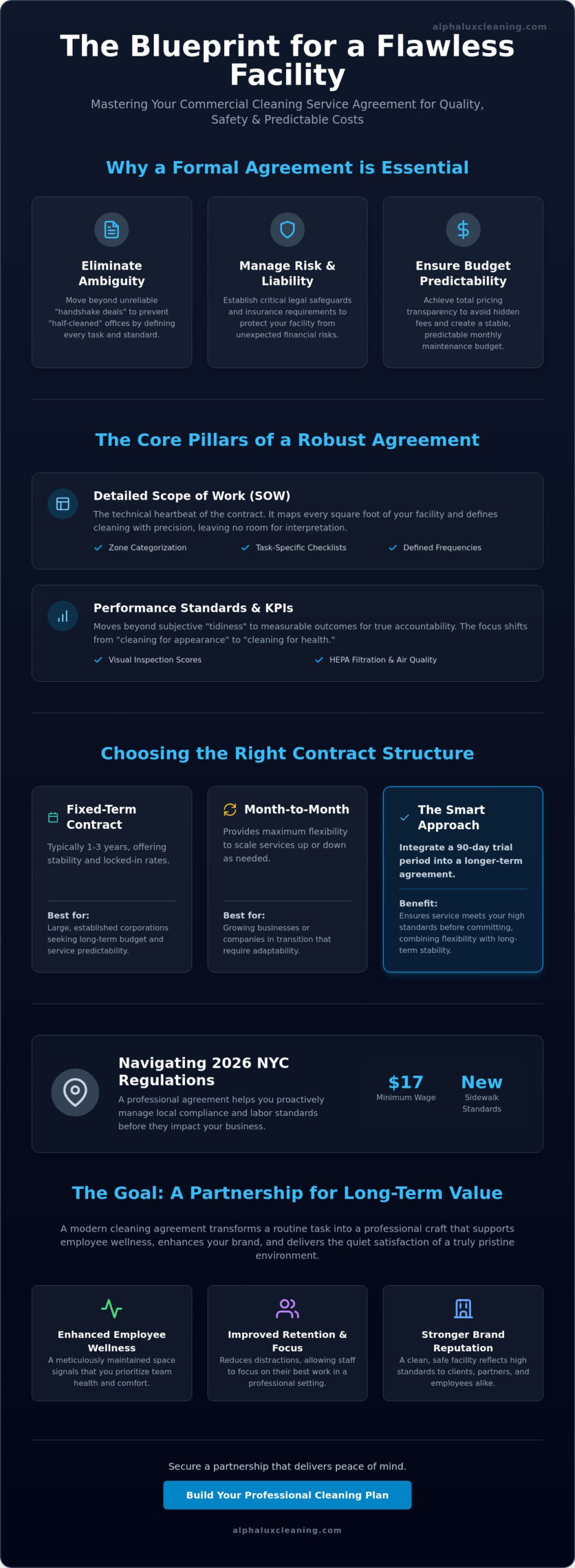
Choosing the right structure for your commercial cleaning service agreement depends on your business’s current lifecycle. Large, established corporations often prefer fixed-term contracts, typically lasting one to three years. These agreements lock in rates and provide a sense of long-term stability. However, growing businesses or those in transition might find more value in month-to-month flexibility. This allows you to scale services as your footprint expands. To find the perfect balance, many organizations structure a ninety day trial period within a larger agreement. This “get to know you” phase ensures the service meets your high standards before you commit to a long-term partnership.
The Core Pillars of a Robust Cleaning Contract: Scope and Standards
A robust commercial cleaning service agreement relies on precision. It moves beyond vague promises of “tidiness” to provide a granular breakdown of every task performed. This clarity ensures that both the facility manager and the service provider share a single vision of excellence. By establishing these pillars early, you eliminate the “half-cleaned” office syndrome and replace it with the quiet satisfaction of a meticulously maintained environment. It’s about transforming a basic necessity into a professional craft that supports your business’s broader goals.
Defining the Scope of Work (SOW)
The Scope of Work (SOW) is the technical heartbeat of any commercial cleaning partnership. It functions by categorizing your facility into distinct zones, acknowledging that a high-traffic lobby requires a different level of care than a back-office storage room. A meticulous SOW includes task-specific lists ranging from high-dusting of light fixtures to specialized floor care and window cleaning. For those seeking the highest level of accountability, looking at government performance standards provides a template for the level of detail required in professional contracts. This mapping ensures every square foot of your facility is accounted for and cared for with intentionality.
Defining “clean” through Key Performance Indicators (KPIs) removes subjectivity from the process. These metrics might include visual inspection scores or ATP swab testing for high-touch surfaces to ensure health standards are met. Additionally, the contract must clarify equipment ownership. It should specify who provides the HEPA-filter vacuums, the microfiber systems, and the eco-friendly, low-VOC chemicals essential for a healthy workplace. If you’re unsure which standards best fit your specific space, a consultation for recurring office cleaning can help clarify these technical requirements before you sign.
Frequency and Timing Logistics
Timing is a critical operational consideration that impacts your daily flow. After-hours cleaning offers the relief of arriving at a pristine office each morning, while daytime porter services ensure high-traffic restrooms and common areas remain immaculate during peak hours. Your agreement should also include clauses for emergency spills or seasonal adjustments. In New York, the winter months bring slush, salt, and mud that demand more frequent floor maintenance to preserve your facility’s integrity. A flexible schedule allows your cleaning plan to adapt to these environmental pressures without requiring a complete contract overhaul.
- Daily Tasks: Trash removal, restroom sanitization, and high-touch surface disinfection.
- Weekly Tasks: Detailed vacuuming, glass entry cleaning, and breakroom deep-cleans.
- Monthly/Quarterly Tasks: Floor burnishing, carpet extraction, and high-ceiling dusting.
Legal Safeguards and Risk Management for New York Facilities
Managing a facility in New York requires meticulous attention to risk. A well-drafted commercial cleaning service agreement provides the legal infrastructure to protect your property and your people. It’s the difference between a minor operational hiccup and a catastrophic financial liability. In a city where litigation is common, these formal protections offer the relief of knowing your business is shielded from third-party claims and regulatory failures. It transforms a service contract into a comprehensive risk management tool.
Indemnification clauses are a critical component of this protection. These clauses ensure that the cleaning provider remains responsible for any losses, damages, or injuries caused by their own negligence. If a visitor slips on a freshly mopped floor that lacked proper signage, a strong indemnification agreement prevents that liability from falling on your business. It establishes a clear boundary of responsibility that protects your financial interests and your brand’s reputation for safety. This legal clarity is essential for any high-end professional partnership.
Insurance Requirements in New York State
In the New York market, a Certificate of Insurance (COI) is non-negotiable. Your agreement should specify that the provider maintains General Liability, Workers’ Compensation, and Umbrella policies. Hiring “uninsured” or under-insured cleaners to save on costs is a gamble that rarely pays off. AlphaLux Cleaning prioritizes the safety of your facility by deploying only vetted, fully insured professionals to every site. This commitment ensures that every worker on your premises is covered, removing the anxiety of potential lawsuits or medical claims from your plate.
Health, Safety, and Environmental Compliance
Compliance with OSHA standards is a baseline for professional cleaning operations. Your provider must maintain up-to-date Material Safety Data Sheets (MSDS) for every chemical used on-site. These documents must be easily accessible to ensure safety during accidental exposure. Modern New York offices are increasingly demanding non-toxic, eco-friendly products that align with both health standards and corporate sustainability goals. For a detailed look at the specific regional standards required for your space, you can review our guide on commercial cleaning services nyc. This ensures your facility remains compliant with local health codes while fostering a superior sensory experience for your staff.
Finally, your agreement should define a “Right to Inspect” and a clear dispute resolution process. If service quality dips below the standards established in your Scope of Work, the contract should outline a specific timeframe, such as 24 hours, for the provider to rectify the issue. This creates a logical path for accountability without immediately resorting to legal conflict. It maintains the premium atmosphere of your facility through proactive management and mutual respect.
Avoiding Common Pitfalls: What to Negotiate Before You Sign
Accepting a generic template is one of the most common mistakes facility managers make. While a standard form provides a starting point, a truly effective commercial cleaning service agreement must be tailored to the unique rhythms of your New York workspace. Negotiation isn’t about conflict; it’s about establishing mutual respect and clear boundaries. By addressing potential friction points before you sign, you ensure a relationship built on transparency and long-term value rather than hidden surprises. It’s the difference between a rigid document and a flexible roadmap for your facility’s success.
Pricing Structures and Payment Terms
Your budget relies on predictability. Choosing between a fixed monthly fee and an hourly rate depends on your facility’s stability. Fixed fees offer the quiet satisfaction of a set expense, while hourly rates provide granular control for fluctuating needs. Be sure to examine any “Inflation Clauses.” With the New York City minimum wage reaching seventeen dollars per hour in 2026, labor costs are a significant factor in any service contract. A fair agreement acknowledges these shifts while protecting you from sudden, unannounced price hikes. It’s also wise to align payment windows, such as Net 30 terms, with your existing cash flow to maintain administrative ease.
Watch for hidden costs that often lurk in the fine print. Some providers add surcharges for fuel, equipment maintenance, or specialized supplies after the initial quote is delivered. A premium partner will offer total transparency, bundling these costs into a single, honest figure. If you’re currently vetting providers, our guide on choosing a cleaning company offers deeper insights into identifying trustworthy partners who prioritize integrity over upselling. This clarity allows you to treat your cleaning service as a deductible business expense without the headache of reconciling unexpected line items.
The Importance of the ‘Exit Strategy’
A professional partnership should feel like a choice, not a trap. Your agreement must include a clear termination clause that protects your interests if standards slip. Standard notice periods typically range from thirty to ninety days, but the most effective contracts include a “cure period.” This allows you to issue a formal notice of a service failure, giving the provider a specific window, often 24 to 48 hours, to rectify the issue. If the failure persists, a performance-based termination clause allows you to end the agreement gracefully without legal penalty. This level of accountability ensures your facility always receives the meticulous care it deserves.
Communication is the final pillar of a successful negotiation. Insist on a single point of contact who can respond to real-time feedback. This prevents the frustration of “half-cleaned” areas by ensuring your requests are heard and acted upon immediately. As your business grows, your contract should remain flexible enough to scale with you, whether you need to add recurring cleaning days or include specialized floor care. To see how a professional plan can be tailored to your exact needs, you can get a customized quote for your facility today. This proactive approach ensures your commercial cleaning service agreement remains a vital component of a well-managed and balanced professional life.
The AlphaLux Difference: Structuring Agreements for Long-Term Value
At AlphaLux Cleaning, we view a commercial cleaning service agreement as more than a list of tasks; it’s a pledge to uphold the professional excellence of your workspace. We move beyond “standard” results by focusing on the sensory and emotional experience of a space. Our approach is designed to evoke feelings of trust and the quiet satisfaction that comes from a meticulously maintained environment. By elevating our work from a simple task to a professional craft, we ensure that your facility remains a vital component of a well-managed and balanced professional life.
The backbone of our service-oriented approach is our team of vetted professionals. We understand that the people on your site are as important as the results they produce. Every member of our staff is trained to maintain high standards of personal respect and thoroughness. This commitment to quality is reinforced by our use of eco-friendly, non-toxic products as a core feature of every contract. We don’t treat green cleaning as an optional add-on; it’s an essential contribution to the health, mental clarity, and personal comfort of everyone in your building.
Customized Cleaning Plans for New York Businesses
Every facility has a unique rhythm, and your agreement should reflect that. A medical office on Long Island requires a different level of targeted disinfection than a corporate suite in Manhattan. We specialize in tailoring our services to meet these specific needs, whether you require recurring cleaning for a high-end office or specialized post-construction cleaning to prepare a new space for occupancy. By integrating deep cleaning cycles into your regular schedule, we provide maximum value while preserving the long-term integrity of your flooring and fixtures.
This customization allows us to position cleaning as a lifestyle solution rather than a chore. We focus on reclaiming your time and providing mental peace by managing the complex details of facility maintenance. Our plans are adaptable, ensuring that as your New York business grows, your cleaning standards grow with it. We prioritize a logical structure that identifies your specific needs and immediately follows with a tangible service requirement to fulfill them.
Getting Started with AlphaLux
Our process begins with an unhurried, informative initial walkthrough of your facility. This allows us to understand the specific nuances of your space before we present a meticulously crafted commercial cleaning service agreement. Once service begins, we establish clear feedback loops to ensure our partnership stays relevant to your evolving needs. This data-driven approach allows us to monitor performance and adjust schedules in real-time, maintaining a premium atmosphere without the need for constant oversight on your part. We invite you to experience the relief and quiet satisfaction of a perfectly maintained environment that supports your team’s best work every day.
Elevating Your Facility Management Strategy
AlphaLux Cleaning is ready to help you transition from routine maintenance to a professional craft. Our team of vetted, insured professionals utilizes eco-friendly, non-toxic products to deliver a sensory experience that goes beyond the purely aesthetic. We specialize in building customizable plans for NY businesses that align with your unique operational rhythms and long-term goals. To experience the quiet satisfaction of a perfectly maintained environment, Request Your Custom Commercial Cleaning Agreement Quote from AlphaLux today. Your facility deserves the meticulous care and dependable partnership that only a premium service can provide.
Frequently Asked Questions
What is the most important clause in a commercial cleaning contract?
The Scope of Work (SOW) is the most critical clause because it defines the exact technical standards and frequency for every area of your facility. By establishing a granular list of tasks, you eliminate ambiguity and ensure your provider is held accountable for specific results. This clause serves as the strategic roadmap for your partnership, protecting you from service gaps and “half-cleaned” office spaces that can impact employee morale.
How do I calculate the cost of a commercial cleaning agreement in 2026?
Should I sign a long-term contract or a month-to-month agreement?
Established corporations often prefer long-term contracts to lock in rates and ensure operational stability, while growing businesses typically find more value in month-to-month agreements. Flexibility allows you to scale your cleaning services as your office footprint expands or changes. Many successful partnerships begin with a ninety day trial period structured into a longer agreement to ensure the provider meets your meticulous standards for quality, reliability, and personal respect.
What insurance documents should I request from a cleaning company?
You should always request a Certificate of Insurance (COI) that specifically lists General Liability, Workers’ Compensation, and Umbrella policies. These documents provide the legal and financial relief of knowing your facility is protected from third-party claims or on-site accidents. Verifying these credentials is an essential step in earning long-term trust and ensuring that your cleaning partner is responsible and serious about their professional obligations to your business.
Can I change the scope of work after the contract is signed?
Yes, you can adjust your scope of work through a formal contract amendment or addendum as your facility’s needs evolve. A professional commercial cleaning service agreement should be adaptable, allowing you to add recurring cleaning days or include specialized deep cleaning cycles for seasonal weather changes. Clear communication with your single point of contact ensures these adjustments are documented accurately and integrated into your monthly budget without administrative friction.
What happens if the cleaning company fails to meet the standards in the agreement?
If a provider fails to meet the standards outlined in your agreement, you should trigger the “cure period” or dispute resolution clause. This typically gives the cleaning company a specific window, such as 24 to 48 hours, to rectify the service failure. If the issues persist after the cure period, a performance-based termination clause allows you to end the partnership gracefully, ensuring your facility’s premium atmosphere and sensory experience are never compromised.
Is it standard for the cleaning company to provide their own supplies?
It is standard for a professional cleaning company to provide their own high-end equipment and eco-friendly supplies as part of the service agreement. This includes HEPA-filter vacuums, microfiber systems, and non-toxic, low-VOC chemicals that support a healthy indoor environment and mental clarity. Your contract should explicitly state which party is responsible for consumable paper products like towels and soap to ensure there are no surprises in your monthly maintenance budget.
How do I handle price increases in a multi-year cleaning contract?
Price increases in multi-year contracts are typically managed through an “Inflation Clause” that caps annual adjustments at a specific percentage or aligns them with the Consumer Price Index (CPI). This structure provides the quiet satisfaction of a predictable budget while acknowledging shifts in labor costs and supply prices. Transparent negotiation of these terms before you sign prevents sudden financial surprises and maintains a sense of mutual respect and intentionality between both parties.