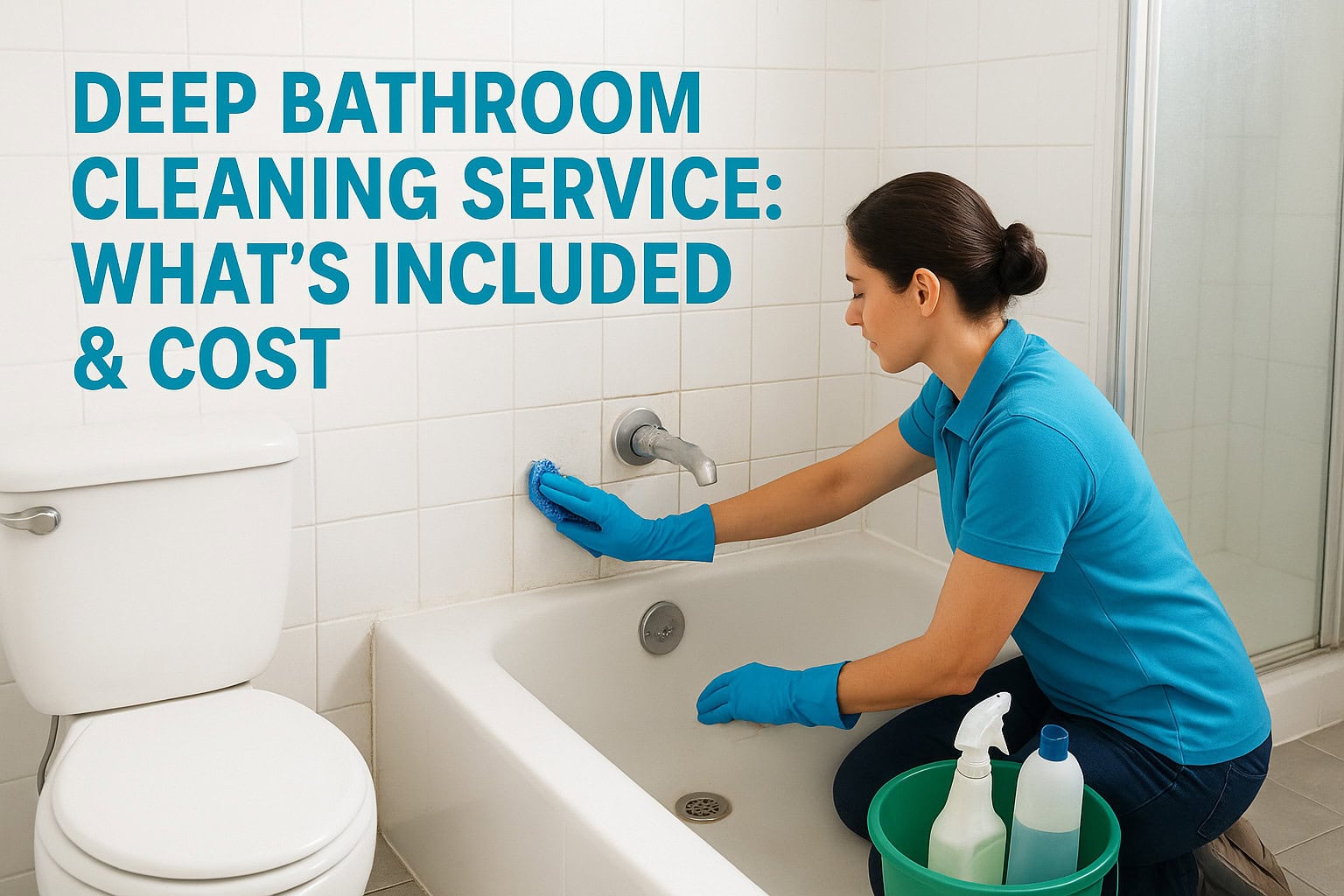
Your bathroom gets more daily use than almost any other room in your home or office, and it shows. Soap scum builds up on glass, grout lines darken, and mildew creeps into corners that a regular wipe-down never reaches. That’s exactly the problem a deep bathroom cleaning service is designed to solve. It goes far beyond surface-level tidying to strip away the grime that accumulates over weeks and months, restoring your bathroom to a genuinely hygienic, fresh condition.
At AlphaLux Cleaning, we handle deep bathroom cleans across New York State for both residential and commercial clients. Our trained, background-checked teams use eco-friendly, non-toxic products that cut through buildup without leaving harsh chemical residue behind, because a truly clean bathroom shouldn’t trade one problem for another. It’s one of the most-requested services we offer, and we understand why.
Still, if you’ve never booked a professional deep clean before, you probably have questions. What exactly does it include? How much should you expect to pay? Is it worth the cost compared to doing it yourself? This article breaks down every task typically covered in a professional deep bathroom cleaning, walks through realistic pricing, and helps you figure out when it makes sense to call in a pro versus handling things on your own.
What a deep bathroom cleaning service includes
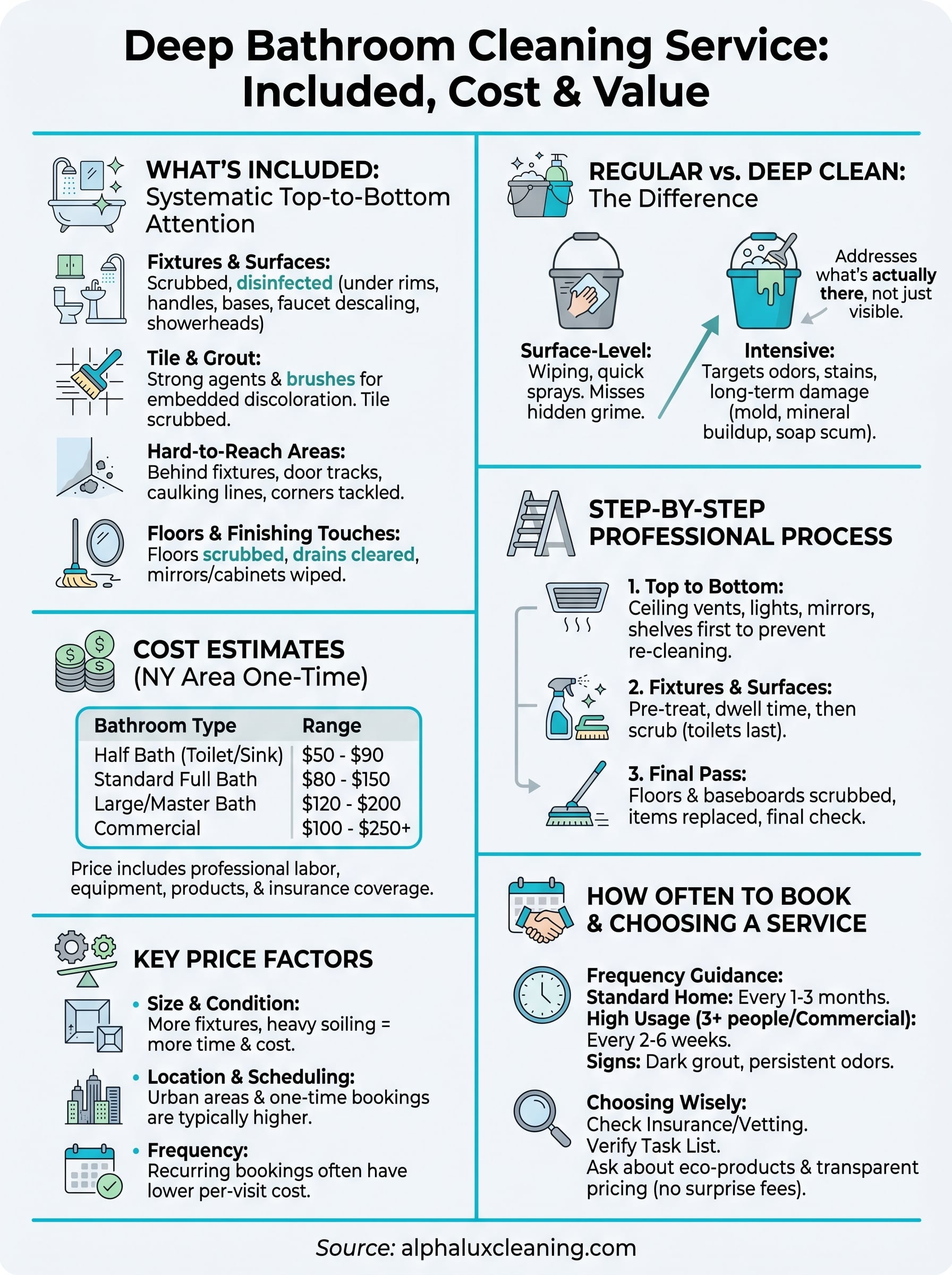
When you book a deep bathroom cleaning service, you’re paying for systematic, top-to-bottom attention that covers every surface, fixture, and corner in the room. Professionals work from ceiling to floor, tackling built-up soap scum, mineral deposits, mildew, and embedded grime that a standard weekly clean simply doesn’t reach. The exact task list varies slightly by company and bathroom size, but most reputable services follow a consistent set of standards that define what a "deep clean" actually means in practice.
A thorough deep clean typically takes two to four times longer than a standard cleaning visit, which reflects how much more work and product is actually required.
Fixtures, surfaces, and hardware
Your toilet gets the most intensive treatment of any fixture. Professionals scrub under the rim, disinfect the bowl, clean the tank exterior, wipe down the base and the areas around the floor bolts, and sanitize the seat, lid, and handle. The sink and vanity area receive similar attention: the faucet is descaled, the drain is cleared of buildup, and the basin is scrubbed rather than just wiped. Cabinet fronts, drawer handles, light switch covers, towel bars, and any exposed wall hardware also get wiped down and disinfected as part of the visit.
Your shower and bathtub are typically the most time-consuming part of the job, which is why they’re often where the biggest visible difference shows after a deep clean. Professionals treat soap scum on glass doors or curtain rods, scrub the tub interior and walls, descale faucet heads and handles, and clean out the drain. Showerheads clogged with mineral buildup often receive a targeted soak or scrub to restore water pressure and flow, something most people skip entirely during their regular cleaning routine.
Tile, grout, and hard-to-reach areas
Grout lines are one of the clearest indicators of how thorough a cleaning actually is. Over time, grout absorbs soap residue, hard water minerals, and mold spores, turning from white or light gray to dark brown or black. A deep clean targets these lines specifically, using stronger agents and brush tools to lift embedded discoloration. Tile surfaces are also scrubbed rather than just wiped to remove the thin film of soap and mineral residue that leaves them looking dull even after a regular clean.
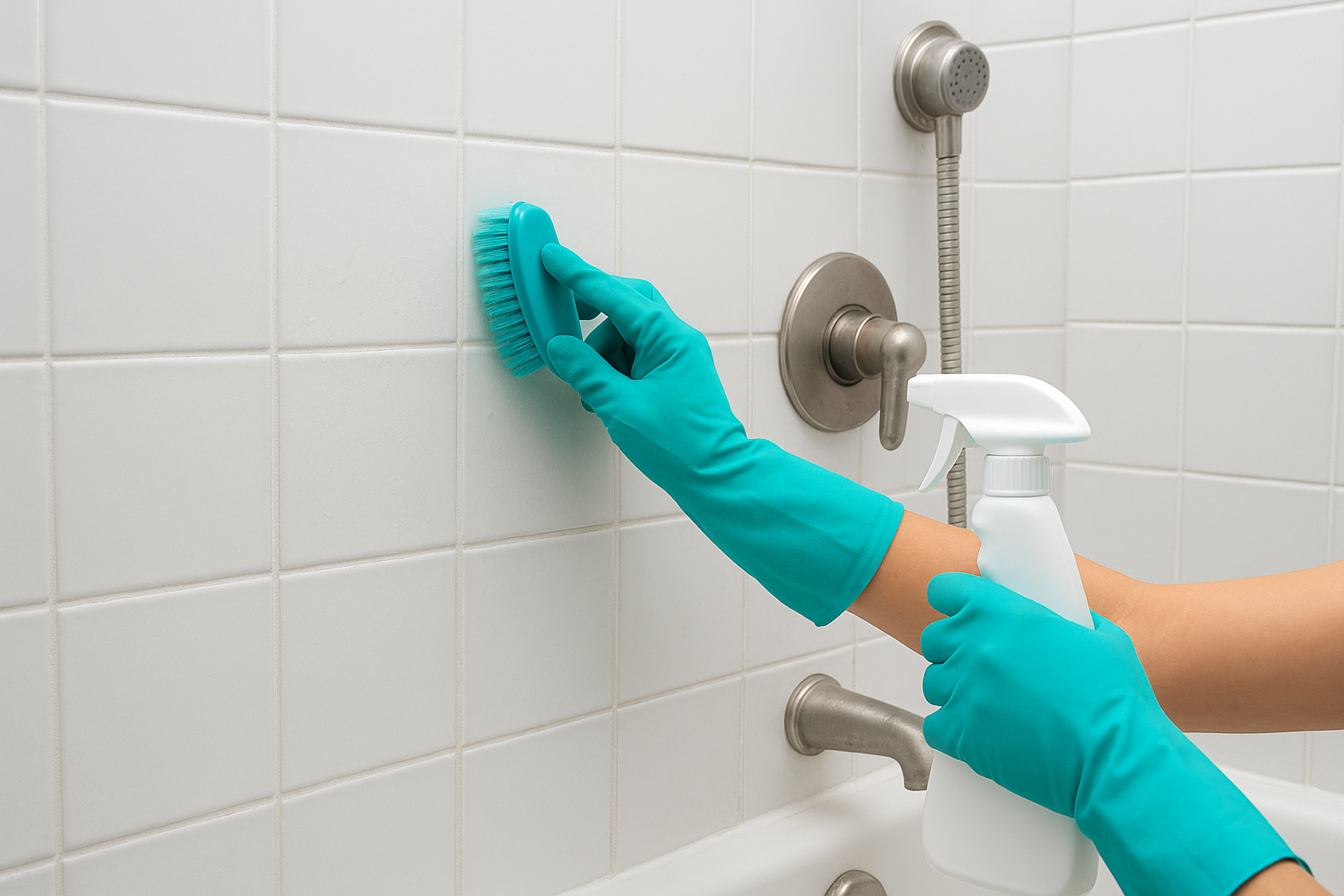
Hard-to-reach spots get deliberate attention during a deep clean in a way they rarely do otherwise. This includes behind the toilet, around the base of fixtures, inside the track of sliding shower doors, along the caulking lines between the tub and wall, and in the corner where the wall meets the floor. These areas accumulate grime quickly but get skipped in most routine cleaning passes.
Floors, drains, and finishing touches
Your bathroom floor gets scrubbed and disinfected, not just mopped. Grout lines on tile floors receive the same treatment as wall grout. The area around the toilet base, which collects splatter and dust that standard mopping misses, is cleaned thoroughly. Drains in the shower, tub, and sink are cleared of hair and debris, and drain covers are removed and cleaned separately when accessible.
Professionals also wipe down mirrors, clean the interior and exterior of the medicine cabinet, remove water spots from glass surfaces, and empty the trash. Some services include baseboard cleaning and vent covers as part of a deep bathroom clean, so it’s worth confirming the full task list when you book so you know exactly what you’re getting.
What deep cleaning covers that regular cleaning misses
A regular cleaning visit keeps your bathroom looking presentable between deep cleans, but it doesn’t come close to addressing everything. Most standard cleanings cover visible surfaces quickly: a wipe of the sink, a spray and swipe of the toilet bowl, a mop of the floor. That approach handles surface-level dirt, but the grime that causes odors, staining, and long-term damage lives in places a standard routine doesn’t touch.
The difference between a regular clean and a deep clean isn’t effort. It’s the specific areas targeted and the amount of time spent on each one.
The surfaces a standard clean skips
Your regular cleaning routine likely hits the same spots every time, which means certain areas accumulate buildup for months without any real attention. The underside of the toilet rim, for example, develops dark mineral and bacteria deposits that never appear in a quick scrub. Sliding shower door tracks collect hair, soap residue, and mold that a surface wipe won’t remove. Caulking lines along the tub, grout joints on tile walls, and the gap between the toilet base and the floor are all areas that standard cleaning passes over consistently.
These overlooked spots aren’t just cosmetic issues. Mold and mildew growing in grout or along caulking lines can spread to adjacent surfaces and contribute to air quality problems in an enclosed space. A professional deep bathroom cleaning service targets these spots directly, using appropriate tools and cleaners to address what’s actually there rather than what’s visible from a standing position.
Buildup that only intensive treatment removes
Certain types of buildup don’t respond to the products and time available in a standard cleaning. Hard water mineral deposits on faucets, showerheads, and glass require either extended dwell time with an acid-based cleaner or physical scrubbing to break down. Soap scum on shower glass forms a semi-transparent layer that ordinary sprays spread around more than they remove. Both of these issues get progressively worse the longer they go without targeted treatment, and both require the kind of deliberate, product-appropriate approach that professionals bring to the job.
Embedded grout discoloration works the same way. Once the grime bonds with the porous surface, routine mopping or wiping does little to reverse it. Getting that grout back to its original color takes scrubbing with a brush and a stronger cleaning agent than most households keep on hand.
How pros deep clean a bathroom step by step
When a professional team arrives for a deep bathroom cleaning service, they don’t start wherever seems most urgent. They follow a deliberate sequence that prevents them from contaminating surfaces they’ve already cleaned. Understanding that sequence helps you know what to expect during the visit and why the job takes as long as it does.
Working top to bottom ensures that dust, product residue, and debris from higher surfaces fall onto areas not yet cleaned, so nothing gets cleaned twice unnecessarily.
Starting at the top and working down
Professionals begin by addressing ceiling vents, light fixtures, and upper wall areas before touching anything at floor level. Exhaust vents accumulate significant dust and mold, and that debris falls when disturbed. After the high areas, they move to mirrors, shelves, and medicine cabinet surfaces, removing items temporarily to clean underneath and behind them. This systematic descent means every surface is addressed in the correct order.
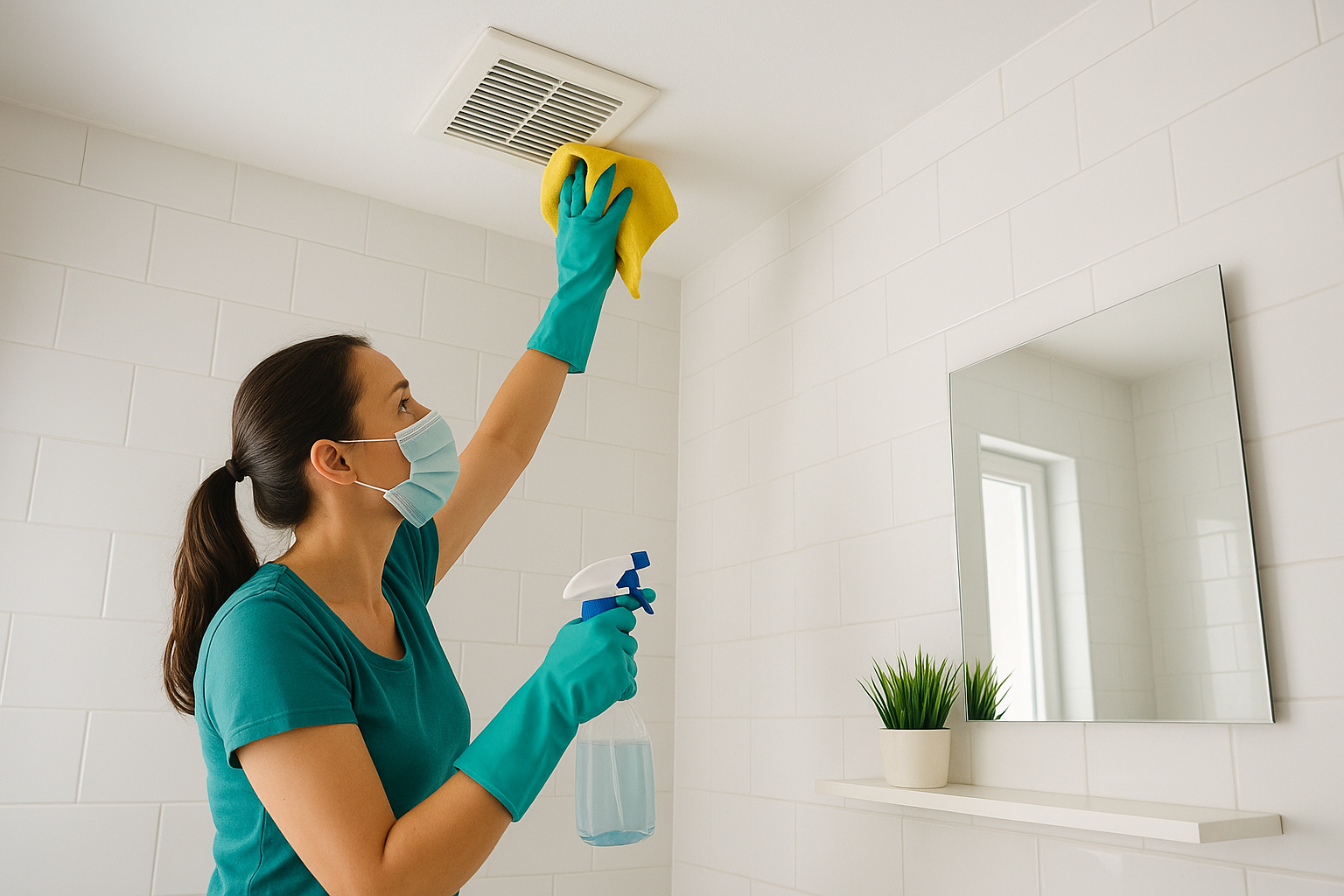
- Ceiling vents and exhaust fans cleaned and wiped
- Light fixtures and covers dusted and sanitized
- Mirrors and shelving wiped down and dried
- Medicine cabinet interior and exterior cleaned
Treating fixtures and surfaces in sequence
Once the upper areas are handled, professionals apply pre-treatment products to the toilet, sink, shower, and tub and allow dwell time before scrubbing. This matters because effective cleaners need time to break down mineral deposits and soap scum before physical agitation can remove them. While those products work, they typically tackle grout lines and tile walls with brushes, descale faucets and showerheads, and clear out drain covers. The toilet gets its most thorough scrub last within the fixture sequence, since it carries the highest contamination risk.
The final pass
After all fixtures and surfaces are scrubbed and wiped, professionals move to the floor and baseboards. The bathroom floor is scrubbed by hand or with a designated tool rather than just mopped, and grout lines on floor tile receive the same brush treatment as the wall grout. Once the floor is dry, they replace any items moved during the clean, confirm all surfaces are streak-free and dry, and do a final check for spots missed. This closing review is part of what separates a professional visit from a rushed home clean.
How much deep bathroom cleaning costs
Pricing for a deep bathroom cleaning service varies based on where you live, the size of your bathroom, and what the service includes, but you can plan around a general range that most professional companies charge. For a standard single bathroom, most homeowners in New York pay between $80 and $150 for a professional deep clean. That number rises if the bathroom is larger, heavily soiled, or hasn’t been professionally cleaned in a long time.
A one-time deep clean typically costs more per visit than the same service on a recurring schedule, since regular bookings give companies more predictable revenue and lower per-visit overhead.
Typical price ranges by bathroom type
Your final price depends significantly on the type and size of the space you need cleaned. A small half-bath with just a toilet and sink sits at the low end, while a full master bath with double vanities, a walk-in shower, and a soaking tub sits considerably higher. The table below gives you a realistic starting point for what to expect in the New York area.
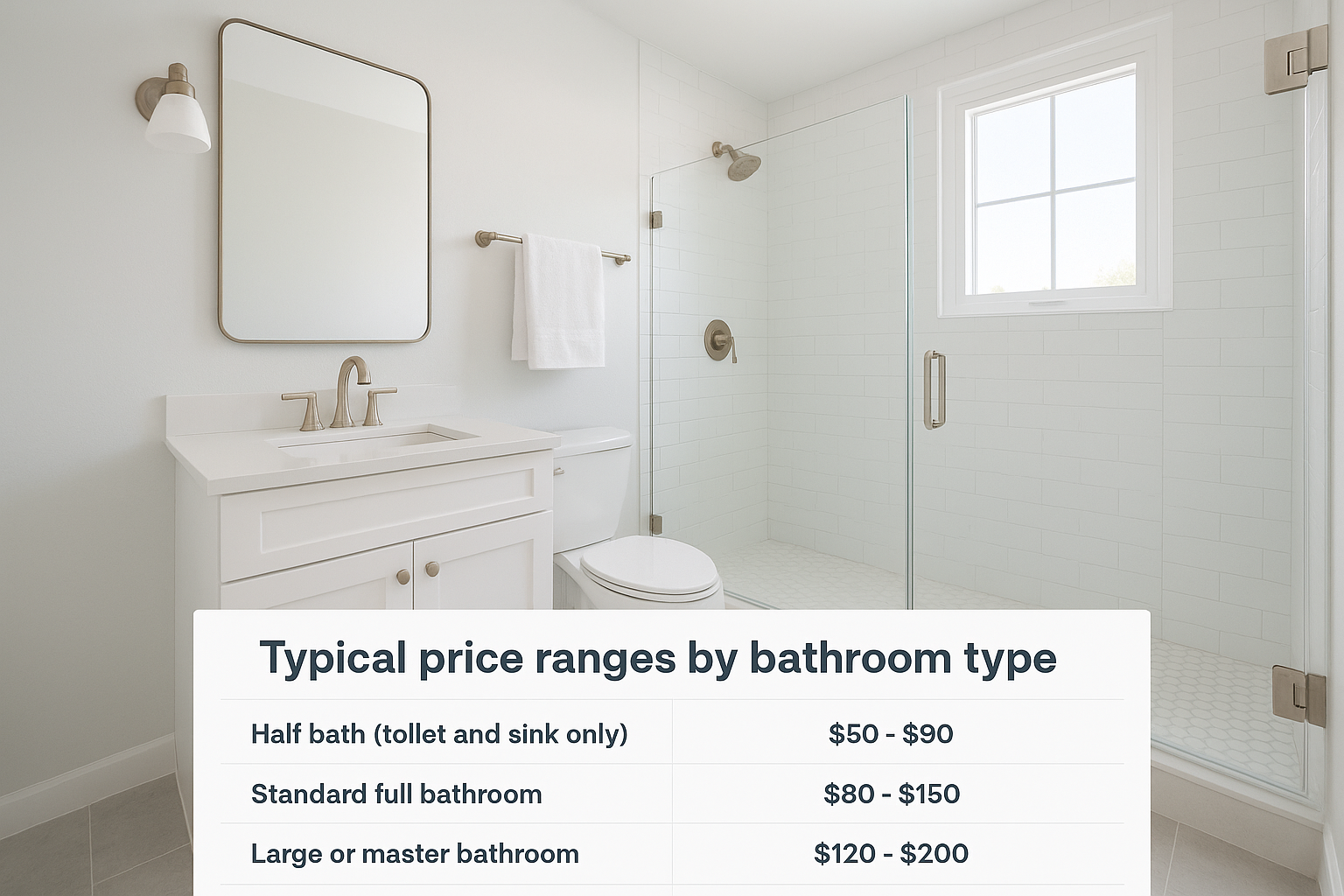
| Bathroom Type | Estimated Price Range |
|---|---|
| Half bath (toilet and sink only) | $50 – $90 |
| Standard full bathroom | $80 – $150 |
| Large or master bathroom | $120 – $200 |
| Commercial bathroom | $100 – $250+ |
These figures reflect one-time deep clean pricing for most New York markets. Prices in smaller or rural areas often run lower, while high-demand urban markets push toward the upper end of each range or slightly beyond.
What you get for the price
When you pay for a professional deep clean, you’re not just paying for time. You’re paying for trained staff, professional-grade equipment, and the right cleaning products matched to each surface in your bathroom. A professional team works faster and more effectively than most people can on their own, which means the actual labor involved justifies the cost even when the hourly rate looks high at first glance.
Your total cost also covers the liability and insurance that reputable companies carry. If a cleaner accidentally damages a fixture or causes a slip hazard, a properly insured company handles it. That coverage has real value and is part of what you pay for when you hire a vetted professional service.
What affects the price of a deep bathroom clean
Several variables push your final quote higher or lower than the average ranges listed above. When you request an estimate for a deep bathroom cleaning service, knowing what drives pricing helps you understand why two quotes for the "same" job can differ by $50 or more, and it gives you a realistic baseline before you commit to booking.
The single biggest driver of price variation is how long the job will realistically take, and that depends on several factors outside your control.
Size and condition of the space
Bathroom square footage has a direct impact on labor time, and labor time is the largest cost component in any cleaning visit. A compact full bath takes a trained cleaner less than half the time of a large master bath with separate shower, soaking tub, and double vanities. Every additional fixture adds cleaning time, so bathrooms with more surfaces to treat consistently cost more.
Condition matters just as much as size. A bathroom that receives routine upkeep between professional visits requires far less work than one that hasn’t been deep cleaned in over a year. Heavy soap scum, severe grout discoloration, and calcium buildup around faucets all require extended dwell time and additional physical scrubbing, which increases the total hours and, therefore, the total cost.
- Lightly maintained bathrooms: closer to the low end of the range
- Moderately soiled bathrooms: mid-range pricing
- Heavily neglected bathrooms: expect a higher quote and a longer visit
Location and scheduling
Where you’re located in New York plays a role in what you’ll pay. Companies serving dense urban areas typically charge more than those operating in suburban or rural markets, reflecting higher operating costs and travel time. Manhattan and Brooklyn pricing tends to run higher than what you’d see quoted on Long Island or in upstate markets.
Scheduling also affects your rate. One-time bookings carry a higher per-visit cost than recurring plans, because companies factor in the predictability and lower acquisition cost of repeat clients when they set recurring rates. Booking early in the week or during off-peak hours sometimes opens lower pricing, since demand fluctuates throughout the week and companies prefer to fill quiet scheduling gaps at a slightly reduced rate.
How to choose a deep cleaning service in New York
New York has no shortage of cleaning companies, but not all of them deliver the same standard of work. Choosing the right provider for a deep bathroom cleaning service comes down to a few specific factors that separate genuinely professional companies from those that simply advertise well. Knowing what to ask before you book saves you from a disappointing result and a wasted afternoon.
Check licensing, insurance, and staff vetting
Any company you hire to clean your home or business needs to carry liability insurance and workers’ compensation coverage. If a cleaner is injured on your property, or if something is damaged during the visit, uninsured companies leave you with nowhere to turn. Ask directly whether the company is insured and whether staff members are background-checked before they’re sent into client homes.
Staff vetting matters as much as insurance, particularly for residential clients who are letting cleaners into their personal space. Reputable companies run background checks and train their staff before placing them on jobs. If a company can’t confirm either of those things, treat that as a reason to look elsewhere.
A company that hesitates to answer questions about insurance or background checks is giving you useful information about how they operate.
Look at what the service actually includes
Pricing means very little without a clear task list attached to it. Two companies can both quote $120 for a deep bathroom clean and cover completely different scopes of work. Before you commit, ask for a written breakdown of exactly which surfaces and fixtures are included, and confirm whether grout scrubbing, showerhead descaling, and drain cleaning are part of the standard service or treated as add-ons.
Ask about products and pricing transparency
The products a company uses reflect their priorities. If you have children, pets, or sensitivities to strong chemicals, eco-friendly and non-toxic cleaning products matter. Ask whether the company uses them and whether you can request specific products if needed.
Transparent pricing with no surprise charges is another sign of a trustworthy company. A reputable service gives you a clear quote upfront, explains what changes the price, and doesn’t add fees after the job is complete. If the quote arrives without explanation, ask for an itemized breakdown so you understand what you’re actually paying for.
How often to book a deep bathroom deep clean
There’s no single schedule that works for every household or business, but you can use a few practical factors to set a cleaning frequency that keeps your bathroom in genuinely good condition rather than just catching up when things get visibly bad. Most professional companies recommend a deep bathroom cleaning service every one to three months for a standard residential bathroom, with that interval shortening as the space gets more use.
The more people sharing a bathroom, the faster buildup accumulates, and the shorter your interval between deep cleans should be.
Frequency based on usage and household size
A single-person household with one full bathroom can typically go three months between professional deep cleans without significant buildup, provided they do basic maintenance in between. A household of three to four people sharing one bathroom usually needs a deep clean every four to six weeks to stay ahead of soap scum, grout discoloration, and drain buildup. Large families or households with young children should consider monthly deep cleaning as a baseline, since the volume of daily use accelerates every type of buildup the process targets.
Commercial bathrooms need more frequent attention than residential ones. A busy office bathroom used by ten or more employees throughout the day accumulates bacteria, odors, and buildup far faster than a home bath. Most commercial clients schedule professional deep cleans every two to four weeks, depending on daily traffic volume and the nature of the business.
Signs your bathroom needs a deep clean now
Some visible and functional signals tell you the interval has stretched too long, regardless of your usual schedule. Grout lines that have shifted noticeably darker, persistent odors that don’t clear after a standard clean, visible mildew along caulking lines, and reduced water pressure from a clogged showerhead are all indicators that surface-level cleaning has stopped keeping pace with the buildup.
Pay attention to how long surface cleaning keeps the bathroom looking fresh. If a standard wipe-down stops making a visible difference within a day or two, that’s a signal that deeper cleaning is overdue rather than just pending. Catching these signs early keeps the cost and effort of each deep clean lower, since buildup that’s addressed before it compounds takes less time and fewer products to reverse.
Plan your next deep clean
Your bathroom works hard every day, and a deep bathroom cleaning service gives it the reset it needs to stay genuinely clean rather than just presentable. Everything covered in this article points to the same conclusion: surface-level cleaning maintains appearances, but professional deep cleaning addresses the buildup that causes odors, staining, and long-term damage to fixtures and grout.
Booking a professional clean doesn’t have to be complicated. Once you know what’s included, what drives the price, and how often your space actually needs it, the decision becomes straightforward. A well-maintained bathroom costs less to deep clean over time because buildup never gets a chance to compound into a bigger problem.
If your bathroom is overdue for a thorough clean, the AlphaLux team is ready to handle it. Trained, insured, and background-checked professionals cover every fixture, surface, and grout line. Book your deep bathroom clean with AlphaLux Cleaning and get a free estimate today.