
Searching "window cleaning near me prices" usually means you’ve got a quote in hand and no idea if it’s fair, or you’re trying to budget before you even call anyone. Either way, you want real numbers, not a vague "contact us for a quote" answer that sends you back to Google.
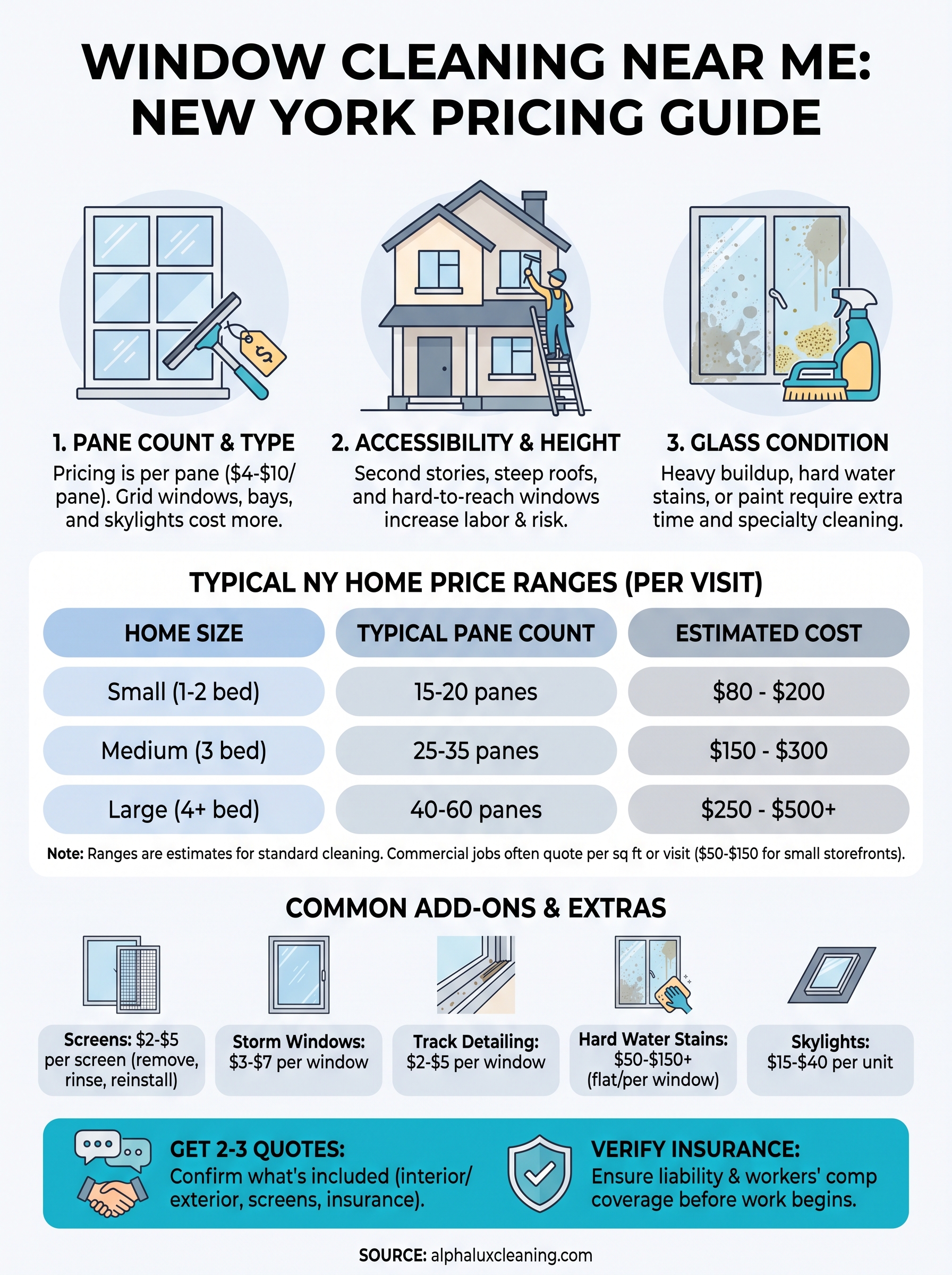
Here’s the short version: most homeowners in New York pay between $4 and $10 per window for standard cleaning, with a typical single-family home running $150 to $350 per visit depending on size, window count, and how dirty the glass is. Storm windows, screens, hard water stains, and second-story access all push the price up. Commercial jobs get quoted differently, usually by square footage or per pane, since office buildings and storefronts have their own logistics.
In this guide, we’ll break down what actually drives those numbers, from window type and accessibility to frequency discounts for recurring service. We’ll also cover what’s typically included, when a "cheap" quote signals corners being cut, and how to get an accurate estimate for your specific home or business instead of guessing based on a national average that doesn’t reflect New York pricing.
Why window cleaning prices vary so much
Ask five window cleaners in New York for a quote on the same house and you might get five different numbers. That’s not a scam, it’s how the trade actually works. Window cleaning pricing depends on a mix of physical factors (how many panes, how high up, how dirty) and business factors (how a company structures its rates, what equipment they use, and how much demand they’re juggling that week). Understanding these variables helps you tell the difference between a company padding its margins and one that’s pricing your job accurately.
Window count, size, and pane style
The biggest driver of your final bill is simple math: how many individual panes need attention. A single large picture window counts as one unit of labor even though it’s bigger than a small double-hung pane, but most companies price per pane or per window, not by square foot, for residential work. Grid-style windows with multiple small panes take longer to clean than a single sheet of glass because each divider adds edges and corners a squeegee can’t glide across. Bay windows, bow windows, and skylights also cost more because they require extra positioning, ladders, or specialty poles.
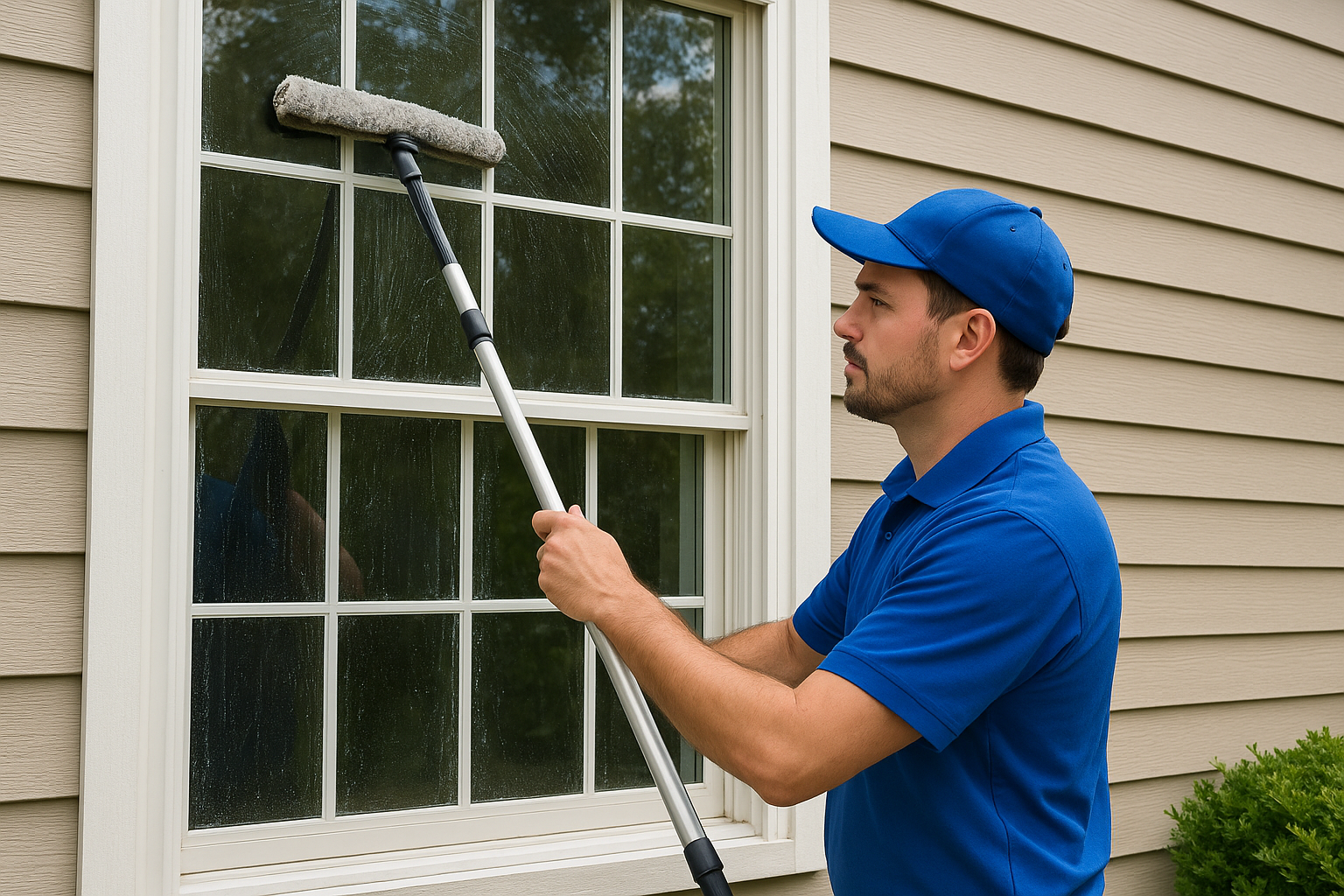
The more individual panes and angles a window has, the longer it takes, and time is what you’re really paying for.
Accessibility and building height
A ground-floor window you can reach from the lawn costs far less to clean than a third-story window over a steep roofline. Professionals price in the risk and equipment involved: extension poles, ladders, harnesses, or in rare cases, lift rentals for tall commercial buildings. Homes on Long Island with waterfront decks, elevated porches, or oddly angled additions often see a modest surcharge because the technician needs extra time to set up safely. If your home has windows that are genuinely hard to reach, ask upfront how that affects the quote rather than being surprised later.
Condition of the glass and surrounding hardware
A window that’s had a light film of dust for two weeks cleans up fast. A window with baked-on hard water spots, years of pollen buildup, or paint overspray from a recent renovation takes real elbow grease and sometimes specialty solutions to restore. Screens, storm windows, and window tracks are usually quoted as add-ons because they’re separate tasks: popping out a screen, rinsing it, and reinstalling it adds minutes per window that multiply fast across a whole house. Interior tracks caked with dirt or pet hair can also bump the price if you want them fully detailed rather than just wiped.
Where you live in New York
Local labor costs and travel time shape pricing more than most people expect. A crew working in Manhattan or Brooklyn deals with parking, building access rules, and higher overhead than a crew covering a suburban route on Long Island or in the Hudson Valley. Rural properties further from a company’s home base sometimes carry a small travel fee if they’re outside the normal service radius. This is exactly why a national average you find online rarely matches what you’ll actually pay: window cleaning near me prices should reflect your specific region, not a blended figure pulled from cities with a completely different cost of living.
Frequency and contract length
One-time cleanings almost always cost more per visit than recurring service because the crew is starting from scratch, often dealing with months or years of buildup. Companies that book you monthly, bimonthly, or quarterly usually offer a discounted recurring rate since the windows stay easier to maintain and the scheduling is predictable for their route. If you’re comparing quotes and one seems unusually low, check whether it assumes a signed recurring contract versus a single visit, because that distinction alone can shift the number by 20% or more.
Season and demand
Spring and early summer are peak season for residential window cleaning in New York, since everyone wants their windows done after a long winter of salt spray and grime. Booking during peak weeks sometimes means paying standard rates but waiting longer for an appointment, while off-season requests (late fall or deep winter) occasionally come with lower demand pricing, though weather can limit what’s safely doable outdoors. Business owners scheduling commercial cleaning on a set calendar typically avoid this seasonal swing altogether since it’s built into an ongoing service agreement rather than a one-off request.
How to estimate your window cleaning cost
Getting a ballpark figure before you call anyone takes about ten minutes and a notepad. You don’t need a contractor’s eye, just an honest count of what you’re working with and a willingness to round up rather than down. Most window cleaning estimates follow a predictable formula that you can replicate at home, which is useful whether you’re budgeting for a one-time deep clean or trying to figure out if a quote you already received is reasonable.

Count every pane, not every window
Start by walking around your home, inside and out, and counting individual panes rather than window openings. A single window with a grid pattern might have six or eight small panes, and each one counts separately in most pricing models. Grab a notepad or your phone and tally by floor: ground level, second story, and any dormers or skylights. Homeowners searching for window cleaning near me prices almost always underestimate this number on the first pass, so double-check before you multiply anything.
Apply a per-pane rate to your count
Once you have a rough pane count, multiply it by the typical New York rate of $4 to $10 per pane for standard interior and exterior cleaning. A modest three-bedroom home with 20 panes lands somewhere between $80 and $200, while a larger home with 40-plus panes and some second-story access climbs toward $300 or more. Use this quick reference to sanity-check your number:
| Home size | Typical pane count | Estimated cost range |
|---|---|---|
| Small (1-2 bed) | 15-20 panes | $60-$200 |
| Medium (3 bed) | 25-35 panes | $150-$300 |
| Large (4+ bed) | 40-60 panes | $250-$500 |
| Large home, second story | 40-60 panes | $350-$600 |
A rough pane count and the local per-pane rate will get you within striking distance of any real quote you receive.
Factor in your home’s specific complications
Start from that baseline number, then adjust for anything unusual about your property. Second-story access, screens, storm windows, or heavy hard water staining each add a percentage on top of the base estimate, typically 10% to 30% depending on how much extra labor is involved. Skylights and bay windows deserve their own line item since they often require specialty poles or a technician working from a ladder rather than the ground. If your home checks several of these boxes at once, lean toward the higher end of any range you calculate.
Get two or three real quotes to confirm
Finally, treat your estimate as a starting point, not a final answer, and request quotes from two or three local companies to see how close reality lands to your math. Reputable companies offering free estimates will typically walk your property or ask detailed questions over the phone before quoting, rather than giving you a flat number sight unseen. If every quote comes in near your self-calculated range, you can book with confidence. If one comes in dramatically lower, that’s your cue to ask what’s excluded before you sign anything.
Typical price ranges for common cleaning services
Numbers help more than percentages when you’re trying to figure out what a job should cost. Below are the price bands we see most often across New York for the services people actually book, based on typical per-pane and per-visit pricing rather than inflated national averages. Treat these as a starting point for comparing quotes, not a guarantee, since your exact home or building will still shift the number up or down.
Standard residential cleaning
Standard cleaning covers interior and exterior glass with a squeegee and cleaning solution, no screens or tracks included unless you ask. Most single-family homes in New York fall into a predictable range depending on pane count and stories:
| Service type | Typical price range |
|---|---|
| Small home (1-2 bed) | $80-$180 |
| Medium home (3 bed) | $150-$300 |
| Large home (4+ bed) | $250-$500 |
| Apartment or condo (interior only) | $50-$120 |
These figures assume ground-floor or easily accessible second-story windows. Add a second story with limited access, and expect the top of each range to climb another 15% to 25%.
Deep cleaning and one-time visits
A one-time deep clean costs more than a recurring visit because the crew is tackling buildup that’s accumulated over months or years, not weeks. Expect to pay $200 to $500 for a typical home, sometimes higher if hard water stains, paint overspray, or heavy pollen film require extra scrubbing or specialty products. This is also where screens and tracks most often get bundled in, since homeowners booking a deep clean usually want the whole job done at once rather than piecemeal.
Move-in and move-out cleaning
Properties changing hands almost always need a full reset, and window cleaning is frequently part of a larger move-in move-out cleaning package rather than a standalone line item. When booked separately, expect $150 to $400 depending on home size, with vacant properties sometimes costing less since there’s no furniture to work around. Landlords and real estate agents scheduling this between tenants often request it alongside a full interior clean to prep the unit for showing.
Vacant homes clean up faster and cheaper than occupied ones, so timing your booking around a move can genuinely save you money.
Commercial and storefront cleaning
Businesses get quoted on a different scale entirely. Small storefronts with street-facing glass typically run $50 to $150 per visit, while multi-story office buildings are priced per pane or per square foot and billed on a recurring contract rather than a one-off visit. Retail storefronts often book weekly or biweekly service to keep glass presentable for customers, which drives the per-visit rate down compared to sporadic one-time requests.
| Commercial job type | Typical pricing basis | Estimated range |
|---|---|---|
| Small storefront | Per visit | $50-$150 |
| Multi-story office | Per pane or sq ft | Custom quote |
| Recurring retail contract | Per visit, discounted | $40-$120 |
Business owners comparing vendors should ask whether quotes reflect a contract rate or a walk-in price, since the gap between the two can be substantial.
What’s included in a quote and what costs extra
A quote is only useful if you know what it actually covers, and this is where most price confusion starts. Two companies can quote the same house $50 apart because one bundles screens and tracks while the other treats them as separate line items. Reading a window cleaning quote carefully before you book saves you from an awkward surprise when the invoice arrives higher than the number you agreed to over the phone.
What a standard quote usually covers
Most baseline quotes include interior and exterior glass cleaning with a squeegee, a cleaning solution, and a final wipe-down of the sill edges where drips land. Companies typically also account for basic ladder work on a standard two-story home as part of the base price, since that’s considered normal access rather than an upcharge. Sills and frames get a quick wipe in most standard packages, but a deep detail of the frame itself is usually not included unless you ask for it directly.
What almost always costs extra
Anything beyond the glass itself tends to land on the add-on list, and it helps to know these before you compare bids side by side.
| Add-on service | Typical extra cost |
|---|---|
| Screen removal, rinse, and reinstall | $2-$5 per screen |
| Storm window cleaning | $3-$7 per window |
| Interior track detailing | $2-$5 per window |
| Hard water stain removal | $50-$150 flat or per window |
| Skylight cleaning | $15-$40 per unit |
| Extension ladder or lift access | $25-$100+ |
If a quote doesn’t mention screens, tracks, or hard water treatment by name, assume they’re not included until the company confirms otherwise.
Why a suspiciously low quote should raise questions
Someone quoting far below the going rate is usually cutting something, whether that’s insurance, cleaning solution quality, or the number of technicians sent to your job. A legitimate business carries liability insurance and workers’ comp, and those costs get baked into every quote, so a number that seems too good often reflects a company skipping coverage that protects you if someone gets hurt on your property. Ask directly whether the price includes both interior and exterior glass, since some low bids only cover the outside and treat interior cleaning as a separate visit.
Questions to clarify before you accept a price
A few quick questions before booking will surface hidden costs faster than reading fine print:
- Does this price include interior and exterior glass, or just one side?
- Are screens and tracks included, or billed separately?
- Is there an extra charge for second-story or hard-to-reach windows?
- What happens if the crew finds heavy hard water staining once they start?
- Is this a one-time price or does it assume a recurring contract?
Getting these answers in writing, even in a simple text or email confirmation, protects both sides and makes the final invoice a formality rather than a negotiation.
DIY window cleaning vs hiring a professional
Before you book anyone, it’s worth asking whether you even need to. A bucket, a squeegee, and a Saturday afternoon can handle a modest single-story home just fine, but the math changes fast once you factor in ladders, second stories, or a house with 40-plus panes. Comparing DIY costs to professional pricing helps you decide where your time is actually worth spending versus where a pro earns their fee.
What DIY actually costs you
Buying the right gear isn’t free, and a lot of first-time DIYers underestimate the startup cost. A decent squeegee, a scrubber, a bucket, microfiber cloths, and a streak-free solution typically run $40 to $80 if you’re starting from scratch, and that’s before you factor in an extension pole or ladder for anything above the ground floor. Here’s what a basic DIY kit usually costs versus what you’d spend hiring a pro for the same job:
| Item or service | DIY cost | Professional equivalent |
|---|---|---|
| Squeegee, scrubber, bucket | $25-$40 (one-time) | Included in service |
| Streak-free cleaning solution | $10-$20 | Included in service |
| Extension pole (2nd story) | $30-$60 | Included in service |
| Ladder rental or purchase | $50-$150 | Included in service |
| Your time (avg 3-5 hours) | Unpaid, but real | 45-90 minutes |
Once you add up the supplies, a one-time DIY clean on a mid-size home often costs $100 or more before you’ve touched a single window, which puts it uncomfortably close to hiring a professional for a job that also comes with insurance and a guaranteed result.
Where professionals earn their fee
Speed and safety are the two biggest reasons homeowners eventually switch to hiring out. A trained technician clears a full house in under two hours with commercial-grade tools like water-fed poles and pure water systems that leave zero streaks, something most DIYers can’t replicate with a grocery-store squeegee. Falls from ladders are also a leading cause of home injury, and any window above the first floor introduces real risk that a fully insured cleaning crew is trained and equipped to manage safely.
The moment a ladder or second story enters the picture, the math almost always favors hiring a professional over doing it yourself.
When DIY still makes sense
Ground-floor windows, apartments, and small condos are the exception where DIY genuinely wins on cost and convenience. If you’re only dealing with 10 to 15 easily reachable panes and you already own basic supplies, spending an hour cleaning them yourself beats paying a minimum service fee for such a small job. Renters in particular often fall into this category, since landlords rarely expect professional window service for a one-bedroom apartment with no ladder work involved. Once your home grows past that scope, though, the time savings and finished quality from hiring out usually justify the price difference.
Questions to ask before you hire a window cleaner
Once you’ve narrowed down a few candidates, the questions you ask before signing anything matter more than the price on the quote itself. Vetting a window cleaner properly takes ten minutes on the phone and protects you from the two most common problems: hidden fees and uninsured crews working on your roofline. Anyone searching for "window cleaning near me prices" who skips this step often ends up comparing bids that aren’t actually comparable, since one company may include tracks and screens while another quietly leaves them out.
Confirm insurance and background checks
Start with the basics that protect your property and your liability, not just the cleaning outcome. Ask directly whether the company carries general liability insurance and workers’ compensation, and request proof if you’re hiring for a larger job or a commercial property. Also ask whether technicians are background-checked, since you’re giving strangers access to your home, sometimes with a key or garage code, and a reputable company will have no hesitation sharing this information.
A company that hesitates to confirm insurance coverage isn’t one you want on a ladder at your house.
Clarify what’s included and what isn’t
Get specifics on scope before you agree to a number, since "window cleaning" means different things to different companies. A few questions surface this fast:
- Does the quote cover interior and exterior glass, or just one side?
- Are screens, tracks, and sills included, or priced separately?
- Is hard water staining or paint removal covered, or billed as an add-on if discovered?
- What products are used, and are eco-friendly or non-toxic options available if you have kids or pets?
Asking about eco-friendly cleaning products specifically matters if anyone in your household has chemical sensitivities, since not every company defaults to non-toxic solutions unless you request them.
Ask about scheduling, guarantees, and cancellation policy
Pricing aside, the logistics of the job affect whether the experience feels smooth or frustrating. Find out how far in advance you need to book during peak spring season, whether the company offers a satisfaction guarantee if streaks or missed spots turn up after the crew leaves, and what their weather policy looks like if rain forces a reschedule. Businesses booking recurring service should also ask about cancellation notice requirements, since some contracts lock you into a set number of visits per year.
Get everything in writing
Finally, request a written confirmation of the price, scope, and date before the crew shows up, even if it’s just a text message or email thread rather than a formal contract. This single step resolves more billing disputes than any conversation after the fact, since both sides can point back to what was actually agreed. Homeowners who skip this step are the ones most likely to feel blindsided by an invoice that doesn’t match what they remember discussing on the phone.
Getting a fair price for spotless windows
At this point, you’ve got what most people searching "window cleaning near me prices" never find: real numbers, a way to calculate your own estimate, and a list of questions that separate a fair quote from a corner-cutting one. Pane count and accessibility drive most of the final price, while screens, storm windows, and hard water staining are the extras that catch people off guard. The fastest way to protect yourself is simple: get two or three quotes, ask what’s included in writing, and confirm insurance before anyone touches a ladder at your house.
If you’re in New York and ready to stop guessing and start comparing real numbers, request a free estimate from AlphaLux Cleaning and see what a fully insured, eco-friendly crew would actually charge for your home or business.